Search this keyword

Showing posts with label wiki. Show all posts

Linking NCBI taxonomy to GBIF


In response to Rutger Vos's question I've started to add GBIF taxon ids to the iPhylo Linkout website. If you've not come across iPhylo Linkout, it's a Semantic Mediawiki-based site were I maintain links between the NCBI taxonomy and other resources, such as Wikipedia and the BBC Nature Wildlife finder. For more background see

Page, R. D. M. (2011). Linking NCBI to Wikipedia: a wiki-based approach. PLoS Currents, 3, RRN1228. doi:10.1371/currents.RRN1228

I'm now starting to add GBIF ids to this site. This is potentially fraught with difficulties. There's no guarantee that the GBIF taxonomy ids are stable, unlike NCBI tax_ids which are fairly persistent (NCBI publish deletion/merge lists when they make changes). Then there are the obvious problems with the GBIF taxonomy itself. But, if you want a way to generate a distribution map for a taxon in the NCBI taxonomy, the quickest way is going to be via GBIF.

The mapping is being made automatically, with some crude checks to try and avoid too many erroneous links (e.g., due to homonyms). It will probably take a few days to complete (the mapping is quick, uploading to the wiki is a bit slower). Using a wiki to manage the mapping makes it easy to correct any spurious matches.

As an example, the page http://iphylo.org/linkout/Ncbi:109175 is for the frog Hyla japonica (NCBI tax_id 109175) and shows links to Wikipedia (http://en.wikipedia.org/wiki/Japanese_Tree_Frog, and to GBIF (http://data.gbif.org/species/2427601/). There's even a link to TreeBASE. I display a GBIF map so you can see what data GBIF currently has for that taxon.

Hyla

So, we have a wiki page, how do we answer Rutger's original question: how to get GBIF occurrence records via web service?

To do this we can use the RDF output by the Semantic Mediawiki software that underpins the Wiki. You can gte this by clicking on the RDF icon near the bottom of the page, or go to http://iphylo.org/linkout/Special:ExportRDF/Ncbi:109175. The RDF this produces is really, really ugly (and people wonder why the Semantic Web has been slow to take off...). In this RDF you will see the statement:

<rdfs:seeAlso rdf:resource="http://data.gbif.org/species/2427601/"/>

So, arm yourself with XPath, a regular expression, or if you are a serious RDF geek break out the SPARQL, and you can extract the GBIF taxon id for a NCBI taxon. Given that id you can query the GBIF web services. One service that I like is the occurrence density service, which you can use to recreate the 1°×1° density maps shown by GBIF. For example, http://data.gbif.org/ws/rest/density/list?taxonconceptkey=2427601 will get you the squares shown in the screen shot above.

Of course, I have glossed over several issues, such as the errors and redundancy in the GBIF classification, the mismatch between NCBI and GBIF classifications (NCBI has many more ranks than GBIF), and whether the taxon concepts used by the two databases are equivalent (this is likely to be more of an issue for higher taxa). But it's a start.

The GBIF classification is broken — how do we fix it?

This post arose from an ongoing email conversation with Tony Rees about extracting and annotating taxonomic names. In BioStor I use the GBIF classification to display the taxonomic names found in the OCR text in the form of a tree. The idea is to give the reader a sense of "what the paper is about". I also use the classification to help link to GBIF occurrence records.

The GBIF backbone classification ("nub") is probably the single largest classification of life that has been assembled, and provides GBIF users with a way to navigate through GBIF's collection of specimen and observation records. Given the scale of the undertaking it is inevitable that there will be issues with the classification, and this post provides one example.

On the page for the article "Further additions to the known marine Molluscan fauna of St. Helena" (http://biostor.org/reference/88554, see also http://dx.doi.org/10.1080/00222939208677383) part of the classification looks like this:

└Animalia
└Annelida
└Polychaeta
└Sabellida
└Serpulidae
└Hipponyx
Tony points out that "Hipponyx" is a mollusc, yet in the GBIF classification appears in the annelid worms.

Like a fool I started to investigate further. First off, what is "Hipponyx"? Browsing the GBIF classification there are species of Hipponyx and Hipponix under the genus Hipponix, so it looks like we have two alternative spellings of this genus name. Nomenclator Zoologicus has both spellings, Hipponix credited to DeFrance 1819 Journ. de Physique, 88, 217, and Hipponyx credited to Defrance 1819 Bull. Sci. Soc. philom. Paris, 8. Gotta love those cryptic citations. After some digging around in BHL I found Journ. de Physique, 88, 217 (Mémoire sur un nouveau genre de mollusque) and Bull. Sci. Soc. philom. Paris, 8. (Sur un nouveau genre de coquilles (Hipponix)). Both papers are by Jacques Louis Marin DeFrance, and both use the spelling Hipponix (no 'y'). I'm guessing the second paper is actually the original description of the genus, but my French is abysmal (Google Translate to the rescue).

OK, so we have two spellings of what is probably the same thing (and I've no idea why we have two spellings). Both spellings seem in use (see Google NGrams chart below).


So, bit of a mess, but this still doesn't deal with Hipponyx being a worm in GBIF. After a bit of Googling on "Serpulidae" and "Hipponyx" I came across a specimen record from Te Papa labelled "Worm, Temporaria inexpectata (Mestayer, 1929); holotype; holotype of Hipponyx inexpectata Mestayer, 1929". I then came across this paper:

Fleming, C. A. (1971). A preliminary list of New Zealand fossil polychaetes. New Zealand Journal of Geology and Geophysics, 14(4), 742–756. doi:10.1080/00288306.1971.10426332

with the following abstract:
An annotated list of fossil “worm tubes” from New Zealand includes both published and new records from Mesozoic and Cenozoic deposits.

The binomen Zoophycos plicatus (Hutton) is proposed for the trace fossil long known as the Amuri fucoid, of unknown zoological affinity.

The following living species are recorded as New Zealand fossils for the first time: Protula bispiralis (Savigny), Salmacina dysteri (Huxley), Hydroides norvegicus Gunnerus, Pomatoceras cariniferus (Gray), P. aff. terranovae (Benham), Galeolaria hystrix (Moerch), Boccardia ? polybranchia (Haswell); new records of fossil species are Ditrupa cf. plana (Sowerby), Dorsoserpula lumbricalis (Schlotheim), and Neomicrorbis crenatostriatus (Münster). The name Hipponyx inexpectata Mestayer 1929, applied to a serpulid operculum, is used in the combination Temporaria inexpectata for a tubeworm common in deep water off New Zealand that has also been identified, with associated operculum, from the bathyal Waitotaran (Pliocene) sediments of Palliser Bay. Serpula wharjensis Wilkens and S. ougenensis Chapman are placed in Sclerostyla Moerch. Two species of Vermiliopsis and two of Spirorbis are figured but not named specifically.

The author of the paper (Charles Fleming) argues that Hipponyx inexpectata, regarded as a mollusc by its describer (Marjorie K. Mestayer, see Notes on New Zealand Mollusca. No. 4.) is actually a worm, and he moves it to the genus Temporaria.

So it seems that the reason Hipponyx has ended up being a worm in the GBIF classification is due to this synonymy.

Now, this little investigation was "fun", but took a couple of hours. Much of that was spent tracking down the literature and adding it to BioStor, which is a one-time cost. Not every issue with the GBIF classification will take this long to resolve, some cases may take longer. So there's a problem of scalability. Then there's the issue of how this information gets into the GBIF classification so we fix it (and so that people don't think Hipponyx is a worm). As has been said several times before, most eloquently by David Shorthouse, isn't it time we started using software development tools such as version control to help build, annotate, and correct classifications such as the one that underpins GBIF? That way when somebody spots an error it can be flagged, and someone with the time (and curiosity) can fix it.

Yet more reasons to have specimen identifiers: annotating GenBank sequences

One reason I'm pursuing the theme of specimen identifiers (and identifiers in general) is the central role they play in annotating databases. To give a concrete example, I (among others) have argued for a wiki-style annotation layer on top of GenBank to capture things such as sequencing errors, updated species names, etc. Annotation is a lot easier if we have consistent identifiers for the things being annotated. For example, every GenBank sequence has a unique accession number, so if you and I are discussing sequence DQ055738, you and I can be sure we are talking about the same thing.

Sequence DQ055738 is interesting because Hua et al. A Revised Phylogeny of Holarctic Treefrogs (Genus Hyla) Based on Nuclear and Mitochondrial DNA Sequences (http://dx.doi.org/10.1655/08-058R1.1 - note the nice identifier we have for this article) have suggested this sequence (published in http://dx.doi.org/10.1554/05-284.1, another nice identifier) is misidentified. Given these identifiers we could construct various statements, such as:


DQ055738 -> published in -> doi:10.1554/05-284.1
DQ055738 -> annotated by -> doi:10.1655/08-058R1.1

(I've omitted the http:// stuff to keep things legible). Hua et al: state the following:

However, the tissue number of this specimen (LSUMZ H-19067) is similar to that of a specimen of H. versicolor (LSUMZ H-19077), which appears to have been processed at the same time (C. Austin, personal communication). Therefore, we hypothesize that the sequence data for H. gratiosa used by Smith et al. (2005) were actually from H. versicolor.

It would be nice if we had unique, resolvable identifiers for LSUMZ H-19067 and LSUMZ H-19077 so that we could construct statements linking the sequence, the publications, and the specimens. But we don't. Nor is it obvious how to find out anything more about LSUMZ H-19067 and LSUMZ H-19077. By contrast, for the DOI or the sequence accession I know how to get more information, in either human- or machine-readable form.

The acronym LSUMZ in this case is the Lousiana State University Museum of Natural Science Herpetology collection (http://biocol.org/urn:lsid:biocol.org:col:34806). Just to confuse matters, LSUMZ specimens in GBIF use LSU as the acronym for Lousiana State University Museum of Natural Science. Given that GBIF's data comes from LSU itself, it's odd (but not surprising) that there's a muddle about which acronym to use (it would be nice to clear this up, but then anybody building identifiers based on those acronyms is in for some heartbreak).

If I look at GBIF LSUMZ records there aren't specimens with the catalogue numbers H-19067 or H-19077. However, after a bit of poking around, and a helpful file from GBIF's Tim Robertson, I discovered that the LSUMZ herpetology tissue numbers (which is what the H-* codes actually are) are stored in GBIF, so I've found the corresponding specimens are http://data.gbif.org/occurrences/45716232 (LSU Herp 84850, LSUMZ HerpNet Tissue 19067) and http://data.gbif.org/occurrences/45710033 (LSU Herp 84862, LSUMZ HerpNet Tissue 19077). (Note that Hua et al. tell the reader that LSU 84850 = LSUMZ H-19067, but don't give the specimen code for LSUMZ H-19077).

Now I have some resolvable identifiers, so I could construct statements like:


DQ055738 -> voucher -> occurrences/45716232
DQ055738 -> voucher -> occurrences/45710033
|
+-> according to -> doi:10.1655/08-058R1.1

Let's skip over whether this is actually the best way to record the annotation, the point is we can now start to construct statements that can be linked to the wider world. If someone else has made statements about these specimens, and they used the GBIF URL, then we could aggregate those and learn more about these specimen and their associated sequences. Without globally unique, stable, resolvable identifiers we are left to flounder around in the bowels of various databases searching for something that may or may not be the object being discussed. Isn't it time we did something about this?

TreeBASE meets NCBI, again

Déjà vu is a scary thing. Four years ago I released a mapping between names in TreeBASE and other databases called TBMap (described here: doi:10.1186/1471-2105-8-158). Today I find myself releasing yet another mapping, as part of my NCBI to Wikipedia project. By embedding the mapping in a wiki, it can be edited, so the kinds of problems I encountered with TbMap, recounted here, here, and here. The mapping in and of itself isn't terribly exciting, but it's the starting point for some things I want to do regarding how to visualise the data in TreeBASE.

Because TreeBASE 2 has issued new identifiers for its taxa (see TreeBASE II makes me pull my hair out), and now contains its own mapping to the NCBI taxonomy, as a first pass I've taken their mapping and added it to http://iphylo.org/linkout. I've also added some obvious mappings that TreeBASE has missed. There are a lot more taxa which could be added, but this is a start.

The TreeBASE taxa that have a mapping each get their own page with a URL of the form http://iphylo.org/linkout/<TreeBase taxon identifier>, e.g. http://iphylo.org/linkout/TB2:Tl257333. This page simply gives the name of the taxon in TreeBASE and the corresponding NCBI taxon id. It uses a Semantic Mediawiki template to generate a statement that the TreeBASE and and NCBI taxa are a "close match". If you go to the corresponding page in the wiki for the NCBI taxon (e.g., http://iphylo.org/linkout/Ncbi:448631) you will see any corresponding TreeBASE taxa listed there. If a mapping is erroneous, we simply need to edit the TreeBASE taxon page in the wiki to fix it. Nice and simple.

At the time of writing the initial mapping is still being loaded (this can take a while). I'll update this post when the uploading has finished.

Why we need wikis

I've just spent a frustrating few minutes trying to find a reference in BioStor. The reference in question is
Heller, Edmund 1901. Papers from the Hopkins Stanford Galapagos Expedition, 1898-1899. WIV. Reptiles. Proc. Biol. Soc. Washington 14: 39-98

and comes from the Reptile Database page for the gecko Phyllodactylus gilberti HELLER, 1903. This is primary database for reptile taxonomy, and supplies the Catalogue of Life, which repeats this reference verbatim.
Thing is, this reference doesn't exist! Page 39 of Proc. Biol. Soc. Washington volume 14 is the start of Gerrit S Miller (1901) A new dormouse from Italy. Proc Biol Soc Washington 14: 39-40.
After much fussing with trying diferent volumes and dates for Proc. Biol. Soc. Washington, I searched BHL for Phyllodactylus gilberti, and discovered that this name was published in Proceedings of the Washington Academy of Sciences:
Edmund Heller (1903) Papers from the Hopkins Stanford Galapagos Expedition, 1898-1899. XIV. Reptiles. Proceedings of the Washington Academy of Sciences 5: 39-98

(see http://biostor.org/reference/20322). Three errors (wrong journal, wrong date, minor typo in title), but enough to break the link between a name and the primary source for that name.

Anybody who demands authoritative, expert-vetted resources, and thinks the Catalgoue of Life is a shining example of this needs to think again. Our databases are riddled with errors, which are repackaged over and over again, yet these would be so easy to fix if they were opened up and made easy to edit. It's time to get serious about wikis.

Wiki frustration

Yesterday I fired off a stream of tweets, starting with:
OK, I'm back to hatin' on the wikis. It's just way to hard to do useful queries (e.g., anything that requires a path linking some entities) [10991434609]

Various people commented on this, either on twitter or in emails, e.g.:
@rdmpage hatin' wikis is irrational - all methods have pros and cons, so wikis are an essential resource among others [@stho002]

So, to clarify, I'm not abandoning wikis. I'm just frustrated with the limitations of Semantic Mediawiki (SMW). Now, SMW is a great piece of software with some cool features. For example,

  1. Storing data in Mediawiki templates (i.e., key-value pairs) makes it rather like a JSON database with version control (shades of CouchDB et al.).

  2. Having Mediawiki underlying SMW makes lots of nice editing and user management features available for free.

  3. The template language makes it relatively easy to format pages.

  4. It is easy to create forms for data entry, so users aren't confronted with editing Mediawiki templates unless they want to.

  5. Supports basic queries.


It's the last item on the list that is causing me grief. The queries are, well, basic. What SMW excels at are queries connecting one page to another. For example, if I create wiki pages for publications, and list the author of each publication, the page for an author can contain a simple query (of the form {{ #ask: [[maker::Author 1]] | }}) that lists all the publications of that author:

q1.png


That's great, and many of the things are want to do can be expressed in this simple way (i.e., find all pages of a certain kind that link to the current page). It's when I want to go more than one page away that things start to go pear shaped. For example, for a given taxon I want to display a map of where it is found, based things like geoferenced GenBank sequences, or sequences from georeferenced museum specimens.

q2.png
This can involve a path between several entities ("pages" in SMW), and this just doesn't seem to be possible. I've managed to get some queries working via baroque Mediawiki templates, but it's getting to the point where hours seem to be wasted trying to figure this stuff out.

So, what tends to happen is I develop something, hit this brick wall, then go and do something else. I suspect that one way forward is to use SMW as the tool to edit data and display basic links, then use another tool to do the deeper queries. This is a bit like what I'm exploring with BioStor, where I've written my own interface and queries over a simple MySQL database, but I'm looking into SMW + Wikisource to handle annotation.

This leaves the question of how to move forward with http://iphylo.org/treebase/? One approach would be to harvest the SMW pages regularly (e.g., by consuming the RSS feed, and either pulling off SMW RDF or parsing the template source code for the pages), use this to populate a database (say, a key-value store or a triple store) where more sophisticated queries can be developed. I guess one could either make this a separate interface, or develop it as a SMW extension, so results could be viewed within the wiki pages. Both approaches have merits. Having a complete separate tool that harvests the phylogeny wiki seems attractive, and in many ways is an obvious direction for iSpecies to take. Imagine iSpecies rebuilt as an RDF aggregator, where all manner of data about a taxon (or sequences, or specimen, or publication, or person) could be displayed in one place, but the task of data cleaning took place elsewhere.

Food for thought. And, given that it seems some people are wondering why on earth I bother with this stuff, and can't I just finish TreeView X, I could always go back to fussing with C++…

Progress on a phylogeny wiki

I've made some progress on a wiki of phylogenies. Still much to do, but here are some samples of what I'm trying to do.

First up, here's an example of a publication http://iphylo.org/treebase/Doi:10.1016/j.ympev.2008.02.021:
wiki1.png

In addition to basic bibiographic details we have links to GenBank sequences and a phylogeny. The sequences are georeferenced, which enables us to generate a map. At a glance we see that the study area is central America.

This study published the following tree:
wiki2.png

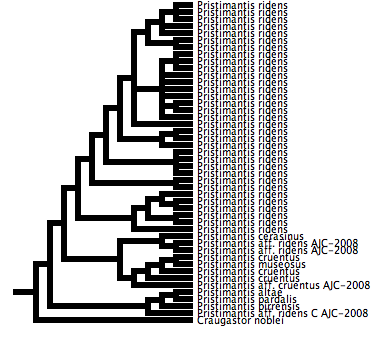
The tree is displayed using my tvwidget. A key task in constructing the wiki is mapping labels used in TreeBASE to other taxonomic names, for example, those in the NCBI taxonomy database. This is something I first started working on in the TbMap project (doi:10.1186/1471-2105-8-158). In the context of this wiki I'm explicitly mapping TreeBASE taxa to NCBI taxa. Taxa are modelled as "namestrings" (simple text strings), OTUs (TreeBASE taxa), and taxonomic concepts (sets of observations or taxa). For example, the tree shown above has numerous samples of the frog Pristimantis ridens, each with a unique label (namestring) that includes, in this case, voucher specimen information (e.g., "Pristimantis ridens La Selva AJC0522 CR"). Each of these labels is mapped to the NCBI taxon Pristimantis ridens.

One thing I'm interested in doing is annotating the tree. Eventually I hope to generate (or make it easy to generate) things such as Google Earth phylogenies (via georeferenced sequences and specimens). For now I'm playing with generating nicer labels for the terminal taxa. As it stands if you download the original tree from TreeBASE you have the original study-specific labels (e.g., "Pristimantis ridens La Selva AJC0522 CR"), whereas it would be nice to also have taxonomic names (for example, if you wanted to combine the tree or data with another study). Below the tree you'll see a NEXUS NOTES block with the "ALTTAXNAMES" command. The program Mesquite can use this command to enable users to toggle between different labels, so that you can have either a tree like this:
wiki3.png

or a tree like this:
wiki4.png

Setting up a local Wikisource

A little while ago I came across Wikisource, and it dawned on me that this is a model for BHL. To quote from the Wikisource web site:
Wikisource is an online library of free content publications, collected and maintained by our community. We now have 140,596 texts in the English language library. See our inclusion policy and help pages for information on getting started, and the community portal for ways you can contribute. Feel free to ask questions on the community discussion page, and to experiment in the sandbox.

Much of their content comes from the Internet Archive (as does BHL's), and Wikisource have developed extensions for Mediaiwki to do some cool things, such as extract text and images from DjVu files. If you haven't come across DjVu before, it's a format designed to store scanned documents, and comes with some powerful open source tools for extracting images and OCR text. Wikisource can take a DjVu file, extract images, thumbnails and text, creating side-by-side displays where users can edit and correct OCR text:

wikisource.png


So, like a fool, I decided to try and install some of these tools locally and see if I could do the same for some BHL content. That's when the "fun" started. Normally Mediawiki is pretty easy to set up. There are a few wrinkles because my servers live behind an institutional HTTP proxy, so I often need to tweak some code (such as the OpenID extension, which also needs a fix for PHP 5.3), but installing the extensions that underlie Wikisource wasn't quite so straightforward.

DjVu
djvu.png
The first step is supporting DjVu files in Mediawiki. This seems straightforward (see How to use DjVu with MediaWiki). First off you need the DjVu tools. I use Mac OS X, so I get these automatically if I install DjView. The tools reside in Applications/DjView.app/Contents/bin (you can see this folder if you Control+click on the DjView icon and choose "Show Package Contents"), so adding this path to the name of each tool DjVu tool Mediaiwiki needs takes care of that.

But I also need NetPbm, and now the pain starts. NetPbm won't build on Mac OS X, at least not out of the box on Snow Leopard. It makes assumptions about Unix that Mac OS X doesn't satisfy. After some compiler error messages concerning missing variables that I eventually traced to signal.h I gave up and installed MacPorts, which has a working version of NetPbm. MacPorts installed fine, but it's a pain having multiple copies of the same tools, one in /usr/local, and one in /opt/local.

OK, now we can display DjVu files in Mediawiki. It's small victories like this which leads to over confidence...

Proofread Page
Next comes the Proofread Page extension, which provides the editing functionality. This seemed fairly straightforward, although the documentation referred to a SQL file (ProofreadPage.sql) that doesn't seem to exist. More worringly, the documentation also says:
If you want to install it on your own wiki, you will need to install a 404 handler for generating thumbnails, such as WebStore.

This seems fine, except the page for WebStore states:
The WebStore extension is needed by the ProofreadPage extension. Unfortunately, documentation seems to be missing completely. Please add anything you know about this extension here.

Then there are the numerous statements "doesn't work" scattered through the page. So, I installed the extension and hoped for the best. It didn't work. As in, really, really didn't work. It took an hour or so of potentially fatal levels of blood pressure-inducing frustration to get to the bottom of this.

WebStore
Now, Webstore is a clever idea. Basically, the Proofread Page extension will need thumbnails of images in potentially varying sizes, and creates a link to the image it wants. Since that image doesn't exist on the web site the web server returns 404 Not Found, which normally results in a page like this. Instead, we tell the web server (Apache) that WebStore will handle 404's. If the request is for an image, Webstore creates the image file, streams it to the web browser, then deletes the file from disk. Essentially WebStore creates a web server for images (Webdot uses much the same trick, but without the 404 handler). Debugging a web server called by another web server is tricky (at least for a clumsy programmer like me), but by hacking the Webstore code (and switching on Mediawiki debug logging) I managed to figure out that Webstore seemed to be fetching and streaming the images fine, but they simply didn't appear in the wiki page (I got the little broken image icon instead). I tried alternative ways of dumping the image file to output, adding HTTP headers, all manner of things. Eventually (by accident, no idea how it happened) I managed to get an image URL to display in the Chrome web browser, but it wasn't an image(!) -- instead I got a PHP warning about two methods in the class DjVuHandler (mustRender and isMultiPage) not being consistent with the class they inherit from. WTF?! Eventually I found the relevant file (DjVu.php in includes/media in the Mediawiki folder), added the parameter $file to both methods, and suddenly everything works. At this point I didn't know whether to laugh or cry.

OCR text
There are some issues with OCR text from Internet Archive DjVu files. There are some extraneous characters (new lines, etc.) that I need to filter, and I'll probably have to deal with hyphenation. It looks fairly straightforward to edit the proofing extension code to handle these situations.

Semantic Mediawiki
Having got the proofing extension working, I then wanted to install the Semantic Mediawiki extensions so that I could support basic inference on the wiki. I approached this with some trepidation as there are issues with Mediawiki namespaces, but everything played nice and so far things seem to be working. Now I can explore whether I can combine the proofing tools from Wikisource with the code I've developed for iTaxon.

BioStor
So, having got something working, the plan is to integrate this with BioStor. One model I like is the video site Metacafe. For each video Metacafe has a custom web page(e.g., http://www.metacafe.com/watch/4137093) with an Edit Video Details link that takes you to a Semantic Mediawiki page where you can edit metadata for the video. I envisage doing something similar for BioStor, where my existing code provides a simple view of an article (perhaps with some nice visualisations), with a link to the corresponding wiki page where you can edit the metadata, and correct the OCR text.

Lessons
In the end I got there, although it was a struggle. Mediawiki is a huge, complicated bit of software, and is also part of a larger ecosystem of extensions, so it has enormous power. But there are lots of times when I think it would be easier if I wrote something to replicate the bit of functionality that I want. For example, side-by-side display of text and images would be straightforward to do. But once you start to think about supporting mark-up, user authentication, recording edit history, etc., the idea of using tools others have developed becomes more attractive. And the code is open source, which means if it doesn't work there's a fighting chance I can figure out why, and maybe fix it. It often feels harder than it should be, but I'll find out in the next few days whether yesterday's exertions were worth it.

iTaxon screencast

Sadly I won't be at TDWG 2009, at least not in person. However, there is a session on wikis, which may contain this brief screencast of my iTaxon experiments. The screencast was made in haste, but tries to convey some of the ideas behind these experiments, especially the idea that by linking data together we can generate more interesting and rich views of objects such as scientific publications. The screencast starts with the The amphibian tree of life page.


Towards a wiki of phylogenies

At the start of this week I took part in a biodiversity informatics workshop at the Naturhistoriska riksmuseets, organised by Kevin Holston. It was a fun experience, and Kevin was a great host, going out of his way to make sure myself and other contributors were looked after. I gave my usual pitch along the lines of "if you're not online you don't exist", and talked about iSpecies, identifiers, and wikis.

I also ran a short, not terribly successful exercise using iTaxon to demo what semantic wikis can do. As is often the case with something that hasn't been polished yet, the students found the mechanics of doing things less than intuitive. I need to do a lot of work making data input easier (to date I've focussed on automated adding of data, and forms to edit existing data). Adding data is easy if you know how, but the user needs to know more than they really should have to.

The exercise was to take some frog taxa from the Frost et al. amphibian tree (doi:10.1206/0003-0090(2006)297[0001:TATOL]2.0.CO;2) and link them to GenBank sequences and museum specimens. The hope was that by making these links new information would emerge. You could think of it as an editable version of this. With a bit of post-exercise tidying, we got someway there. The wiki page for the Frost et al.
paper
now shows a list of sequences from that paper (not all, I hasten to add), and a map for those sequences that the students added to the wiki:

frost.png


Although much remains to be done, I can't help thinking that this approach would work well for a database like TreeBASE, where one really needs to add a lot of annotation to make it useful (for example, mapping OTUs to taxon names, linking data to sequences and specimens). So, one of the things I'm going to look at is dumping a copy of TreeBASE (complete with trees) into the wiki and seeing what can be done with it. Oh, and I need to make it much, much easier for people to add data.

To wiki or not to wiki?

What follows are some random thoughts as I try and sort out what things I want to focus on in the coming days/weeks. If you don't want to see some wallowing and general procrastination, look away now.

I see four main strands in what I've been up to in the last year or so:
  1. services
  2. mashups
  3. wikis
  4. phyloinformatics
Let's take these in turns.

Services
Not glamourous, but necessary. This is basically bioGUID (see also hdl:10101/npre.2009.3079.1). bioGUID provides OpenURL services for resolving articles (it has nearly 84,000 articles in it's cache), looking up journal names, resolving LSIDs, and RSS feeds.

Mashups
iSpecies is my now aging tool for mashing up data from diverse sources, such as Wikipedia, NCBI, GBIF, Yahoo, and Google Scholar. I tweak it every so often (mainly to deal with Google Scholar forever mucking around with their HTML). The big limitation of iSpecies is that it doesn't make it's results reusable (i.e., you can't write a script to call iSpecies and return data). However, it's still the place I go to to quickly find out about a taxon.

The other mashups I've been playing with focus on taking standardised RSS feeds (provided by bioGUID, see above) and mashing them up, sometimes with a nice front end (e.g., my e-Biosphere 09 challenge entry).

Wiki
I've invested a huge amount of effort in learning how wikis (especially Mediawiki and its semantic extensions) work, documented in earlier posts. I created a wiki of taxonomic names as a sandbox to explore some of these ideas.

I've come to the conclusion that for basic taxonomic and biological information, the only sensible strategy for our community is to use (and contribute to) Wikipedia. I'm struggling to see any justification for continuing with a proliferation of taxonomic databases. After e-Biosphere 09 the game's up, people have started to notice that we've an excess of databases (see Claire Thomas in Science, "Biodiversity Databases Spread, Prompting Unification Call", doi:10.1126/science.324_1632).

Phyloinformatics
In truth I've not been doing much on this, apart from releasing tvwidget (code available from Google Code), and playing with a mapping of TreeBASE studies to bibliographic identifiers (available as a featured download from here). I've played with tvwidget in Mediawiki, and it seems to work quite well.

Where now?
So, where now? Here are some thoughts:
  1. I will continue to hack bioGUID (it's now consuming RSS feeds from journals, as well as Zotero). Everything I do pretty much depends on the services bioGUID provides

  2. iSpecies really needs a big overhaul to serve data in a form that can be built upon. But this requires decisions on what that format should be, so this isn't likely to happen soon. But I think the future of mashup work is to use RDF and triple stores (providing that some degree of editing is possible). I think a tool linking together different data sources (along the lines of my ill-fated Elsevier Challenge entry) has enormous potential.

  3. I'm exploring Wikipedia and Wikispecies. I'm tempted to do a quantitative analysis of Wikipedia's classification. I think there needs to be some serious analysis of Wikipedia if people are going to use it as a major taxonomic resource.

  4. If I focus on Wikipedia (i.e., using an existing wiki rather than try to create my own), then that leaves me wondering what all the playing with iTaxon was for. Well, actually I think the original goal of this blog (way back in December 2005) is ideally suited to a wiki. Pretty much all the elements are in place to dump a copy of TreeBASE into a wiki and open up the editing of links to literature and taxonomic names. I think this is going to handily beat my previous efforts (TbMap, doi:10.1186/1471-2105-8-158), especially as errors will be easy to fix.

So, food for thought. Now, I just need to focus a little and get down to actually doing the work.