Search this keyword

Showing posts with label classification. Show all posts

Visualising differences between classifications using cluster maps

As part of a project to build a tool to navigate through taxonomic names and classifications I've become interested in quick ways to compare classifications. For example, EOL has multiple classifications for the same taxon, and I'd like to quickly discover what the similarities and differences are.

One promising approach is to use "cluster maps", a technique described by Fluit et al. (see Aduna Cluster Map for an implementation):

Fluit, C., Sabou, M., & Harmelen, F. (2006). Visualizing the Semantic Web. (V. Geroimenko & C. Chen, Eds.) (pp. 45–58). Springer Science + Business Media. doi:10.1007/1-84628-290-X_3 (see also http://www.cs.vu.nl/~frankh/abstracts/VSW05.html)

Cluster map details

Cluster maps can be thought of as fancy Venn Diagrams, in that they can be used to depict the overlap between sets of objects. The diagram is a graph with two kinds of nodes. One represents categories (in the example above, file formats and search terms), the other represents sets of objects that occur in one or more categories (in the example above, these are files that match the search terms "rdf" and "aperture").

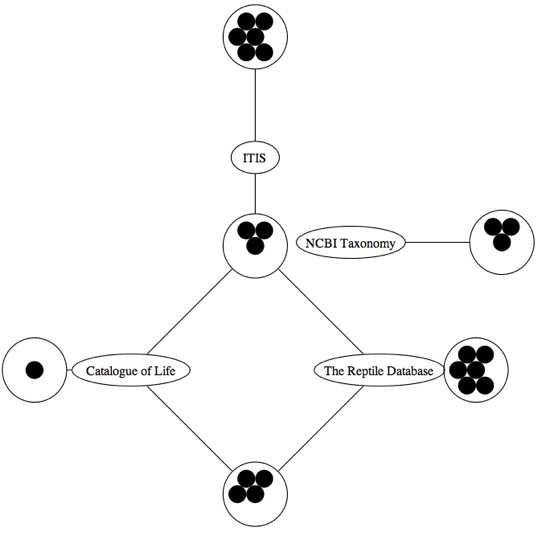
I've cobbled together a crude version of cluster maps. For a given taxon (e.g., a genus) I list all the immediate sub-taxa (e.g., species) in each classification in EOL, and then find the sets of sub-taxa that are shared across the classification sources (e.g., ITIS, NCBI, etc.) and those that are unique to one source. I then create the cluster map using Graphviz. Inspired by the hexagonal packing used by Aduna, I've done something similar to display the taxa in each set. Adding these to the output of Graphviz required a little fussing with. First I get Graphviz to output the graph in SVG, then I load the SVG into a program that locates each node in the graph and inserts SVG for the packed circles (given that SVG is XML this is fairly straightforward).

As an example, consider the genus Demansia (http://eol.org/pages/34967/overview). EOL reports four classifications for this genus. Below is a cluster map for this genus:
34967

This diagram show that, for example, the Catalogue of Life (CoL) and Reptile databases share 4 names, these databases share three other names with ITIS. All databases have names unique to themselves, one database (NCBI) is completely disconnected from the other three databases.

One important caveat here is that I'm mapping the scientific names as returned by EOL, and in many cases these contain the taxonomic authority. This is a major headache, prompting this outburst:


If we clean the names by removing the taxonomic authority the clusters overlap rather more:
Demansia
Now we see that only ITIS and the Reptile Database have unique names. This is one reason why I get stroppy when taxonomists start saying databases shouldn't have to supply cleaned "canonical" names. If the names have authorities then I have to clean them, because in many cases the authorities (while useful to know) are inconsistent across databases. For example:

  • Demansia olivacea GRAY 1842 versus Demansia olivacea (Gray, 1842)
  • Demansia torquata GÜNTHER 1862 versus Demansia torquata (Günther, 1862)

Taxonomic authorities are frequently misspelt, and people seem confused about when to use parentheses or not. Databases should spare the user some pain and provide clean names (and authority strings separately where they have them).

The visualisation is still incomplete (I need to make it interactive), but it shows promise. The names that are unique to one database are usually worth investigating. In some cases they are names other databases regard as synonyms, in other cases they represent spelling variations. The goal of this visualisation is to highlight the names that the user might want to investigate further.

The GBIF classification is broken — how do we fix it?

This post arose from an ongoing email conversation with Tony Rees about extracting and annotating taxonomic names. In BioStor I use the GBIF classification to display the taxonomic names found in the OCR text in the form of a tree. The idea is to give the reader a sense of "what the paper is about". I also use the classification to help link to GBIF occurrence records.

The GBIF backbone classification ("nub") is probably the single largest classification of life that has been assembled, and provides GBIF users with a way to navigate through GBIF's collection of specimen and observation records. Given the scale of the undertaking it is inevitable that there will be issues with the classification, and this post provides one example.

On the page for the article "Further additions to the known marine Molluscan fauna of St. Helena" (http://biostor.org/reference/88554, see also http://dx.doi.org/10.1080/00222939208677383) part of the classification looks like this:

└Animalia
└Annelida
└Polychaeta
└Sabellida
└Serpulidae
└Hipponyx
Tony points out that "Hipponyx" is a mollusc, yet in the GBIF classification appears in the annelid worms.

Like a fool I started to investigate further. First off, what is "Hipponyx"? Browsing the GBIF classification there are species of Hipponyx and Hipponix under the genus Hipponix, so it looks like we have two alternative spellings of this genus name. Nomenclator Zoologicus has both spellings, Hipponix credited to DeFrance 1819 Journ. de Physique, 88, 217, and Hipponyx credited to Defrance 1819 Bull. Sci. Soc. philom. Paris, 8. Gotta love those cryptic citations. After some digging around in BHL I found Journ. de Physique, 88, 217 (Mémoire sur un nouveau genre de mollusque) and Bull. Sci. Soc. philom. Paris, 8. (Sur un nouveau genre de coquilles (Hipponix)). Both papers are by Jacques Louis Marin DeFrance, and both use the spelling Hipponix (no 'y'). I'm guessing the second paper is actually the original description of the genus, but my French is abysmal (Google Translate to the rescue).

OK, so we have two spellings of what is probably the same thing (and I've no idea why we have two spellings). Both spellings seem in use (see Google NGrams chart below).


So, bit of a mess, but this still doesn't deal with Hipponyx being a worm in GBIF. After a bit of Googling on "Serpulidae" and "Hipponyx" I came across a specimen record from Te Papa labelled "Worm, Temporaria inexpectata (Mestayer, 1929); holotype; holotype of Hipponyx inexpectata Mestayer, 1929". I then came across this paper:

Fleming, C. A. (1971). A preliminary list of New Zealand fossil polychaetes. New Zealand Journal of Geology and Geophysics, 14(4), 742–756. doi:10.1080/00288306.1971.10426332

with the following abstract:
An annotated list of fossil “worm tubes” from New Zealand includes both published and new records from Mesozoic and Cenozoic deposits.

The binomen Zoophycos plicatus (Hutton) is proposed for the trace fossil long known as the Amuri fucoid, of unknown zoological affinity.

The following living species are recorded as New Zealand fossils for the first time: Protula bispiralis (Savigny), Salmacina dysteri (Huxley), Hydroides norvegicus Gunnerus, Pomatoceras cariniferus (Gray), P. aff. terranovae (Benham), Galeolaria hystrix (Moerch), Boccardia ? polybranchia (Haswell); new records of fossil species are Ditrupa cf. plana (Sowerby), Dorsoserpula lumbricalis (Schlotheim), and Neomicrorbis crenatostriatus (Münster). The name Hipponyx inexpectata Mestayer 1929, applied to a serpulid operculum, is used in the combination Temporaria inexpectata for a tubeworm common in deep water off New Zealand that has also been identified, with associated operculum, from the bathyal Waitotaran (Pliocene) sediments of Palliser Bay. Serpula wharjensis Wilkens and S. ougenensis Chapman are placed in Sclerostyla Moerch. Two species of Vermiliopsis and two of Spirorbis are figured but not named specifically.

The author of the paper (Charles Fleming) argues that Hipponyx inexpectata, regarded as a mollusc by its describer (Marjorie K. Mestayer, see Notes on New Zealand Mollusca. No. 4.) is actually a worm, and he moves it to the genus Temporaria.

So it seems that the reason Hipponyx has ended up being a worm in the GBIF classification is due to this synonymy.

Now, this little investigation was "fun", but took a couple of hours. Much of that was spent tracking down the literature and adding it to BioStor, which is a one-time cost. Not every issue with the GBIF classification will take this long to resolve, some cases may take longer. So there's a problem of scalability. Then there's the issue of how this information gets into the GBIF classification so we fix it (and so that people don't think Hipponyx is a worm). As has been said several times before, most eloquently by David Shorthouse, isn't it time we started using software development tools such as version control to help build, annotate, and correct classifications such as the one that underpins GBIF? That way when somebody spots an error it can be flagged, and someone with the time (and curiosity) can fix it.

Wikipedia and Gregg's paradox

Continuing the theme of taxonomic classification in Wikipedia, I'm perversely delighted that Wikipedia demonstrates Gregg's paradox so nicely.

1s2mges1n3b5q1bnvf5a3i4u8y_2009-05-31.jpgThe late John R. Gregg wrote several papers and a book exploring the logical structure of taxonomy. His 1954 book The language of taxonomy stimulated a debate a decade later in Systematic Zoology concerning what Buck and Hull (1966) (doi:10.2307/2411628) termed "Gregg's Paradox".

Gregg showed that if we (a) treat taxa as sets defined by extension (i.e., by listing all members), and (b) accept that two sets with exactly the same content must be the same set, then many biological classifications violate these premises because the same taxon may be assigned to multiple levels in the Linnean hierarchy. For example, the aardvark, Orycteropus afer, is the only extant species of the genus Orycteropus, which is the only extant member of the family Orycteropodidae, which in turn is the sole extant representative of the order Tubulidentata. Under Gregg's model, Tubulidentata, Orycteropodidae, and Orycteropus are all the same thing as they have exactly the same content (i.e., Orycteropus afer). Put another way, monotypic taxa are redundant and violate basic set theory. Gregg would argue that they should be eliminated.

aardvark.pngWikipedia illustrates this nicely. Wikipedia conforms to Gregg's model in that taxa are defined by extension (each taxon comprises one or more wiki pages), and if taxa have the same content only one taxon (typically that with the lowest taxonomic rank) has a page in Wikipedia. Put another way, if the aardvark is the sole representative of the Tubulidentata, then there is nothing that could be put on the Tubulidentata page that shouldn't also belong on the page for the aardvark. As a result, the page for the aardvark gives a full classification of this animal, but most taxa in the hierarchy don't have their own pages.

Responses

There are several possible responses to Gregg's paradox. One is to argue that taxa should be defined intentionally (i.e., on the basis of their characters), which was Buck and Hull's approach. Essentially, they were arguing that we could (somewhat arbitrarily) specify properties of Orycteropodidae that weren't shared by all Tubulidentata, and hence we are justified in keeping these taxa separate. Gregg himself was less than impressed by this argument (doi:10.2307/2412017).

Another approach is to suggest that we may discover taxa in the future that will, say, be members of Orycteropus but which aren't O. afer, and that the taxa between the rank suborder and species are placeholders for these discoveries. Indeed, in the case of the Tubulidentata there are extinct aardvarks (doi:10.1163/002829675x00137, doi:10.1016/j.crpv.2005.12.016, and doi:10.1111/j.1096-3642.2008.00460.x) that could be added to Wikipedia, thus justifying the creation of pages for the taxa that Gregg would have us eliminate.

Of course, Gregg's paradox is a consequence of having ranks and requiring each rank (or at least a reasonable subset of them) to exist in a classification. If we ignore ranks, then there's no reason to put any taxa between Afrotheria and Orycteropus afer. So, we could drop this requirement for having taxa at each rank or, of course, drop ranks altogether, which is one of the motivations behind phylogenetic classifications (e.g., the phylocode).

Implications for parsing Wikipedia

From a practical point of view, Gregg's paradox means that one has to be careful parsing Wikipedia Taxoboxes. As I've argued earlier, the simplest way to ensure that a classification is a tree is for each taxon to include a unique parent taxon. The simplest way to extract this for a taxon in a Wikipedia page would be to retrieve the taxon immediately above it in the classification (i.e., for Orycteropus afer this would be Orycteropus). But Orycteropus doesn't have a page in Wikipedia (OK, it does, but it's a redirect to the page for the aardvark). So, we have to go up the classification until we hit Afrotheria before we get a taxon page.

Personally I quite like the fact that a largely forgotten argument from the middle of the last century concerning logic and Linnean taxonomy seems relevant again.

Wikipedia's taxonomic classification is badly broken

Wikipedia is wonderful, but parts of it are horribly broken. Take, for example, taxonomic classifications. A classification is a rooted tree, which means that each node in the tree has a single parent. We can store trees in databases in a variety of ways. For example, for each node we could store a list of its children, or we could store the single unique parent of each node. Ideally we'd choose to store one or other, but not both. If we store both sets of statements (i.e., that node A has node B as one of its children, and that node B's parent is node A) then there is enormous potential for these two statements to get out of sync.
tree.png


This is what has happened in Wikipedia. Each page for a taxon lists the lineage to which it belongs (i.e., its parent, and its parent's parent, and so on), and also lists the children of that node. What this means is that if somebody edits the page for taxon A and adds taxon B as a child, they also need to edit the page for taxon B to make A its parent. If only one of these two edits is made the classification may end up internally inconsistent.

For example, the page for Amphibia lists the classification of Amphibia like this:
a1.png

It also lists the child taxa of Amphibia:
a2.png

So, the children of Amphibia are Temnospondyli, Lepospondyli, and Lissamphibia. Furthermore, Anura, Caudata, and Gymnophiona are children of Lissamphibia:

child.png


Given this, if I go to the pages for Anura, Caudata, and Gymnophiona I should see that each of these taxa lists Lissamphibia as its parent. However, only one of these (Caudata) does: the Anura and Gymnophiona both have Amphibia as their parents, not Lissamphibia.

The diagram below shows the taxa that have Amphibia as their parent:
parent.png


Note that Stegocephalia have now turned up as an addition amphibian order, and that only Caudata is included in Lissamphibia. But what is striking is that another 274 Wikipedia taxon pages have Amphibia as their parent. These pages are all for fossil amphibians that do not fit easily in the existing Wikipedia classification.

From the perspective of building a database, the "has parent" relationship is the one I'd prefer to use, because that statement is going to be made just once (on the page for the taxon of interest). This seems a lot safer than making the statement "has child" on another page (for one thing, more than one page could claim a taxon as their child, which again will break the tree). But if we use the "has parent" relationship, our tree will be very bushy, with lots of fossil amphibian genera attached to the Amphibia node. This is going to make the tree hard to interpret, because this basal bush isn't saying that all these genera radiated off at once, but rather that we don't really know where in the amphibian tree these things go, so we'll have to settle for saying merely "they are amphibians" (for the cladistic theorists among you, this is Nelson and Platnick's "interpretation 2" in their "Multiple Branching in Cladograms: Two Interpretations", doi:10.2307/2412630).

So, the dilemma is whether to use "has child" relationships, and accept that these are likely to be inconsistent with the inverse "has parent" relationship, or use the "has parent" relationship, which will be internally consistent, but at the cost of potentially very large, unresolved bushes due to fossil taxa of uncertain affinities.

Comparing Wikipedia and Mammal Species of the World classifications


Continuing the saga of making sense of the mammal classification in Wikipedia, I've done a quick comparison with the Mammal Species of the World (third edition) classification. MSW is the default taxonomic reference used by WikiProject Mammals. I downloaded the MSW taxonomy as a CSV file (warning, it's big), and wrote a script to pull out the classification as a GML file (my preferred graph format).

Based on some earlier work with Gabriel Valiente, I wrote a simple program that takes two trees and highlights the nodes in common to the two trees. I then input into this program the MSW tree, and the largest component of the graph of Wikipedia mammals. The MSW tree has 13582 nodes, the Wikipedia tree has 6287. Note that Wikipedia has more taxa than these 6287 nodes suggest, but they aren't connected to the largest tree (often due to intermediate nodes in the classification lacking a page in Wikipedia). The two trees have 4935 nodes in common (again, this number will be a little low, there are some weird taxon names due to problems parsing Wikipedia).

MSW versus Wikipedia
Below is a the MSW classification with taxa in Wikipedia shown in red.
w-msw.jpg


[Larger scale view here]

The impression given is that most Wikipedia mammal pages are in MSW, with some notable exceptions, including higher level taxa such as Afrotheria, and extinct taxa such as the Multituberculata. Some extant taxa are missing due to synonymy. For example, Wikipedia gives the scientific name of Anthony's pipistrelle as Pipistrellus anthonyi, whereas MSW has it as Hypsugo anthonyi.
As an aside, Wikipedia pages often get muddled about parentheses around taxonomic author names. The authority is in parentheses if the current genus is not the original genus the species was placed. Hence, Pipistrellus anthonyi (Tate, 1942) should actually be Pipistrellus anthonyi Tate, 1942, as Tate originally described this taxon as a species of Pipistrellus (see hdl:2246/1783). However, the name Hypsugo anthonyi (Tate, 1942) does need parentheses.


Some Wikipedia taxa also postdate the publication of MSW, such as Philander deltae (see doi:10.1644/05-MAMM-A-065R2.1).


Wikipedia versus MSW
When we do the reverse comparison we see something rather different.

msw-w.jpg


[Larger scale view here]

This is the MSW tree, coloured red where the MSW taxon has a page in Wikipedia. There are big gaps, some of which are due to those pages being in another component (in other words, many "missing" taxa do have pages in Wikipedia, they are just not properly linked to the bigger tree). MSW is also rich in subspecies, which tend to lack their own pages in Wikipedia (possibly a good thing in the cases of taxa such as pocket gophers).

It would be nice to make these comparisons automatic, and develop tools so that managing taxonomy in Wikipedia could be made easier.

Mammal tree from Wikipedia

Following on from my previous post about visualising the mammalian classification in Wikipedia, I've extracted the largest component from the graph for all mammal taxa in Wikipedia, and it is a tree. This wasn't apparent in the previous diagram, where the component appeared as a big ball due to the layout algorithm used.
tree.jpg


What this suggests is that Wikipedia contributors are quite capable of generating trees, it's just that not all the bits of the tree are connected (hence all the components in the previous post.

As Cyndy Parr suggested in her comments, it would be useful to compare the Wikipedia-derived tree with other trees, say from Mammal species of the World or ITIS.