Search this keyword

Showing posts with label Tree of Life. Show all posts

OneZoom

6e1f1693ed5d70b2f495e9a2c8666114 reasonably smallJames Rosindell's OneZoom tree viewer is out and the paper describing the viewer has been published in PLoS One (disclosure, I was a reviewer):

Rosindell, J., & Harmon, L. J. (2012). OneZoom: A Fractal Explorer for the Tree of Life. PLoS Biology, 10(10), e1001406. doi:10.1371/journal.pbio.1001406.g004
Below is a video where James describes OneZoom.


OneZoom is fun, and is deservedly attracting a a lot of attention. But as visually striking as it is, I confess I have reservations about fractal-based viewers. For a start they make it hard to get a sense of the relative size of taxonomic groups. Looking at the mammal tree shown in the video above your eye is drawn to the monotremes, one of the smallest mammalian lineages. That the greatest number of extant mammals are either rodents or bats is not readily apparent. Fractal geometry also removes the timescale, so you can't discover whether radiations in different clades are the same age (unlike, say, if the tree was drawn in a "traditional" fashion with a linear timescale). In some ways I think fractal viewers are rather like the hyperbolic viewers that attracted attention about a decade ago - visually striking but ultimately difficult to interpret. What I'd like to see are studies which evaluate how easily people can navigate different trees and accomplish specific tasks (such as determining closest relationships, relative clade diversity, etc.).

HypviewerIn some ways OneZoom resembles Google Maps with its zoomable interface. But ironically this only serves to illustrate a key different between OneZoom and Google Maps. Part of the strength of the later is the consistent conventions for drawing maps (e.g., north is up, south is down) which, when coupled with agreed co-ordinates (latitude and longitude), enables people to mash up geographic data. What I'd like is the equivalent of CartoDB for trees.

Touching the tree of life

Prompted by a conversation with Vince Smith at the recent Online Taxonomy meeting at the Linnean Society in London I've been revisiting touch-based displays of large trees. There are a couple of really impressive examples of what can be done.

Perceptive Pixel


I've blogged about this before, but came across another video that better captures the excitement of touch-based navigation of a taxonomy. Perceptive Pixel's (recently acquired by Microsoft) Jeff Han demos browsing an animal classification. The underlying visualisation is fairly sttaightforward, but the speed and ease with which you can interact with it clearly makes it fun to use.

DeepTree


DeepTree comes from Life on Earth lab, and there's a paper coming out by @blockflorian and colleagues (I was reminded of this project by @treevisproject):


For technical details on the layout algorithm see https://lifeonearth.seas.harvard.edu/downloads/DeepTree.pdf. Below is a video of it in use:


Both of these are really nice, but what I really want is to have this on my iPad…

EOL Phylogenetic Tree Challenge

34106 130 130The Encyclopedia of Life have announced the EOL Phylogenetic Tree Challenge. The contest has two purposes:

It provides a testbed for the Evolutionary Informatics community to develop robust methods for producing, serving, and evaluating large, biologically meaningful trees that will be useful both to the research community and to broader audiences.

It enables the Encyclopedia of Life to organise the information it aggregates according to phylogenetic relationships; in other words, it provides a direct pipeline from research results to practical use.


First prize is a trip to iEvoBio 2012, this year in Ottawa, Canada. For more details visit the challenge website. There is also an EOL community devoted to this challenge.

Challenges are great things, especially ones with worthwhile tasks and decent prizes. EOL badly needs a phylogenetic perspective, so this is a welcome development.

But (there's always a but), I can't help feeling that we need something a little more radical. The tree of life isn't a tree. At deep levels it's a forest, and even at shallow levels things are a complicated tangle of gene trees. Sometimes the tree is clear, sometimes not, and some of this is real and some reflects our ignorance.

If you want a simple tree to navigate, then I'd argue that the NCBI tree is a pretty good start, and EOL already has this. What would be really cool is to have a way to navigate that makes it clear that phylogenetic knowledge has a degree of uncertainty, and that the "tree of life" might be better depicted as a set of overlapping trees. The mental image I have is of a collage of trees from different data sets, superimposed over each other, with perhaps an underlying consensus to help navigate. This visualisation could be zoomable, because in some ways the tree of life is fractal. Trees don't stop at species, as the wealth of barcoding and phylogeographic studies show. Given computational constraints (not to mention visualisation issues), I wonder whether there is an effective limit to the size of any one tree in terms of number of taxa. What varies is the taxonomic scope. So we could imagine a backbone tree based on slowly evolving genes, we zoom in and more trees appear, but at lower levels, and finally we hit populations and individuals, trees that may have 100's of samples, but a very narrow scope.

This is all rather poorly articulated, but I can't help wondering whether a phylogenetic classification will end up distorting the very thing we're trying to depict. It also looses connection with the underlying data (and trees), which for me is a huge drawback of existing classifications. There's no sense of why they are the way they are. There's a chance here to bring together ideas that have been kicking around in the phylogenetic community for a couple of decades and rethink how we navigate the "tree of life".

Tree of Life 0.1 - annotating the NCBI taxonomy

Last week I was at the NSF "Assembling, Visualising and Analysing the Tree of Life" Ideas Lab, run by KnowInnovation.com/. It was an interesting experience, essentially a structured week of brainstorming ideas.

One thing I came away with is the feeling that our notions of the "tree of life" are fuzzy, contradictory, and often probably unobtainable. It's tempting to imagine all sorts of wonderful visualisations, and loose sight of building something that is useful. Perhaps it's time instead to think of "Tree of Life version 0.1".

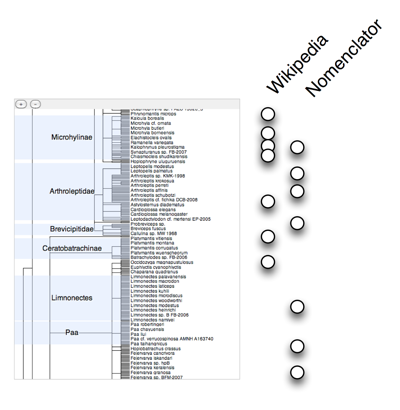
Imagine taking the NCBI taxonomy as a starting point. Yes it's incomplete, and has almost no fossils, but it's freely available and linked to a lot of data. Let's use a Google Maps-like viewer along the lines I explored earlier this year.

Then add annotation "tracks" to the tips. As a first pass these could be taken from the NCBI LinkOut service, such as the NCBI-Wikipedia mapping http://iphylo.org/linkout.

Ncbi 1

The NCBI tree is a classification rather than a phylogeny, so we could add greater phylogenetic content by linking to phylogenetic databases, such as TreeBASE and PhyLoTA. Imagine clicking on a node in the NCBI taxonomy and seeing a display of all the phylogenies centred on that node:

Ncbi 02

Now we have a way to navigate a large tree, view annotations, and display phylogenetic trees. All of this could be done fairly easily. The key is to have services keyed by the NCBI tax_id used to identify nodes on the tree.

Among the next steps would be to add additional "tracks", perhaps based on curated links analogous to the wiki-based NCBI-Wikipedia mapping. For example, very basic habitat data (marine or terrestrial) could be added, or geography, or host relationships (could be based in part on the data already in GenBank).

Given that the NCBI tree continues to grow, subsequent versions could be released as the tree changes. Or we could "fork" the NCBI tree and start to refine it based on phylogenetic information, and add taxa that aren't in the genome databases (these taxa will need consistent identifiers so we can map annotations on to them as well). Perhaps we could use something like Git to manage this tree, and to handle the necessary merging of updated versions of the NCBI tree. People could edit the tree, or indeed fork it and come up with their own.

Logo tmp reasonably smallThere are lots of ways to visualise trees (see TreeVis.net for some great examples), but what I'm after is a tool that is useful, that gives us a sense of what we know and what we don't. I suspect that one of the reasons we've struggled with visualising the tree of life is that there are lots of different notions about what it's for. In this case, I want a tool to navigate data about organisms, one that we can easily add annotations too.