Search this keyword

Showing posts with label twitter. Show all posts

Mapping evolutionary biology: @evoldir and #ProjectEvoMap

Robert M. Griffin (@GriffinEvo) has launched ProjectEvoMap. Rob explains:
I have decided this week to try to create a resource where evolutionary
biologists can find info on labs and groups from all around the world. I
have created a collaborative Google map online which evolutionary biology
research groups can pin their labs to with a brief description of their
interests. Others can then browse the map to look for labs in specific
areas – for example, if someone wants to find suitable labs in their
current country for work they can see all the labs in that area, likewise
anyone looking for work in a specific region or who needs access to labs
while on fieldwork can look for nearby groups which may be able to help.

Below is a screen shot of part of the map. If you're working on evolutionary biology now is your chance to literally put your lab on the map.

Project
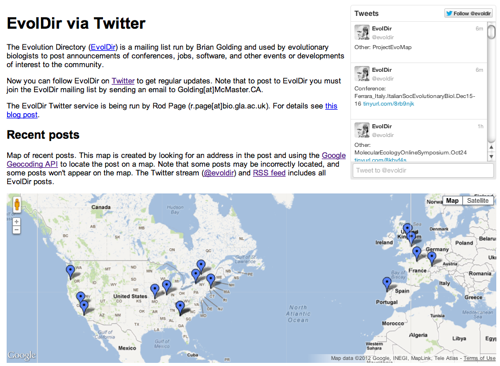
In parallel I'm experimenting with adding a map to the venerable EvolDir mailing list, for which I run a twitter stream (@evoldir). Using some terribly crude code to extract what looks like an address from EvolDir posts, then calling Google's Geocoding API results in a map of recent posts. You can see the live map at http://bioguid.info/services/evoldir/. This service compliments Rob's by giving a sense of current activity in the community (e.g., conferences, courses, jobs).

Evoldir

VIZBI 2011

broad.jpg
I've spent the last three days at VIZBI, a Workshop on Visualizing Biological Data, held at the Broad Institute in Boston (note that "Broad" rhymes with "Code"). A great conference in a special venue that includes the DNAtrium. Videos of the talks will be online "real soon now", look for the keynotes, which were full of great ideas and visualisations. To get a flavour of the meeting search for the hashtag #vizbi on Twitter (you can also see the tweet stream on the VIZBI home page). All the keynotes were great, but I personally found Tamara Munzer's the most enlightening. She drew on lots of research in visual perception to outline what works and what doesn't when presenting information visually. You can grab a PDF of her presentation here.

One aspect of the meeting which worked really well was the poster presentations. Poster sessions were held during coffee breaks, and after the last talk of the session but before the audience broke for coffee, each author of a poster got 90 seconds to introduce their poster (there were typically around 10 posters per break). This meant the poster authors got a chance to introduce themselves and their work to the workshop audience, and the audience could discover what posters were being displayed. Neat idea.

I gave a presentation on phylogenies, which I've put on slideshare. After explaining that I thought phylogeny visualisation was mostly a solved problem (as evidenced by the large number of tree viewers available), I continued the theme of why I don't think 3D works for phylogeny (except for geophylogenies), made the pitch for building a phylogeny viewer on the iPad, and finished with my recent work on Google Maps-style viewing very large trees.

BioStor updates on Twitter

BioStor has had a Twitter account @biostor_org for a while, but it's not been active. I finally got around to hooking it up to BioStor, so that now every time an article is added to BioStor, the title of that article and it's URL appears in the @biostor_org Twitter feed.


Activity on this feed will be variable, depending on whether articles are being added manually, or in bulk. But it's a handy way to keep tabs on the growing number of articles being harvested from the Biodiversity Heritage Library.

Flipboard and BHL

Flipboard is a new application for the iPad that is pitching itself as a personalised social magazine. It's launch created a lot of buzz, so much so that many users were unable to add their Facebook and Twitter accounts to it, much to their chagrin. I was one of these annoyed users, but now that I've been able to login I've been having a play and it's a lot of fun.


Nice typography and a clever layout is part of the attraction, and there has been some discussion about whether the Biodiversity Heritage Library (BHL) could be integrated.

@chrisfreeland @rdmpage #bhlib integration on @flipboard? The fb interface is very polished, familiar and comfortableless than a minute ago via Twitter for iPhone


Personally I'm sceptical. For me the key to Flipboard is not so much the nice interface, but the fact that the content is timely and relevant: timely because it's taken from live streams, and relevant because it comes from sources you select, including those form your social network. BHL doesn't have any of these characteristics. It's a huge digital archive with very little structure, and what structure it does have is largely bibliographic. For this content to work in a Flipboard-like environment I think BHL would need to develop "streams" based on, say taxa, geography, or readership, and these would have to be personalised. In a sense, Flipboard is displaying streams of content assembled by a combination of editors and your social network, and BHL has neither.

BHL interface ideas

I've been buried in programming (and it's exam time at Glasgow) so I've not blogged for a month (gasp). I've been playing with ways to visualise Biodiversity Heritage Library content for a while (click here for a list of previous posts), and have occasionally surfaced to tweet a screenshot via twitpic. The more I play with the BHL content the more I think it's a gold mine, and that many of the ideas I played with for my ill-fated Elsevier Challenge entry (website here, background paper at hdl:10101/npre.2009.3173.1) are taking on a new life with this project.

I'm hoping to release my BHL article finding and visualising web site by the end of the month, but meantime I'm gathering the screenshots here.

The first shows a Google map generated from latitude and longitudes extracted from OCR text using some simple regular expressions from page 7705952 in the BHL.There's quite a bit of latitude and longitude information in BHL, and that's before trying georeferencing tools.

<46740423.png


The idea is to display this map next to the article so that user get's an immediate sense of what region in the world the article covers, such as this article about Riekia wasps:

46744940.png


I'm also interested in useful ways to display search results. Here's an experiment using TileBars to visualise how relevant a search result is. The width of the bar is a function of how many pages are in the article, the vertical stripes indicate pages that have the search term. The idea is to get a quick visual impression of whether the article mentions the term in parsing, or treats it in some detail.

48350737.png


TileBars were developed by Marti Hearst, whose web site has some great resources. Partly inspired by her BioText projec, as well as the thumbnail page display in JSTOR I'm now experimenting with showing thumbnails in search results. For example, here's a search for the deep sea octopus Graneledone pacifica, showing two articles:


48832222-196574b7b6d6a2bc5764a5e853cd478b.4b228b85-full.png


I display thumbnails for pages that (a) have the name on the page, and (b) have what look like figure captions on them. The idea is that an article that figures a taxon is likely to be a fairly important article to look at, so displaying thumbnails will highlight those articles. The second article in the search results is the paper that published the name Graneledone pacifica, and the figures illustrate the taxon.

These are all pretty rough, but they give some idea of what I've been working on the last month.


ChrisFreeland.com: #ebio09, silverbacks, & haiku

Chris Freeland has written a thoughtful summary of his experiences of the two-day closed session to create a road map for biodiversity informatics, entitled #ebio09, silverbacks, & haiku.

e-Biosphere '09: Twitter rules, and all that


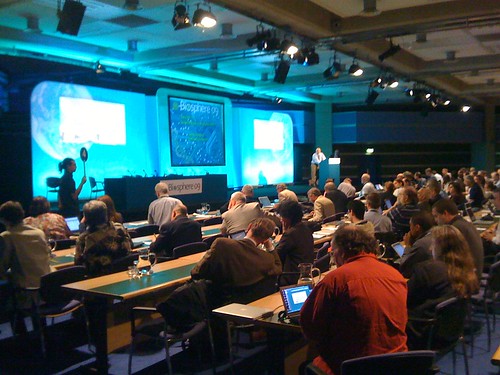
So, e-Biosphere '09 is over (at least for the plebs like me, the grown ups get to spend two days charting the future of biodiversity informatics). It was an interesting event, on several levels. It's late, and I'm shattered, so this post ill cover only a few things.

This was first conference I'd attended where some of the participants twittered during proceedings. A bunch of us settled on the hashtag #ebio09 (you can also see the tweets at search.twitter.com). For the uninitiated, a "hashtag" is a string preceded by a hash symbol (#), to indicate that it is a tag, such as #fail. It provides a simple way to tag tweets so that others interested in that topic can find them.

Twittering created a whole additional layer to the conference. We were able to:

Twitter greatly enhanced the conversation, noticeably when a speaker said something controversial (all too rare, sadly), or when a group rapporteur's summary didn't reflect all the views in that group. It also helped document what was going on, and this can be further exploited. For fun, I grabbed tweets from days 2 and 3 and made a wordle:
As @edwbaker noted @edwbaker @rdmpage The size of 'together', 'people' & 'visionary' is somewhat telling...... In case you're wondering about the prominence of "Knowlton", it's because Nancy Knowlton gave a nice talk highlighting the every increasing number of cases where we have no names for the things we are encountering (for example, when barcoding fresh samples from poorly studied environments). This is just one example of the huge disconnect between the obsession with taxonomic names in biodiversity informatics, and the reality of metagenomics and DNA barcoding. Just as worrying is the lack of resemblance of the taxonomic classification used by the Encyclopedia of Life and our notion of the evolutionary tree of those organisms. A systematist would find much of EOL's classification laughable. I don't want to bash EOL, but it's worrying that they can continue to crank out press releases, but fail to provide something like a modern classification.

But I digress. In many ways this was less of a scientific conference and more of an event to birth a discipline, namely "biodiversity informatics" (which I'm sure some would claim as been around for quite a while). So, the event was to attract attention to the topic, and assure the outside world (and those attending) that the field exists and has something to say. It also was billed as a forum to discuss strategies for its future. Sadly, much of this discussion will take place behind closed doors, and will feature the major players who bring money and influence (but not much innovation) to the table.

Symptomatic of this lack of innovation, in a sense, was the contrast between the official "Online Conference Community", and the twitter feed. When I asked if anybody on twitter had used the official forum, @fak3r replied tellingly: @rdmpage thought we were on it ;) #ebio09. As fun as it is to use the new hotness to conduct a parallel (and slightly subversive) discussion at a conference it's worrying that, in a field that calls itself "informatics" the big beasts probably had little idea what was going on. If we are going to exploit the tools the web provides, we need people who "get it", and I'm unconvinced that the big players in this area truly grasp the web (in all it's forms). There's also a worrying degree of physics envy, which might be cured by reading The Unreasonable Effectiveness of Data (doi:10.1109/mis.2009.36).

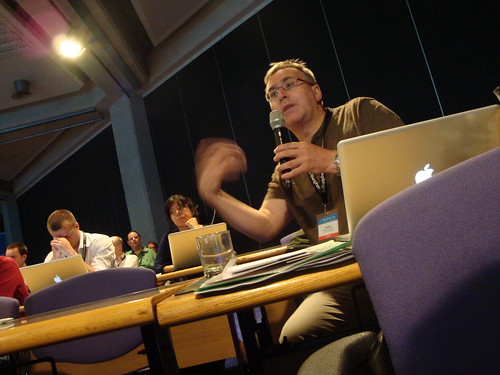
I tried to stir things up a little (almost literally as captured in this photo by Chris Freeland), with a couple of questions, but to not much effect (other than apparently driving to despair the poor chap behind me ).


But enough grumbling. It was great to see lots of people attending the event, the were lots of interesting posters and booths (creating a market for this field may go some way towards providing an incentive to provide better, more reliable services), and my challenge entry won joint first prize, so perhaps I should sit back, enjoy the wine Joel Sachs choose as the prize (many thanks for his efforts in putting the challenge event together), and let others say what they thought of the meeting.