Search this keyword

Showing posts with label error. Show all posts

Can you trust EOL?

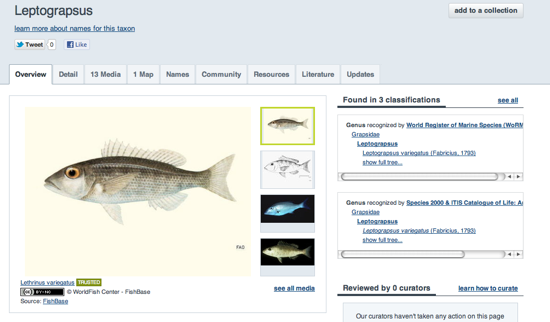
There's a recent thread on the Encyclopedia of Life concerning erroneous images for the crab Leptograpsus. This is a crab I used to chase around rooks on stormy west-coast beaches near Auckland, so I was a little surprised to see the EOL page for Leptograpsus looks like this:

Leptograpsus

The name and classification is the crab, but the image is of a fish (Lethrinus variegatus). Perhaps at some point in aggregating the images the two taxa, which share the abbreviated name "L.variegatus" got mixed up.

Now, errors like this are bound to happen in a project the size of EOL, and EOL has some pretty active efforts to clean up errors (e.g., the Homonym Hunters). But what bothers me about this example is the prominent label Trusted that appears below the image. If I look at all the images for Leptograpsus on EOL, I see "trusted" images for fish. All images of the crab (i.e., the real Leptograpsus) are labelled "unreviewed" and implicitly "untrusted":

Leptograpsus2

If you are going to claim something is "trusted" you need to be very careful. The images of the fish may well come from a trusted source (FishBase), and FishBase's assertion that the image is of Lethrinus variegatus may well be "trusted", but I certainly can't trust the assertion made by EOL that this image depicts a crab.

In this example the error is easy to spot (if you know that crabs and fish are different), but what if the error was more subtle? Or what if you are using EOL's API and explicitly asking for only content you can trust? Then you get the fish images (see https://gist.github.com/2850321).

If I can't trusted "trusted" then EOL has a problem. One way forward is to unpack the notion of "trust" and make sure the user knows what "trusted" means. In this case there are at least two assertions being made:
  1. This image is of a fish (made by FishBase)
  2. This image is of a crab (made by EOL)

EOL needs to make clear what assertions are being made, and which ones it is stating can be "trusted". Ideally it also needs to move away from blanket assertions of "trusted" versus not trusted, because that's far too coarse (just because FishBase knows about fish I'm not sure I'm going to put equal trust that every image it contains has been correctly identified). Trust is something that is conferred by users and acquired over time, not something to be simply asserted.

The GBIF classification is broken — how do we fix it?

This post arose from an ongoing email conversation with Tony Rees about extracting and annotating taxonomic names. In BioStor I use the GBIF classification to display the taxonomic names found in the OCR text in the form of a tree. The idea is to give the reader a sense of "what the paper is about". I also use the classification to help link to GBIF occurrence records.

The GBIF backbone classification ("nub") is probably the single largest classification of life that has been assembled, and provides GBIF users with a way to navigate through GBIF's collection of specimen and observation records. Given the scale of the undertaking it is inevitable that there will be issues with the classification, and this post provides one example.

On the page for the article "Further additions to the known marine Molluscan fauna of St. Helena" (http://biostor.org/reference/88554, see also http://dx.doi.org/10.1080/00222939208677383) part of the classification looks like this:

└Animalia
└Annelida
└Polychaeta
└Sabellida
└Serpulidae
└Hipponyx
Tony points out that "Hipponyx" is a mollusc, yet in the GBIF classification appears in the annelid worms.

Like a fool I started to investigate further. First off, what is "Hipponyx"? Browsing the GBIF classification there are species of Hipponyx and Hipponix under the genus Hipponix, so it looks like we have two alternative spellings of this genus name. Nomenclator Zoologicus has both spellings, Hipponix credited to DeFrance 1819 Journ. de Physique, 88, 217, and Hipponyx credited to Defrance 1819 Bull. Sci. Soc. philom. Paris, 8. Gotta love those cryptic citations. After some digging around in BHL I found Journ. de Physique, 88, 217 (Mémoire sur un nouveau genre de mollusque) and Bull. Sci. Soc. philom. Paris, 8. (Sur un nouveau genre de coquilles (Hipponix)). Both papers are by Jacques Louis Marin DeFrance, and both use the spelling Hipponix (no 'y'). I'm guessing the second paper is actually the original description of the genus, but my French is abysmal (Google Translate to the rescue).

OK, so we have two spellings of what is probably the same thing (and I've no idea why we have two spellings). Both spellings seem in use (see Google NGrams chart below).


So, bit of a mess, but this still doesn't deal with Hipponyx being a worm in GBIF. After a bit of Googling on "Serpulidae" and "Hipponyx" I came across a specimen record from Te Papa labelled "Worm, Temporaria inexpectata (Mestayer, 1929); holotype; holotype of Hipponyx inexpectata Mestayer, 1929". I then came across this paper:

Fleming, C. A. (1971). A preliminary list of New Zealand fossil polychaetes. New Zealand Journal of Geology and Geophysics, 14(4), 742–756. doi:10.1080/00288306.1971.10426332

with the following abstract:
An annotated list of fossil “worm tubes” from New Zealand includes both published and new records from Mesozoic and Cenozoic deposits.

The binomen Zoophycos plicatus (Hutton) is proposed for the trace fossil long known as the Amuri fucoid, of unknown zoological affinity.

The following living species are recorded as New Zealand fossils for the first time: Protula bispiralis (Savigny), Salmacina dysteri (Huxley), Hydroides norvegicus Gunnerus, Pomatoceras cariniferus (Gray), P. aff. terranovae (Benham), Galeolaria hystrix (Moerch), Boccardia ? polybranchia (Haswell); new records of fossil species are Ditrupa cf. plana (Sowerby), Dorsoserpula lumbricalis (Schlotheim), and Neomicrorbis crenatostriatus (Münster). The name Hipponyx inexpectata Mestayer 1929, applied to a serpulid operculum, is used in the combination Temporaria inexpectata for a tubeworm common in deep water off New Zealand that has also been identified, with associated operculum, from the bathyal Waitotaran (Pliocene) sediments of Palliser Bay. Serpula wharjensis Wilkens and S. ougenensis Chapman are placed in Sclerostyla Moerch. Two species of Vermiliopsis and two of Spirorbis are figured but not named specifically.

The author of the paper (Charles Fleming) argues that Hipponyx inexpectata, regarded as a mollusc by its describer (Marjorie K. Mestayer, see Notes on New Zealand Mollusca. No. 4.) is actually a worm, and he moves it to the genus Temporaria.

So it seems that the reason Hipponyx has ended up being a worm in the GBIF classification is due to this synonymy.

Now, this little investigation was "fun", but took a couple of hours. Much of that was spent tracking down the literature and adding it to BioStor, which is a one-time cost. Not every issue with the GBIF classification will take this long to resolve, some cases may take longer. So there's a problem of scalability. Then there's the issue of how this information gets into the GBIF classification so we fix it (and so that people don't think Hipponyx is a worm). As has been said several times before, most eloquently by David Shorthouse, isn't it time we started using software development tools such as version control to help build, annotate, and correct classifications such as the one that underpins GBIF? That way when somebody spots an error it can be flagged, and someone with the time (and curiosity) can fix it.
Yet more reasons to have specimen identifiers: annotating GenBank sequences

One reason I'm pursuing the theme of specimen identifiers (and identifiers in general) is the central role they play in annotating databases. To give a concrete example, I (among others) have argued for a wiki-style annotation layer on top of GenBank to capture things such as sequencing errors, updated species names, etc. Annotation is a lot easier if we have consistent identifiers for the things being annotated. For example, every GenBank sequence has a unique accession number, so if you and I are discussing sequence DQ055738, you and I can be sure we are talking about the same thing.

Sequence DQ055738 is interesting because Hua et al. A Revised Phylogeny of Holarctic Treefrogs (Genus Hyla) Based on Nuclear and Mitochondrial DNA Sequences (http://dx.doi.org/10.1655/08-058R1.1 - note the nice identifier we have for this article) have suggested this sequence (published in http://dx.doi.org/10.1554/05-284.1, another nice identifier) is misidentified. Given these identifiers we could construct various statements, such as:


DQ055738 -> published in -> doi:10.1554/05-284.1
DQ055738 -> annotated by -> doi:10.1655/08-058R1.1

(I've omitted the http:// stuff to keep things legible). Hua et al: state the following:

However, the tissue number of this specimen (LSUMZ H-19067) is similar to that of a specimen of H. versicolor (LSUMZ H-19077), which appears to have been processed at the same time (C. Austin, personal communication). Therefore, we hypothesize that the sequence data for H. gratiosa used by Smith et al. (2005) were actually from H. versicolor.

It would be nice if we had unique, resolvable identifiers for LSUMZ H-19067 and LSUMZ H-19077 so that we could construct statements linking the sequence, the publications, and the specimens. But we don't. Nor is it obvious how to find out anything more about LSUMZ H-19067 and LSUMZ H-19077. By contrast, for the DOI or the sequence accession I know how to get more information, in either human- or machine-readable form.

The acronym LSUMZ in this case is the Lousiana State University Museum of Natural Science Herpetology collection (http://biocol.org/urn:lsid:biocol.org:col:34806). Just to confuse matters, LSUMZ specimens in GBIF use LSU as the acronym for Lousiana State University Museum of Natural Science. Given that GBIF's data comes from LSU itself, it's odd (but not surprising) that there's a muddle about which acronym to use (it would be nice to clear this up, but then anybody building identifiers based on those acronyms is in for some heartbreak).

If I look at GBIF LSUMZ records there aren't specimens with the catalogue numbers H-19067 or H-19077. However, after a bit of poking around, and a helpful file from GBIF's Tim Robertson, I discovered that the LSUMZ herpetology tissue numbers (which is what the H-* codes actually are) are stored in GBIF, so I've found the corresponding specimens are http://data.gbif.org/occurrences/45716232 (LSU Herp 84850, LSUMZ HerpNet Tissue 19067) and http://data.gbif.org/occurrences/45710033 (LSU Herp 84862, LSUMZ HerpNet Tissue 19077). (Note that Hua et al. tell the reader that LSU 84850 = LSUMZ H-19067, but don't give the specimen code for LSUMZ H-19077).

Now I have some resolvable identifiers, so I could construct statements like:


DQ055738 -> voucher -> occurrences/45716232
DQ055738 -> voucher -> occurrences/45710033
|
+-> according to -> doi:10.1655/08-058R1.1

Let's skip over whether this is actually the best way to record the annotation, the point is we can now start to construct statements that can be linked to the wider world. If someone else has made statements about these specimens, and they used the GBIF URL, then we could aggregate those and learn more about these specimen and their associated sequences. Without globally unique, stable, resolvable identifiers we are left to flounder around in the bowels of various databases searching for something that may or may not be the object being discussed. Isn't it time we did something about this?

Phantom articles: why Mendeley needs to make duplication transparent

Browsing Mendeley I found the following record: http://www.mendeley.com/research/description-larva/. This URL is for a paper
Costa, J. M., & Santos, T. C. (2008). Description of the larva of. Zootaxa, 99(2), 129-131
which apparently has the DOI doi:10.1645/GE-2580.1. This is strange because Zootaxa doesn't have DOIs. The DOI given resolves to a paper in the Journal of Parasitology:
Harriman, V. B., Galloway, T. D., Alisauskas, R. T., & Wobeser, G. A. (2011). Description of the larva of Ceratophyllus vagabundus vagabundus (Siphonaptera: Ceratophyllidae) from nests of Rossʼs and lesser snow geese in Nunavut, Canada. The Journal of parasitology, 93(2), 197-200
Now, this paper has it's own record in Mendeley.

OK, so this is weird..., but it gets weirder. If you look at the Mendeley page for this chimeric article there is a PDF preview of yet another article:
LOPES, Maria José Nascimento; FROEHLICH, Claudio Gilberto and DOMINGUEZ, Eduardo (2003). Description of the larva of Thraulodes schlingeri (Ephemeroptera, Leptophlebiidae). Iheringia, Sér. Zool. 92(2), 197-200 2003 doi:10.1590/S0073-47212003000200011
Mendeley duplicate

But it gets even more interesting. The abstract for the phantom Zootaxa article belongs to yet another paper:
Marques, K. I. D. S., & Xerez, R. D.Description of the larva of Popanomyia kerteszi James & Woodley (Diptera: Stratiomyidae) and identification key to immature stages of Pachygastrinae. Neotropical Entomology, 38(5), 643-648.
which also exists in Mendeley.

To investigate further I used Mendeley's API to retrieve this record (I had to look at the source of the web page to find the internal identifier used by Mendeley, namely 010c48d0-edb5-11df-99a6-0024e8453de6 to do this, why does Mendeley hide these?). Here's the abbreviated JSON for this record.

{
...
"website": "http:\/\/www.ncbi.nlm.nih.gov\/pubmed\/21506868",
"identifiers": {
"pmid": "21506868",
"issn": "19372345",
"doi": "10.1645\/GE-2580.1"
},
...
"issue": "2",
"pages": "129-131",
"public_file_hash": "fe7eed3f6c43a3be1480a0937229b9ad33666df4",
"publication_outlet": "Zootaxa",
"type": "Journal Article",
"mendeley_url": "http:\/\/www.mendeley.com\/research\/description-larva\/",
"uuid": "010c48d0-edb5-11df-99a6-0024e8453de6",
"authors": [
{
"forename": "J M",
"surname": "Costa"
},
{
"forename": "T C",
"surname": "Santos"
}
],
"title": "Description of the larva of",
"volume": "99",
"year": 2008,
"categories": [
39,
203,
37,
52,
43,
40,
210
],
"oa_journal": false
}

Doesn't add much to the story, but does give us the sha1 for the PDF for the chimeric article (fe7eed3f6c43a3be1480a0937229b9ad33666df4). If I download the PDF for the article in Iheringia, Sér. Zool. it has the same sha1:


openssl sha1 a11v93n2.pdf
SHA1(a11v93n2.pdf)= fe7eed3f6c43a3be1480a0937229b9ad33666df4

This article doesn't exist
So, to summarise, this paper doesn't exist. It is credited to a journal that doesn't have DOIs, the DOI resolves to an article in a different journal, the abstract comes from another article in another journal, and the PDF is from a third article. OMG!

This is just weird
So, something about the way Mendeley merges references is broken. Merging references is a tough problem so there will always be cases where things go wrong. But it would be really, really helpful if Mendeley could display the set of articles that it has merged to create each canonical reference (say by listing the UUIDs for each article). Users could then see if badness had happened, and provide feedback, for example by highlighting references that are clearly the same, and those that are clearly different. Until this happens I'm a bit nervous about trusting Mendeley with my bibliographic data, I don't want it mangled into chimeric papers that don't exist.