Search this keyword

Showing posts with label taxonomy. Show all posts

BioNames: yet another taxonomic database

Yet another taxonomic database, this time I can't blame anyone else because I'm the one building it (with some help, as I'll explain below).

BioNames was my entry in EOL's Computable Data Challenge (you can see the proposal here: http://dx.doi.org/10.6084/m9.figshare.92091). In that proposal I outlined my goal:
BioNames aims to create a biodiversity “dashboard” where at a glance we can see a summary of the taxonomic and phylogenetic information we have for a given taxon, and that information is seamlessly linked together in one place. It combines classifications from EOL with animal taxonomic names from ION, and bibliographic data from multiple sources including BHL, CrossRef, and Mendeley. The goal is to create a database where the user can drill down from a taxonomic name to see the original description, track the fate of that name through successive revisions, and see other related literature. Publications that are freely available will displayed in situ. If the taxon has been sequenced, the user can see one or more phylogenetic trees for those sequences, where each sequence is in turn linked to the publication that made those sequences available. For a biologist the site provides a quick answer to the basic question “what is this taxon?”, coupled with with graphical displays of the relevant bibliographic and genomic information.

The bulk of the funding from EOL is going into interface work by Ryan Schenk (@ryanschenk), author of synynyms among other cool things. EOL's Chief Scientist Cyndy Parr (@cydparr) is providing adult supervision ("Chief Scientist", why can't I have a title like that?).

Development of BioNames is taking place in the open as much as we can, so there are some places you can see things unfold:


I've lots of terrible code scattered around which I am in the process of organising into something usable, which I'll then post on GitHub. Working with Ryan is forcing me to be a lot more thoughtful about coding this project, which is a good thing. Currently I'm focussing on building an API that will support the kinds of things we want to do. I'm hoping to make this public shortly.

The original proposal was a tad ambitious (no, really). Most of what I hope to do exists in one form or another, but making it robust and usable is a whole other matter.

As the project takes shape I hope to post updates here. If you have any suggestions feel free to make them. The current target is to have this "out the door" by the end of May.

Rate of description of new animal species and *that* Taxatoy graph

As part of the discussion on whether legacy biodiversity literature matters a graph from the following paper came up:

Sarkar, I., Schenk, R., & Norton, C. N. (2008). Exploring historical trends using taxonomic name metadata. BMC Evolutionary Biology, 8(1), 144. doi:10.1186/1471-2148-8-144


So, why is the Sarkar et al. graph bogus? Here is their graph (Fig. 3) for animals:

Taxatoy

This is the number of new animal species described each year, estimated by parsing taxonomic names and extracting the date in the taxonomic authority. There are two prominent "spikes" which are worrying. Sarkar et al. discuss the peak in 1994:

For example, the analyzed data indicate that a significant portion of the 1994 peak is due to an increase in descriptions of the family Cerambycidae, a large group of beetles.


So, 1994 was a bumper year for describing new species of Cerambycidae? Not quite. Taxatoy is based on names in uBio, and I have a local copy of most of these names. The Cerambycidae names contain lots of duplicate names that differ only in taxon authority. For example, searching the name Ancylocera macrotela on uBio finds:


Ancylocera macrotela
Ancylocera macrotela Aurivillius, 1912
Ancylocera macrotela BATES Henry Walter, 1880
Ancylocera macrotela Bates, 1880
Ancylocera macrotela Bates, 1885
Ancylocera macrotela Blackwelder, 1946
Ancylocera macrotela Chemsak & Linsley, 1970
Ancylocera macrotela Chemsak, 1963
Ancylocera macrotela Chemsak, 1964
Ancylocera macrotela Chemsak, Linsley & Mankins, 1980
Ancylocera macrotela Chemsak, Linsley & Noguera, 1992
Ancylocera macrotela Lameere, 1883
Ancylocera macrotela Maes & al., 1994
Ancylocera macrotela Monné & Giesbert, 1994
Ancylocera macrotela Monné, 1994
Ancylocera macrotela Noguera & Chemsak, 1996
Ancylocera macrotela Viana, 1971


These names are chresonyms. The original name is Ancylocera macrotela Bates, 1880 (you can see first publication of this name in BHL), the rest are subsequent citations of that name (gotta love taxonomy...).

Why the spike in 1994? I suspect that this is due to the publication in 1994 of "Checklist of the Cerambycidae and Disteniidae (Coleoptera) of the Western Hemisphere" by Miguel A Monné and Edmund F Giesbert. At least 8552 names from that checklist seem to have ended up in uBio, all with the date "1994". So the spike is an artefact. Similarly, the other peak (1912) corresponds to the publication of a checklist by Per Olof Christopher Aurivillius, which contributes over 3000 names.

One reason I was suspicious of the Taxatoy graph is that it doesn't look anything like the equivalent graph from the Index of Organism Names. After a bit of fussing I've grabbed data from the ION site, and from Taxatoy's Google Code repository and created the following chart:

Taxatoy version2

The data for this chart is on figshare http://dx.doi.org/10.6084/m9.figshare.156862. ION is an index of all new animal names, based on Zoological Record. I place more confidence in its data than data derived from uBio, but it clearly ION has its own issues (such as the gap after 1850, and the uneven sampling of the early years of taxonomy). The key point is that arguments on the temporal distribution of taxonomic descriptions (and the value of legacy literature) need to be aware that the data used is in pretty poor shape.

Update 2013-02-23
Jose Antonio Gonzalez Oreja pointed out in an email that the values for ION that I used were a little higher than those that appear on the ION web site. My script for retrieving those values hadn't quite worked. I've uploaded the corrected data to Figshare http://dx.doi.org/10.6084/m9.figshare.156862, updated the diagram above, and put the web calls I used to fetch the data on GitHub https://gist.github.com/rdmpage/5019153. The story doesn't change, but it helps to have the correct data.

Species wait 21 years to be described - show me the data

21Benoît Fontaine et al. recently published a study concluding that average lag time between a species being discovered and subsequently described is 21 years.

Fontaine, B., Perrard, A., & Bouchet, P. (2012). 21 years of shelf life between discovery and description of new species. Current Biology, 22(22), R943–R944. doi:10.1016/j.cub.2012.10.029

The paper concludes:

With a biodiversity crisis that predicts massive extinctions and a shelf life that will continue to reach several decades, taxonomists will increasingly be describing from museum collections species that are already extinct in the wild, just as astronomers observe stars that vanished thousands of years ago.

This is a conclusion that merits more investigation, especially as the title of the paper suggests there is an appalling lack of efficiency (or resources) in the way we decsribe biodiversity. So, with interest I looked at the Supplemental Information for the data:

I was hoping to see the list of the 600 species chosen at random, the publication containing their original description, and the date of their first collection. Instead, all we have is a description of the methods for data collection and analysis. Where is the data? Without the data I have no way of exploring the conclusions, asking additional questions. For example, what is the distribution of date of specimen collection in each species? One could imagine situations where a number of specimens are recently collected, prompting recognition and description of a new species, and as part of that process rummaging through the collections turns up older, unrecognised members of that species. Indeed, if it takes a certain number of specimens to describe a species (people tend to frown upon descriptions based on single specimens) perhaps what we are seeing is the outcome of a sampling process where specimens of new species are rare, they take a while to accumulate in collections, and the distribution of collection dates will have a long tail.

These are the sort of questions we could have if we had the data, but the authors don't provide that. The worrying thing is that we are seeing a number of high-visibility papers that potentially have major implications for how we view the field of taxonomy but which don't publish their data. Another recent example is:

Joppa, L. N., Roberts, D. L., & Pimm, S. L. (2011). The population ecology and social behaviour of taxonomists. Trends in Ecology & Evolution, 26(11), 551–553. doi:10.1016/j.tree.2011.07.010

Biodiversity is a big data science, it's time we insisted on that data being made available.

Touching the tree of life

Prompted by a conversation with Vince Smith at the recent Online Taxonomy meeting at the Linnean Society in London I've been revisiting touch-based displays of large trees. There are a couple of really impressive examples of what can be done.

Perceptive Pixel


I've blogged about this before, but came across another video that better captures the excitement of touch-based navigation of a taxonomy. Perceptive Pixel's (recently acquired by Microsoft) Jeff Han demos browsing an animal classification. The underlying visualisation is fairly sttaightforward, but the speed and ease with which you can interact with it clearly makes it fun to use.

DeepTree


DeepTree comes from Life on Earth lab, and there's a paper coming out by @blockflorian and colleagues (I was reminded of this project by @treevisproject):


For technical details on the layout algorithm see https://lifeonearth.seas.harvard.edu/downloads/DeepTree.pdf. Below is a video of it in use:


Both of these are really nice, but what I really want is to have this on my iPad…

Sometimes the mess taxonomy creates drives me nuts

Playing with some sequence data I found numerous Plasmodium sequences from the following paper:

Werner, E. B. ., Taylor, W. R., & Holder, A. A. (1998). A Plasmodium chabaudi protein contains a repetitive region with a predicted spectrin-like structure1Note: Nucleotide sequence data reported in this paper are available in the EMBL, GenBank™ and DDJB databases under the accession number U43145.1. Molecular and Biochemical Parasitology, 94(2), 185–196. doi:10.1016/S0166-6851(98)00067-X

These sequences (e.g., U43145) give the host as Thamnomys rutilans. You'd think it would be fairly easy to learn more about this animal, given that it hosts a relative of the cause of malaria in humans, and indeed there are a number of biomedical papers that come up in Google, e.g.:

Landau, I., & Chabaud, A. (1994). Advances in Parasitology (Vol. 33, pp. 49–90). Elsevier BV. doi:10.1016/S0065-308X(08)60411-X
Killick-Kendrick, R. (1968). Malaria parasites of Thamnomys rutilans (Rodentia, Muridae) in Nigeria. Bull World Health Organ. 1968; 38(5): 822–824. PMC2554675

Google also tells me that Thamnomys rutilans is an African rodent (e.g., 6.1.6. Rodent malaria, but NCBI has no sequences for "Thamnomys rutilans", and GBIF has no data on its distribution. If I search Mammal Species of the World I get (literally) "nothing found ...".

So, this is an African rodent, host to Plasmodium, and we know nothing about it? A bit of Googling, a trip to Wikipedia and Google Books reveals that Thamnomys rutilans is a synonym of Grammomys rutilans, but it is now called Grammomys poensis because the original name (Mus rutilans Peters 1876) is a junior synonym homonym of Mus rutilans Olfers, 1818 (simples). You can see the original description of Mus rutilans Peters 1876 in BioStor http://biostor.org/reference/105261 (this took some tracking down, but that's another story):


The original description of Mus rutilans Olfers, 1818 is given by The description of a new species of South American hocicudo, or long-nose mouse, genus Oxymycterus (Sigmodontinae, Muroidea), with a critical review of the generic content as:

Olfers, I. 1818. Bemerkungen zu Illiger's Ueberblick der Saugethiere nach ihrer Betheilung über die Welttheile rüchsichtlich der Südamerikanischen Arten (Species). In Eschwege, W. L., ed., Journal von Brasilien, Weimar, 15(2): 192-237.

This reference doesn't seem to be online.

The upshot of all this information about the host of Plasmodium chabaudi is hidden behind taxonomic name changes, and databases that one might expect to help simply don't. If names are the glue that link biodiversity data together then we need to get a lot better at making basic information about name changes accessible, otherwise we are creating islands of disconnected data.

EOL challenge draft proposal

In the spirit of the Would you give me a grant experiment? [1] here's the draft of a proposal I'm working on for the Computable Data Challenge. It's an attempt to merge taxonomic names, the primary literature, and phylogenetics into one all-singing, all-dancing website that makes it easy to browse names, see the publications relevant to those names, and see what, if anything, we know about the phylogeny of those taxa. It builds on a number of other projects I've been working on, most recently my efforts to link names to the primary literature. Comments welcome (the proposal deadline is next week).

The proposal is embedded below using Google's PDF viewer, if you can't see it try logging into your Google account, or click here.


1. The answer from NERC was a resounding "no".

Clustering strings

Revisiting an old idea (Clustering taxonomic names) I've added code to cluster strings into sets of similar strings to the phyloinformatics course site.

This service (available at http://iphylo.org/~rpage/phyloinformatics/services/clusterstrings.php) takes a list of strings, one per line, and returns a list of clusters. For example, given the names


Ferrusac 1821
Bonavita 1965
Ferussa 1821
Fer.
Lamarck 1812
Ferussac 1821


the service finds three clusters, displayed here using Google images:


(Note to self, investigate canviz as an alternative for displaying graphviz graphs.)

If you are curious, these strings are taxonomic authorities associated with the name Helicella, and based on this clustering there are three taxonomic names, one of which has three different variations of the author's name.

Sherborn presentation on Open Taxonomy

Here is my presentation from today's Anchoring Biodiversity Information: From Sherborn to the 21st century and beyond meeting.


All the presentations will be posted online, along with podcasts of the audio. Meantime, presentations by Dave Remsen and Chris Freeland are already online.

Taxonomy - crisis, what crisis?

Following on from the last post How many species are there, and why do we get two very different answers from same data? another interesting paper has appeared in TREE:

Lucas N. Joppa, David L. Roberts, Stuart L. Pimm The population ecology and social behaviour of taxonomists Trends in Ecology & Evolution doi:10.1016/j.tree.2011.07.010

The paper analyses the "ecology and social habits of taxonomists" and concludes:

Conventional wisdom is highly prejudiced. It suggests that taxonomists were a formerly more numerous people, are in 'crisis', are becoming endangered and are generally asocial. We consider these hypotheses and reject them to varying degrees.

Queue flame war on TAXACOM, no doubt, but it's a refreshing conclusion, and it's based on actual data. Here I declare an interest. I was a reviewer, and in a fit of pique recommended rejection simply because the authors don't make the data available (they do, however, provide the R scripts used to do the analyses). As the authors patiently pointed out in their response to reviews, the various explicit or implicit licensing statements attached to taxonomic data mean they can't provide the data (and I'm assuming that in at least some cases the dark art of screen scrapping was used to get the data).

There's an irony here. Taxonomic databases are becoming hot topics, generating estimates of the scale of the task facing taxonomy, and diagnosing state of the discipline itself (according to Joppa et al. it's in rude health). This is the sort of thing that can have a major impact on how people perceive the discipline (and may influence how many resources are allocated to the subject). If taxonomists take issue with the analyses then they will find them difficult to repeat because the taxonomic data they've spent their careers gathering are under lock and key.

How many species are there, and why do we get two very different answers from same data?

GlobeTwo papers estimating the total number of species have recently been published, one in the open access journal PLoS Biology:

Camilo Mora, Derek P. Tittensor, Sina Adl, Alastair G. B. Simpson, Boris Worm. How Many Species Are There on Earth and in the Ocean?. PLoS Biol 9(8): e1001127. doi:10.1371/journal.pbio.1001127
SSB logo final
the second in Systematic Biology (which has an open access option but the authors didn't use it for this article):

Mark J. Costello, Simon Wilson and Brett Houlding. Predicting total global species richness using rates of species description and estimates of taxonomic effort. Syst Biol (2011) doi:10.1093/sysbio/syr080

The first paper has gained a lot of attention, in part because Jonathan Eisen Bacteria & archaea don't get no respect from interesting but flawed #PLoSBio paper on # of species on the planet was mightily pissed off about the estimates of the number:
Their estimates of ~ 10,000 or so bacteria and archaea on the planet are so completely out of touch in my opinion that this calls into question the validity of their method for bacteria and archaea at all.

The fuss over the number of bacteria and archaea seems to me to be largely a misunderstanding of how taxonomic databases count taxa. Databases like Catalogue of Life record described species, and most bacteria aren't formally described because they can't be cultured. Hence there will always be a disparity between the extent of diversity revealed by phylogenetics and by classical taxonomy.

The PLoS Biology paper has garnered a lot more reaction than the Systematic Biology paper (e.g., the commentary by Carl Zimmer in the New York TimesHow Many Species? A Study Says 8.7 Million, but It’s Tricky), which arguably has the more dramatic conclusion.

How many species, 8.7 million, or 1.8 to 2.0 million?

Whereas the Mora et al. in PLoS Biology concluded that there are some 8.7 million (±1.3 million SE) species on the planet, Costello et al. in Systematic Biology arrive at a much more conservative figure (1.8 to 2.0 million). The implications of these two studies are very different, one implies there's a lot of work to do, the other leads to headlines such as 'Every species on Earth could be discovered within 50 years'.

What is intriguing is that both studies use the same databases, Catalogue of Life and the World's Register of Marine Species, and yet arrive at very different results.

So, the question is, how did we arrive at two very different answers from the same data?


Anchoring Biodiversity Information: from Sherborn to the 21st century and beyond

Next month I'll be speaking in London at The Natural History Museum at a one day event Anchoring Biodiversity Information: From Sherborn to the 21st century and beyond. This meeting is being organised by the International Commission on Zoological Nomenclature and the Society for the History of Natural History, and is partly a celebration of his major work Index Animalium and partly a chance to look at the future of zoological nomenclature.

Details are available from the ICZN web site. I'll be giving a a talk entitled "Towards an open taxonomy" (no, I don't know what I mean by that either). But it should be a chance to rant about the failure of taxonomy to embrace the Interwebs.

SherbornPoster Sept 11

The top-ten new species described in 2010 and the failure of taxonomy to embrace Open Access publication

Each year the grandly titled International Institute for Species Exploration (IISE) publishes list of the top 10 species described in the previous year. This year's list is reproduced below, to which I've added the links to the original publications (why do people think still it's OK to omit links to the primary literature when all of these articles are online?).

The striking thing is that only 2 of the 10 species were described in Open Access publications (and I use that term loosely as as Arthropod Systematics & Phylogeny PDFs are freely available, but the licensing isn't clear). Sadly much of our knowledge of the planet's diversity is still locked up behind a paywall.

SpeciesReferenceDOI/PDFOpen Access
Caerostris 5Darwin's Bark SpiderKuntner, M. and I. Agnarsson. 2010. Web gigantism in Darwin's bark spider, a new species from Madagascar (Araneidae: Caerostris). The Journal of Arachnology 38(2):346-35610.1636/B09-113.1No
Mycena 2Bioluminescent MushroomDesjardin, D.E., B.A. Perry, D.J. Lodge, C.V. Stevani, and E. Nagasawa. 2010. Luminescent Mycena: new and noteworthy species. Mycologia 102(2):459-47710.3852/09-197No
HalomonasBacteriumSanchez-Porro, C., B. Kaur, H. Mann and A. Ventosa. 2010. Halomonas titanicae sp. nov., a halophilic bacterium isolated from the RMS Titanic. International Journal of Systematic and Evolutionary Microbiology 60(12):2768-277410.1099/ijs.0.020628-0No
VaranusMonitor LizardWelton, L.J., C.D. Siler, D. Bennett, A. Diesmos, M.R. Duya, R. Dugay, E.L.B. Rico, M. van Weerd and R.M. Brown. 2010. A spectacular new Philippine monitor lizard reveals a hidden biogeographic boundary and a novel flagship species for conservation. Biology Letters 6(5):654-65810.1098/rsbl.2010.0119No
GlomeremusPollinating cricketHugel, S., C. Micheneau, J. Fournel, B.H. Warren, A. Gauvin-Bialecki, T. Pailler, M.W. Chase and D. Strasberg. 2010. Glomeremus species from the Mascarene islands (Orthoptera, Gryllacrididae) with the description of the pollinator of an endemic orchid from the island of Réunion. Zootaxa 2545:58-68PDFNo
Philantomba 2DuikerColyn, M., J. Hulselmans, G. Sonet, P. Oudé, J. de Winter, A. Natta, Z.T. Nagy and E. Verheyen. 2010. Discovery of a new duiker species (Bovidae: Cephalophinae) from the Dahomey Gap, West Africa. Zootaxa 2637:1-30PDFNo
TyrannobdellaLeechPhillips, A.J., R. Arauco-Brown, A. Oceguera-Figueroa, G.P. Gomez, M. Beltran, Y.-T. Lai and M.E. Siddall. 2010. Tyrannobdella rex n. gen. n. sp. and the evolutionary origins of mucosal leech infestations. PLoS ONE 5(4):e1005710.1371/journal.pone.0010057Yes
PsathyrellaUnderwater mushroomFrank, J.L., R.A. Coffan and D. Southworth. 2010. Aquatic gilled mushrooms: Psathyrella fruiting in the Rogue River in southern Oregon. Mycologia 102(1):93-10710.3852/07-190No
SaltoblattellaJumping cockroachBohn, H., M. Picker, K.-D. Klass and J. Colville. 2010. A jumping cockroach from South Africa, Saltoblattella montistabularis, gen. nov., spec. nov. (Blattodea: Blattellidae). Arthropod Systematics and Phylogeny 68(1):53-39/td>PDFYes
HalieutichthysPancake BatfishHo, H.-C., P. Chakrabarty and J.S. Sparks. 2010. Review of the Halieutichthys aculeatus species complex (Lophiiformes: Ogcocephalidae), with descriptions of two new species. Journal of Fish Biology 77(4):841-86910.1111/j.1095-8649.2010.02716.xNo

Dark taxa: GenBank in a post-taxonomic world

In an earlier post (Are names really the key to the big new biology?, I questioned Patterson et al.'s assertion in a recent TREE article (doi:10.1016/j.tree.2010.09.004) that names are key to the new biology.

In this post I'm going to revisit this idea by doing a quick analysis of how many species in GenBank have "proper" scientific names, and whether the number of named species has changed over time. My definition of "proper" name is a little loose: anything that had two words, second one starting with a lower case letter, was treated as a proper name. hence, a name like Eptesicus sp. A JLE-2010" is not a proper name, but Eptesicus andersoni is.

Mammals

Since GenBank started, every year has seen some 100-200 mammal species added to the database.


Until around 2003 almost all of these species had proper binomial names, but since then an increasing percentage of species-level taxa haven't been identified to species. In 2010 three-quarters of new tax_ids for mammals weren't identified.

Invertebrates

For "invertebrates" 2010 saw an explosive growth in the number of new taxa sequenced, with nearly 71,000 new taxa added to GenBank.


This coincides with a spectacular drop in the number of properly-named taxa, but even before 2010 the proportion of named invertebrate species in GenBank was in decline: in 2009 just over a half of the species added had binomials.

Bacteria

To put this in perspective, here are the equivalent graphs for bacteria.
Although at the outset most of the bacteria in GenBank had binomial names, pretty quickly the bulk of sequenced bacteria had informal names. In 2010 less than 1% of newly sequenced bacteria had been formerly described.

Dark taxa

For bacteria the graphs are hardly surprising. To get a proper name a bacterium must be cultured, and the vast majority of bacteria haven't been (or can't be) cultured. Hence, microbiologists can gloat at the nomenclatural mess plant and animal taxonomists have to deal with only because microbiologists have a tiny number of names to deal with.

For mammals and invertebrates there's clear a decline in the use of proper names.It would be tempting to suggest that this reflects a decline in the number of taxonomists - there might simply not be enough of them in enough groups to be able to identify and/or describe the taxa being sequenced.

However, if we look at the recent peaks of unnamed animal species, we discover that many have names like Lepidoptera sp. BOLD:AAD7075, indicating that they are DNA Barcodes from the Barcode of Life Data Systems. Of the 62,365 unnamed invertebrates added last year, 54,546 are BOLD sequences that haven't been assigned to a known species. Of the 277 unnamed mammals, 218 are BOLD taxa. Hence, DNA bnacording is flooding Genbank with taxa that lack proper names (and typically are represented by a single DNA bnacode sequence).

There are various ways to interpret these graphs, but for me the message is clear. The bulk of newly added taxa in GenBank are what we might term "dark taxa", that is, taxa that aren't identified to a known species. This doesn't necessarily mean that they are species new to science, we may already have encountered these species before, they may be sitting in museum collections, and have descriptions already published. We simply don't know. As the output from DNA barcoding grows, the number of dark taxa will only increase, and macroscopic biology starts to look a lot like microbiology.


A post-taxonomic world
If we look at the graphs for bacteria, we see that taxonomic names are virtually irrelevant, and yet microbiology seems to be doing fine as a discipline. So, perhaps it's time to think about a post-taxonomic world where taxonomic names, contra Patterson et al., are not that important. We can discover a good deal about organismal biology from GenBank alone (see my post Visualising the symbiome: hosts, parasites, and the Tree of Life for some examples, as well as Rougerie et al. 2010 doi:10.1111/j.1365-294X.2010.04918.x).

This leaves us with two questions:
  1. How much biology can we do without taxonomic names?
  2. If the lack of taxonomic names limits what we can do (and, playing devil's advocate, this is an open question) how can we speed up linking GenBank sequences to names?


I suspect that the answer to (1) is "quite a lot" (especially if we think like microbiologists). Question (2) is ultimately a question about how fast we can link literature, museum collections, sequences, and phylogenies. If progress to date is any indication, we need to rethink how we do this, and in a hurry, because dark taxa are accumulating at an accelerating rate.

How the analyses were done

Although the NCBI makes a dump of its taxonomic database available via FTP (at ftp://ftp.ncbi.nih.gov/pub/taxonomy/), this dump doesn't have dates for when the taxa were added to the database. However, using the Entrez EUtilities we can get the tax_ids that were published within a given date range. For example, to retrieve all the tax_ids added to the database in December 2010, we set the URL parameters &mindate=2010/12/01 and &maxdate=2010-12-31 to form this URL:

http://eutils.ncbi.nlm.nih.gov/entrez/eutils/esearch.fcgi?db=taxonomy&mindate=2010/12/01&maxdate=2010/12/31&retmax=1000000.

I've set &retmax to a big number to ensure I get all the tax_ids for that month (in this case 23511). I then made a local copy of the NCBI database in MySQL ( instructions here) and queried for all species-level taxa in GenBank. I used a rather crude regular expression REGEXP '^[A-Z][a-z]+ [a-z][a-z]+$' to find just those species names that were likely to be proper scientific names (i.e., no "sp.", "aff.", museum or voucher codes, etc.). To group the species into major taxonomic groups I used the division_id.

Results are available in a Google Spreadsheet.

TreeBASE meets NCBI, again

Déjà vu is a scary thing. Four years ago I released a mapping between names in TreeBASE and other databases called TBMap (described here: doi:10.1186/1471-2105-8-158). Today I find myself releasing yet another mapping, as part of my NCBI to Wikipedia project. By embedding the mapping in a wiki, it can be edited, so the kinds of problems I encountered with TbMap, recounted here, here, and here. The mapping in and of itself isn't terribly exciting, but it's the starting point for some things I want to do regarding how to visualise the data in TreeBASE.

Because TreeBASE 2 has issued new identifiers for its taxa (see TreeBASE II makes me pull my hair out), and now contains its own mapping to the NCBI taxonomy, as a first pass I've taken their mapping and added it to http://iphylo.org/linkout. I've also added some obvious mappings that TreeBASE has missed. There are a lot more taxa which could be added, but this is a start.

The TreeBASE taxa that have a mapping each get their own page with a URL of the form http://iphylo.org/linkout/<TreeBase taxon identifier>, e.g. http://iphylo.org/linkout/TB2:Tl257333. This page simply gives the name of the taxon in TreeBASE and the corresponding NCBI taxon id. It uses a Semantic Mediawiki template to generate a statement that the TreeBASE and and NCBI taxa are a "close match". If you go to the corresponding page in the wiki for the NCBI taxon (e.g., http://iphylo.org/linkout/Ncbi:448631) you will see any corresponding TreeBASE taxa listed there. If a mapping is erroneous, we simply need to edit the TreeBASE taxon page in the wiki to fix it. Nice and simple.

At the time of writing the initial mapping is still being loaded (this can take a while). I'll update this post when the uploading has finished.

Are names really the key to the big new biology?

David ("Paddy") Patterson, Jerry Cooper, Paul Kirk, Rich Pyle, and David Remsen have published an article in TREE entitled "Names are key to the big new biology" (doi:10.1016/j.tree.2010.09.004). The abstract states:

Those who seek answers to big, broad questions about biology, especially questions emphasizing the organism (taxonomy, evolution and ecology), will soon benefit from an emerging names-based infrastructure. It will draw on the almost universal association of organism names with biological information to index and interconnect information distributed across the Internet. The result will be a virtual data commons, expanding as further data are shared, allowing biology to become more of a ‘big science’. Informatics devices will exploit this ‘big new biology’, revitalizing comparative biology with a broad perspective to reveal previously inaccessible trends and discontinuities, so helping us to reveal unfamiliar biological truths. Here, we review the first components of this freely available, participatory and semantic Global Names Architecture.
Do we need names?

Reading this (full disclosure, I was a reviewer) I can't wondering whether the assumption that names are key really needs to be challenged. Roger Hyam has argued that we should be calling time on biological nomenclature, and I wonder whether for a generation of biologists brought up on DNA barcodes and GPS, taxonomy and names will seem horribly quaint. For a start, sequences and GPS coordinates are computable, we can stick them in computers and do useful things with them. DNA barcodes can be used to infer identity, evolutionary relationships, and dates of divergence. Taken in aggregate we can infer ecological relationships (such as diet, e.g., doi:10.1371/journal.pone.0000831), biogeographic history, gene flow, etc. While barcodes can tells us something about an organism, names don't. Even if we have the taxonomic description we can't do much with it — extracting information from taxonomic descriptions is hard.

Furthermore, formal taxonomic names don't seem terribly necessary in order to do a lot of science. Patterson et al. note that taxa may have "surrogate" names":

Surrogates include provisional names and specimen, culture or strain numbers which refer to a taxon. 'SAR-11' ('SAR' refers to the Sargasso Sea) was a surrogate name given in 1990 to an important member of the marine plankton. Only a decade later did it become known as Pelagibacter ubique.


The name Pelagibacter ubique was published in 2002 (doi:10.1038/nature00917), although as a Candidatus name (doi:10.1099/00207713-45-1-186), not a name conforming to the International Code of Nomenclature of Bacteria. I doubt the lack of a name that follows this code is hindering the study of this organism, and researchers seem happy to continue to use 'SAR11'.

So, I think that as we go forward we are going to find nomenclature struggling to establish its relevance in the age of digital biology.

If we do need them, how do we manage them?
If we grant Patterson et al. their premise that names matter (and for a lot of the legacy literature they will), then how do we manage them? In many ways the "Names are key to the big new biology" paper is really a pitch for the Global Names Architecture or GNA (and it's components GNI, GNITE, and GNUB). So, we're off into alphabet soup again (sigh). The more I think about this the more I want something very simple.

Names
All I want here is a database of name strings and tools to find them in documents. In other words, uBio.

Documents
Broadly defined to include articles, books, DNA sequences, specimens, etc. I want an database of [name,document] pairs (BHL has a huge one), and a database of documents.

namedocs.jpg

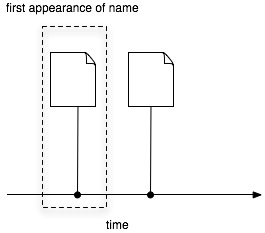
Realistically, given the number and type of documents there will be several "document" databases, such as GenBank and GBIF. For citations Mendeley looks very promising. If we had every taxonomic publication in Mendeley, tagged with scientific names, then we'd have the bibliography of life. Taxonomic nomenclators would be essentially out of business, given that their function is to store the first publication of a name. Given a complete bibliography we just create a timeline of usage for a name and note the earliest [name,document] pair:

timeline.jpgTaxonomy
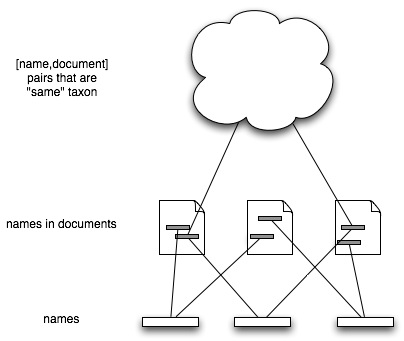
There are a few wrinkles to deal with. Firstly, names may have synonyms, lexical variants, etc. (the Patterson et al. paper has a nice example of this). Leaving aside lexical variants, what we want is a "view" of the [name,document] pairs that says this subset refer to the same thing (the "taxon concept").

concept.jpg

We can obsess with details in individual cases, but at web-scale there are only two ones that spring to mind. The first is the Catalogue of Life, the second is NCBI. The Catalogue of Life lists sets of names and reference that it regards as being the same thing, although it does unspeakable things to many of the references. In the case of NCBI the "concepts" would be the sets of DNA sequences and associated publications linked to the same taxonomy id. Whatever you think of the NCBI taxonomy, it is at least computable, in the sense that you could take a taxon and generate a list of publications 'about" that taxon.

So, we have names, [name,document] pairs, and sets of [name,document] pairs. Simples.

Linnaeus meets the Internet: PLoS + Botany = #fail

C2914D0E-13E9-4CA6-BE0A-7A8645BC6A72.jpgTo much fanfare (e.g., Nature News, "Linnaeus meets the Internet" doi:10.1038/news.2010.221), on May 5th PLoS ONE published Sandy Knapp's "Four New Vining Species of Solanum (Dulcamaroid Clade) from Montane Habitats in Tropical America" doi:10.1371/journal.pone.0010502. To quote the Nature News piece:
The paper represents the culmination of a campaign to institute the electronic publication of scientific names, a case Knapp and others have made in journals including Nature[doi:10.1038/446261a]. Allowing electronic publication should make accessing information easier for scientists worldwide — especially those in developing countries who may not have access to fully stocked libraries. This, in turn, will aid conservation efforts, Knapp says.

Given the profile of this paper, "...the first time new plant names have been published in a purely electronic journal and still complied with ICBN rules", you'd think the participants would ensure the electronic aspects of the publication worked. Sadly, this is not the case.

The four names in question have apparently been deposited in IPNI with the following LSID's:

  • Solanum aspersum: urn:lsid:ipni.org:names:77103633-1

  • Solanum luculentum: urn:lsid:ipni.org:names:77103634-1

  • Solanum sanchez-vegae: urn:lsid:ipni.org:names:77103635-1

  • Solanum sousae: urn:lsid:ipni.org:names:77103636-1


Today is May 6th. None of these names are returned by a search of IPNI, for example http://www.ipni.org/ipni/simplePlantNameSearch.do?find_wholeName= returns this:

ipni1.png

Resolving the LSID returns this:

<?xml version="1.0" encoding="UTF-8"?>
<rdf:RDF xmlns:xsi="http://www.w3.org/2001/XMLSchema-instance"
xmlns:dc="http://purl.org/dc/elements/1.1/"
xmlns:dcterms="http://purl.org/dc/terms/"
xmlns:tn="http://rs.tdwg.org/ontology/voc/TaxonName#"
xmlns:tm="http://rs.tdwg.org/ontology/voc/Team#"
xmlns:tcom="http://rs.tdwg.org/ontology/voc/Common#"
xmlns:p="http://rs.tdwg.org/ontology/voc/Person#"
xmlns:rdf="http://www.w3.org/1999/02/22-rdf-syntax-ns#"
xmlns:owl="http://www.w3.org/2002/07/owl#">
<tn:TaxonName rdf:about="urn:lsid:ipni.org:names:77103633-1">
<tcom:versionedAs rdf:resource="urn:lsid:ipni.org:names:77103633-1:1.2"/>
<tcom:Deleted>Yes</tcom:Deleted>
</tn:TaxonName>
</rdf:RDF>

Hmmm, so apparently this record has been "deleted"?

The paper also states that:
The IPNI LSIDs (Life Science Identifiers) can be resolved and the associated information viewed through any standard web browser by appending the LSID contained in this publication to the prefix http://ipni.org/.

This sentence mirrors similar ones in other PLoS ONE papers saying we can resolve ZooBank LSIDs by appending the LSID to http://zoobank.org (e.g., see doi:10.1371/journal.pone.0001787).

Thing is, URLs such as http://ipni.org/urn:lsid:ipni.org:names:77103633-1 return a 404 from Kew (any IPNI LSID I've tried does this).


Update As per Alan Paton's comment below, the http://ipni.org prefix now works.


So, to recap:

  1. The names aren't in IPNI

  2. The LSIDs state the record has been deleted

  3. The LSID's can't be resolved by the means stated in the paper

Now, I don't know what happened (perhaps IPNI wanted to hold off until the paper actually appeared before releasing the names), but the paper is out, the buzz in Nature is out, and IPNI doesn't have the resolver in place, yet alone the names.

Given the milestone this paper represents, and the fuss over the publication of the name Darwinius, you'd expect the bioinformatics side of it to be, you know, actually working. In these circumstances, how on Earth do we make the case that the LSID and name databasing side of taxonomic publication is useful?

Wikipedia and Gregg's paradox

Continuing the theme of taxonomic classification in Wikipedia, I'm perversely delighted that Wikipedia demonstrates Gregg's paradox so nicely.

1s2mges1n3b5q1bnvf5a3i4u8y_2009-05-31.jpgThe late John R. Gregg wrote several papers and a book exploring the logical structure of taxonomy. His 1954 book The language of taxonomy stimulated a debate a decade later in Systematic Zoology concerning what Buck and Hull (1966) (doi:10.2307/2411628) termed "Gregg's Paradox".

Gregg showed that if we (a) treat taxa as sets defined by extension (i.e., by listing all members), and (b) accept that two sets with exactly the same content must be the same set, then many biological classifications violate these premises because the same taxon may be assigned to multiple levels in the Linnean hierarchy. For example, the aardvark, Orycteropus afer, is the only extant species of the genus Orycteropus, which is the only extant member of the family Orycteropodidae, which in turn is the sole extant representative of the order Tubulidentata. Under Gregg's model, Tubulidentata, Orycteropodidae, and Orycteropus are all the same thing as they have exactly the same content (i.e., Orycteropus afer). Put another way, monotypic taxa are redundant and violate basic set theory. Gregg would argue that they should be eliminated.

aardvark.pngWikipedia illustrates this nicely. Wikipedia conforms to Gregg's model in that taxa are defined by extension (each taxon comprises one or more wiki pages), and if taxa have the same content only one taxon (typically that with the lowest taxonomic rank) has a page in Wikipedia. Put another way, if the aardvark is the sole representative of the Tubulidentata, then there is nothing that could be put on the Tubulidentata page that shouldn't also belong on the page for the aardvark. As a result, the page for the aardvark gives a full classification of this animal, but most taxa in the hierarchy don't have their own pages.

Responses

There are several possible responses to Gregg's paradox. One is to argue that taxa should be defined intentionally (i.e., on the basis of their characters), which was Buck and Hull's approach. Essentially, they were arguing that we could (somewhat arbitrarily) specify properties of Orycteropodidae that weren't shared by all Tubulidentata, and hence we are justified in keeping these taxa separate. Gregg himself was less than impressed by this argument (doi:10.2307/2412017).

Another approach is to suggest that we may discover taxa in the future that will, say, be members of Orycteropus but which aren't O. afer, and that the taxa between the rank suborder and species are placeholders for these discoveries. Indeed, in the case of the Tubulidentata there are extinct aardvarks (doi:10.1163/002829675x00137, doi:10.1016/j.crpv.2005.12.016, and doi:10.1111/j.1096-3642.2008.00460.x) that could be added to Wikipedia, thus justifying the creation of pages for the taxa that Gregg would have us eliminate.

Of course, Gregg's paradox is a consequence of having ranks and requiring each rank (or at least a reasonable subset of them) to exist in a classification. If we ignore ranks, then there's no reason to put any taxa between Afrotheria and Orycteropus afer. So, we could drop this requirement for having taxa at each rank or, of course, drop ranks altogether, which is one of the motivations behind phylogenetic classifications (e.g., the phylocode).

Implications for parsing Wikipedia

From a practical point of view, Gregg's paradox means that one has to be careful parsing Wikipedia Taxoboxes. As I've argued earlier, the simplest way to ensure that a classification is a tree is for each taxon to include a unique parent taxon. The simplest way to extract this for a taxon in a Wikipedia page would be to retrieve the taxon immediately above it in the classification (i.e., for Orycteropus afer this would be Orycteropus). But Orycteropus doesn't have a page in Wikipedia (OK, it does, but it's a redirect to the page for the aardvark). So, we have to go up the classification until we hit Afrotheria before we get a taxon page.

Personally I quite like the fact that a largely forgotten argument from the middle of the last century concerning logic and Linnean taxonomy seems relevant again.

Scientific citations in Wikipedia

wikipediaisaccuratecitationneeded.jpg
While thinking about measuring the quality of Wikipedia articles by counting the number of times they cite external literature, and conversely measuring the impact of papers by how many times they're cited in Wikipedia, I discovered, as usual, that somebody has already done it. I came across this nice paper by Finn Årup Nielsen (arXiv:0705.2106v1) (originally published in First Monday as a HTML document, I've embedded the PDF from arXiv below).

Nielsen retrieved 30,368 citations from Wikipedia, and summarised how many times each journal is cited within Wikipedia. He then compared this with a measure of citations within the scientific literature by multiplying the journal's impact factor by the total number of citations. In general there's a pretty good correlation.
1997-20088-1-PB.gif


What is striking to me is that
When individual journals are examined Wikipedia citations to astronomy journals stand out compared to the overall trend (Figure 2). Also Australian botany journals received a considerable number of citations, e.g., Nuytsia (101 [citations]), in part due to concerted effort for the genus Banksia, where several Wikipedia articles for Banksia species have reached "featured article" status.


In the diagram, note also that Australian Systematic Botany (ISSN 1030-1887), which has a impact factor of 1.351, is punching well above its weight in Wikipedia. What I want to find out is whether this is true for other taxonomic journals. Nielsen's study was based on a Wikipedia dump from 2 April 2007, and a lot has been added since then (and the journal Zootaxa has become a major publisher of new taxonomic names).

But what I'm also wondering is whether this is not a great opportunity for the taxonomic community. By responding to {{citation needed}}, we can improve the quality of Wikipedia, and increase the visibility of their work. Given that many Wikipedia taxon pages are in the top 10 Google hits {{citation needed}}, our work is but one click away from the Google results page. Instead of endlessly moaning about the low impact factor of taxonomic journals, we can actively do something that increases the quality and visibility of taxonomic information, and by extension, taxonomy itself.

Scientific citations in Wikipedia

Wikipedia taxonomy, the good, the bad, and the very ugly

In the previous post I suggested that a productive way to meet EOL's goal of a web page per taxon would be to build upon Wikipedia, rather than go it alone. In a nutshell the arguments were:

  1. Wikipedia has considerable traction and has some richly populated taxon pages

  2. The linked data community uses DBPedia.org as a core source of URIs for entities, as as DBPedia is derived from Wikipedia the later will be the core source of identifiers for taxa

To explore this a little further I grabbed two files from the 20090618 Wikipedia dump, namely page.sql and templatelinks.sql, and extracted page ids and titles for Wikipedia pages containing the Taxobox template. I then queried Wikipedia for the source for each of these pages, and tried to extract the taxonomic information from each page (a tedious and error-prone process at best).

I've put together a shockingly crude web page where you can browse the results (warning, this page is a 10 minute hack with little error checking).

There is some good news. There are over 120,000 taxon pages (I've not got an exact figure because the Taxobox template occurs on some pages that aren't taxon pages, such as documentation and user pages). Some pages are extensive (the largest page is Dinosaur for which the source text is 128K in size), and there are lots of links to external references (I counted 7205 distinct DOIs to papers and/or books, and 3248 distinct ISBNs). This represents a degree of external linkage that puts EOL to shame.

However, there are also some major problems. Firstly, Wikipedia does not have a single, internally consistent classification (i.e., the classification is not a tree). This is not unexpected, given that Wikipedia pages comprise semi-structured text that is (largely) manually entered. It's not a database. If it were, the simplest way to ensure consistency would be to have each child node include a pointer to its parent, and when we want a list of the children of the parent node we simply query the database ("what nodes have this node as their parent?"). Because Wikipedia isn't a database, authors have entered these two relationships ("has parent" and "has child") on different pages, and these often conflict. For a spectacular example of this, take a look at the page for Amphibia. When I scrapped Wikipedia I extracted the "has parent" link, as this is the simplest way to create a tree. This results in over 200 child taxa for Amphibia, yet the Wikipedia page for Amphibia lists only four child taxa. What appears to be happening is that many fossil taxa are being added to Wikipedia, and since we are often hazy about where they go in the tree, authors are listing their parent taxon as (in this case) "Amphibia". Given this direct link, they should also be listed as children of Amphibia (although, of course, that would make a mess of the Amphibia page). Perhaps the solution is to add a "incerta sedis" taxon page for each taxon, and make that the parent of all the taxa that we're aren't sure where to put. This would ensure consistency, but not make the current taxon pages unreadable.

Homonymy (the same name for different taxa) also raises it's ugly head. For example, the page for the crab family Latreilliidae lists the genus Latreillia, which is a fly. In this case, the fly genus Latreillia Robineau-Desvoidy, is a junior homonym of the crab genus Latreillia Roux (see http://biodiversitylibrary.org/page/12221111).

Finally, the page titles (which become the basis of DBPedia.org URIs) are a muddled mixture of common and scientific names.

So, what to do? Well, the idea of simply using Wikipedia as is isn't going to fly, it's too broken. We will have to contemplate a concerted effort to fix it (which will require using bots to clean up the inconsistencies). Another option (assuming that we like the Wiki-style environment) is to use a semantic wiki (see my earlier post), which constrains some of the possible markup, but retains a lot of the freedom that make wikis so powerful.

This isn't an argument for not using Wikipedia as such, it's arguably still much more informative than, say, EOL. It's just that it's showing signs of the limitations of free-form text entry. The trick is to find a way to combine the obvious strengths of this approach (ease of creating and editing pages, massive community support) with the more structured approach needed to avoid the internal inconsistencies that currently bedevil Wikipedia.

Taxonomy on a hard disk

This post is likely to seem somewhat off the wall, given the rush to getting everything in the cloud, but it's Friday, so let's give it a whirl.

One idea I've been toying with is dispensing with relational databases, wikis, etc. and just storing taxonomic data using files and folders on a disk. There are several reasons for this:

  • File system naturally enforces hierachy

  • There are existing systems for putting files and folders under version control (e.g., CVS, Subversion, git)

  • Native text and image editors handily beat web-based ones

  • Some file systems have great tools for searching on metadata (e.g., "smart folders" and Spotlight on Mac OS X)

  • Some of the visualisations that we would like for classifications (such as treemaps) already exist in very polished form for viewing file systems

By way of background, I've been prompted to think along these lines by David Shorthouse's observation that we could place a taxonomic hierachy under version control (e.g., github) and deal with changes/multiple versions that way. I've also been inspired by tools such as couchdb, which is a schema-less database that one can talk to directly via HTTP. This reflects a trend where people are starting to exploit the untapped power in some basic, well-known technologies (such as the HTTP protocol), avoiding the need for lots of middle-ware in the process (why write stuff in Java/Ruby/PHP, etc. when HTTP GET, PUT, POST, etc. cover the bases?). Another inspiration is Dropbox, which enables replication of files across multiple machines and the web. The web interface to Dropbox is very clean, and essentially mirrors the local folder structure.

So, in some ways this probably sounds silly, and closely resembles the naive way many of us started making digital versions of taxonomies, and it will have many database people rolling their eyes and muttering about "data consistency" and "queries". But, a key thing to remember is that the file system is a database that resides under a graphical user interface, and it maintains some forms of consistency that classical relational databases are poor at handling. For example, file systems enforce hierarchical consistency (if I move a folder to another folder, all the files and folders below that folder move as well). Of course, we can program this with a relational database, but our track record in doing this is pretty miserable. I've found inconsistencies in versions of ITIS (haven't checked recently), and last years' Catalogue of Life database had all sorts of orphans lurking in the tree table.

Then there's the GUI. If I write a taxonomic database in the classical way, I need to write code to talk to the database, edit records, support user authentication, data versioning, etc. If I use the file system, I get this pretty much for free. Authentication? It's called the login screen. Versioning? I put it in a public repository like Google Code or github, and that takes care of that (plus I get online authentication for free). Editing? Well, I can drag and drop items onto folders, and I can open them in native editors.

What I envisage is replicating a taxonomic hierarchy on disk, and representing key-value pairs of attributes (such as taxon name authorship, bibliographic details) as text files where the name of the file is the key (e.g., publishedIn) and the content of the file is the value (e.g., doi:10.1590/S0101-81752005000300004). I could add images and PDFs, and the neat thing is that they have lots of useful metadata embedded inside (where, arguably, it belongs).

I'm also toying with the idea of using symbolic links (Windows users, look away now) to represent relationships such as basionym links to original names.

This is all a bit half-baked at present, but it seems worth pursing. One could argue that having a full taxonomic hierachy is overkill (and raises the issue of which one to use), but binomial names are themselves hierachical (species epithet nested inside genus name), so we need some degree of hierarchy anyway. I like the idea that copying a folder called "behreae" in the folder "Pinnixa" and placing the copy under "Austinixa", then within Austinixa/behreae adding a symbolic link to Pinnixa/behreae pretty much takes care of synonomy. I also like the idea that one could download an entire taxonomy, and using just the native tools on your computer, edit and annotate it, then merge changes with a remote copy. It makes mamnaging the data little different from writing code.

In practise we'll want to add some things. It would be nice to have a web interface for browsing, but this could be as trivial as having a script that read the contents of a folder, display folders as HTML links, and list the files (keys) and their contents (values) in the web page.

Perhaps this is a little silly, but I like the idea of having data on my machine that is trivially easy to edit. I also like the idea of getting functionality for free, rather than having to invent it from scratch.