Search this keyword

Showing posts with label DOI. Show all posts

BHL is duplicating DOIs because it doesn't know about articles

Quick note that as much as I like that the Biodiversity Heritage Library is using DOIs, they are generating them for publications that already have them (or are acquiring them from other sources). For example, here are the two DOIs for the same article (formatted using the DOI Citation Formatter), one from BHL and one from the Smithsonian:

Springer, V. G. (1982). Pacific Plate biogeography, with special reference to shorefishes / Victor G. Springer. Smithsonian Institution. doi:10.5962/bhl.title.37141
Springer, V. G. (1982). Pacific Plate biogeography, with special reference to shorefishes. Smithsonian Contributions to Zoology, (367), 1–182. doi:10.5479/si.00810282.367


The BHL DOI resolves to a page in BHL, the other DOI resolves to the a page in the Smithsonian Digital Repository (this article also has the handle hdl:10088/5222).

Now this is a problem, because DOIs are meant to be unique: one article, one DOI. I've encountered duplicates elsewhere, but in these cases one should be an alias of the other. In the example above, the DOIs resolve to different locations. If you are just after the content this isn't a huge problem, but if, say, you were using the DOI to uniquely identify the publication (say, in a database) you have a problem: which DOI to choose? If you and I choose differently then we will make statements about the same article but be unaware of that sameness.

Much of this problem arises because BHL has no concept of articles. Most articles are likely to reside within scanned volumes of a journal, but some articles (e.g., monographs) may be treated a single title by BHL, and each BHL title now gets a DOI.

I know that handling articles is on BHL's radar, but it because it hasn't tackled it yet we are going to have cases where BHL DOIs duplicate existing DOIs. In these cases, BHL may have to make their DOI an alias of the other DOI.

Figshare and F1000 integrate data into publication: could TreeBASE do the same?

Spiralsticker reasonably smallQuick thoughts on the recent announcement by figshare and F1000 about the new journals being launched on the F1000 Research site. The articles being published have data sets embedded as figshare widgets in the body of the text, instead of being, say, a static table. For example, the article:

Oliver, G. (2012). Considerations for clinical read alignment and mutational profiling using next-generation sequencing. F1000 Research. doi:10.3410/f1000research.1-2.v1
has a widget that looks like this:

Widget
You can interact with this widget to view the data. Because the data are in figshare those data are independently citable, e.g. the dataset "Simulated Illumina BRCA1 reads in FASTQ format" has a DOI http://dx.doi.org/10.6084/m9.figshare.92338.

Now, wouldn't it be cool if TreeBASE did something similar? Imagine if uploading trees to TreeBASE were easy, and that you didn't have to have published yet, you just wanted to store the trees and make them citable. Imagine if TreeBASE had a nice tree viewer (no, not a Java applet, a nice viewer that uses SVG, for exmaple). Imagine if you could embed that tree viewer as a widget when you published your results. It's a win all round. People have an incentive to upload trees (nice viewer, place to store them, and others can cite the trees because they'd have DOIs). TreeBASE builds its database a lot more quickly (make it dead easy to upload tree), and then as more publishers adopt this style of publishing TreeBASE is well placed to provide nice visualisations of phylogenies pre-packaged, interactive, and citable. And let's not stop there, how about a nice alignment viewer? Perhaps this is the something currently rather moribund PLoS Currents Tree of Life could think about supporting?

Citations, Social Media & Science

Quick note that Morgan Jackson (@BioInFocus) has written nice blog post Citations, Social Media & Science inspired by the fact that the following paper:

Kwong, S., Srivathsan, A., & Meier, R. (2012). An update on DNA barcoding: low species coverage and numerous unidentified sequences. Cladistics, no–no. doi:10.1111/j.1096-0031.2012.00408.x

cites my "Dark taxa" in the body of the text but not in the list of literature cited. This prompted some discussion of DOIs and blog posts on Twitter:


Read Morgan's post for more on this topic. While I personally would prefer to see my blog posts properly cited in papers like doi:10.1111/j.1096-0031.2012.00408.x, I suspect the authors did what they could given current conventions (blogs lack DOIs, are treated differently from papers, and many publishers cite URLs in the text, not the list of references cited). If we can provide DOIs (ideally from CrossRef so we become part of the regular citation network), suitable archiving, and — most importantly — content that people consider worthy of citation then perhaps this practice will change.

UUIDs

Just for future reference:

Quick thoughts on specimen identifiers

Based on recent discussions my sense is that our community will continue to thrash the issue of identifiers to death, repeating many of the debates that have gone on (and will go on) in other areas. To be trite, it seems to me we have three criteria: cheap, resolvable, and persistent. We get to pick two.

Cheap and resolvable means URLs, which everybody is nervous about because they break. They don't have to break, but for a bunch of reasons they do.

Cheap and persistent means things like Darwin Triplet Core or URNs. You can write things on paper and they will persist (the Biodiversity Heritage Library shows us that), but how in the digital era do we do anything with this? If it's not resolvable what, exactly, is the point? We tried URNs — even ones that were resolvable (LSIDs) — and that was a disaster (we learnt a lot, but what a mess).

Resolvable and persistent. This is where technologies such as DOIs reside. If every specimen had a DOI would we still be having this discussion? We'd have a resolvable identifier that is resistant to change (including loss of museum domain names, specimens moving to new institutions, etc.), and one that is already in use by CrossRef and DataCite, and will also play ball with linked data folks.

In practical terms, what if we had a convention that each collection gets it's own DOI prefix "10.nnnn", after which it appends whatever specimen identifier makes sense (and is unique within that collection).

The bulk of specimen identifiers in the wild are of the form "Institution" "Catalogue number", e.g. ANSP 332467 (from the example I discussed in BHL and GBIF as biomedical databases).

If we wrote this as a DOI of the form <doi prefix>/Collection/InstitutionCatalogue number then we'd have identifiers that (in part) matched what most people would expect to see. In the example above we would have something like:

10.nnnnn/MAL/ANSP332467

where "MAL" is the acronym for the Malacology collection. This is pretty close to "ANSP 332467", is human friendly, but would also be resolvable. It also carries limited branding, so if the specimen was moved from it's current collection to a new institution, people wouldn't get too upset by the presence of "ANSP"). It would also help make the links between specimen codes and DOIs. We couldn't rely on 10.nnnnn/MAL/ANSP332467 being a specimen in the Academy of Natural Sciences's malacological collection, but it would be a good place to start looking.

As I've argued before, we could centralise the minting of these identifiers using GBIF, but do it in a such a way that host institutions could assume responsibility for it if and when they are able (i.e., initially GBIF is responsible for managing the DOI prefixes for each institution, with the option for institutions to do this). The beauty of identifiers like DOIs is that from the user's perspective the identifier is unchanged.

I'm hoping we'll make some progress on this in the coming months...

DNA Barcoding, the Darwin Core Triplet, and failing to learn from past mistakes

Banner05
Given various discussions about identifiers, dark taxa, and DNA barcoding that have been swirling around the last few weeks, there's one notion that is starting to bug me more and more. It's the "Darwin Core triplet", which creates identifiers for voucher specimens in the form <institution-code>:<OPTIONAL collection-code>:<specimen-id>. For example,

MVZ:Herp:246033

is the identifier for specimen 246033 in the Herpetology collection of the Museum of Vertebrate Zoology (see http://arctos.database.museum/guid/MVZ:Herp:246033).

On the face of it this seems a perfectly reasonable idea, and goes some way towards addressing the problem of linking GenBank sequences to vouchers (see, for example, http://dx.doi.org/10.1016/j.ympev.2009.04.016, preprint at PubMed Central). But I'd argue that this is a hack, and one which potentially will create the same sort of mess that citation linking was in before the widespread use of DOIs. In other words, it's a fudge to postpone adopting what we really need, namely persistent resolvable identifiers for specimens.

In many ways the Darwin Core triplet is analogous to an article citation of the form <journal>, <volume>:<starting page>. In order to go from this "triplet" to the digital version of the article we've ended up with OpenURL resolvers, which are basically web services that take this triple and (hopefully) return a link. In practice building OpenURL resolvers gets tricky, not least because you have to deal with ambiguities in the <journal> field. Journal names are often abbreviated, and there are various ways those abbreviations can be constructed. This leads to lists of standard abbreviations of journals and/or tools to map these to standard identifiers for journals, such as ISSNs.

This should sound familiar to anybody dealing with specimens. Databases such as the Registry of Biological Repositories and the Biodiversity Collectuons Index have been created to provide standardised lists of collection abbreviations (such as MVZ = Museum of Vertebrate Zoology). Indeed, one could easily argue that the what we need is an OpenURL for specimens (and I've done exactly that).

As much as there are advantages to OpenURL (nicely articulated in Eric Hellman's post When shall we link?), ultimately this will end in tears. Linking mechanisms that depend on metadata (such as museum acronyms and specimen codes, or journal names) are prone to break as the metadata changes. In the case of journals, publishers can rename entire back catalogues and change the corresponding metadata (see Orwellian metadata: making journals disappear), journals can be renamed, merged, or moved to new publishers. In the same way, museums can be rebranded, specimens moved to new institutions, etc. By using a metadata-based identifier we are storing up a world of hurt for someone in the future. Why don't we look at the publishing industry and learn from them? By having unique, resolvable, widely adopted identifiers (in this case DOIs) scientific publishers have created an infrastructure we now take for granted. I can read a paper online, and follow the citations by clicking on the DOIs. It's seamless and by and large it works.

On could argue that a big advantage of the Darwin Core triplet is that it can identify a specimen even if it doesn't have a web presence (which is another way of saying that maybe it doesn't have a web presence now, but it might in the future). But for me this is the crux of the matter. Why don't these specimens have a web presence? Why is it the case that biodiversity informatics has failed to tackle this? It seems crazy that in the context of digital data (DNA sequences) and digital databases (GenBank) we are constructing unresolvable text strings as identifiers.

But, of course, much of the specimen data we care about is online, in the form of aggregated records hosted by GBIF. It would be technically trivial for GBIF to assign a decent identifier to these (for example, a DOI) and we could complete the link between sequence and specimen. There are ways this could be done such that these identifiers could be passed on to the home institutions if and when they have the infrastructure to do it (see GBIF and Handles: admitting that "distributed" begets "centralized").

But for now, we seem determined to postpone having resolvable identifiers for specimens. The Darwin Core triplet may seem a pragmatic solution to the lack of specimen identifiers, but it seems to me it's simply postponing the day we actually get serious about this problem.


Mapping names to literature: closing in on 250,000 names

Following on from my earlier post Linking taxonomic names to literature: beyond digitised 5×3 index cards I've been slowly updating my latest toy:

http://iphylo.org/~rpage/itaxonAlpheus

This site displays a database mapping over 200,000 animal names to the primary literature, using a mix of identifiers (DOIs, Handles, PubMed, URLs) as well as links to freely available PDFs where they are available. Lots still to do as about a third of the 1.5 million names in the database have citations that my code hasn't been able to parse. There are also lots of gaps that need to be filled in, for example missing DOIs or PubMed identifiers, and a lot of the earlier names are linked by "microcitations" to names, and I'll need to handle those (using code from my earlier project Nomenclator Zoologicus meets Biodiversity Heritage Library: linking names directly to literature).

The mapping itself is stored in a database that I'm constantly editing, so this is far from production quality, but I've found it eye-opening just how much literature is available. There is a lot of scope for generating customised lists of papers, for example, primary taxonomic sources for taxa currently on the IUCN Red List, or those taxa which have sequences in GenBank (building on the mapping of NCBI taxa onto Wikipedia). Given that a lot of the relevant literature is in BHL, or available as PDFs, we could do some data mining, such as extracting geographical coordinates, taxonomic names, and citations. And if linked data is your thing, the 110,000 DOIs and nearly 9,000 CiNiii URLs all serve RDF (albeit not without a few problems).

I've set a "goal" of having 250,000 names mapped to the primary literature, at which point the database interface will get some much-needed attention, but for now have a look for your favourite animal and see if it's original description has been digitised.

BHL needs to engage with publishers (and EOL needs to link to primary literature)

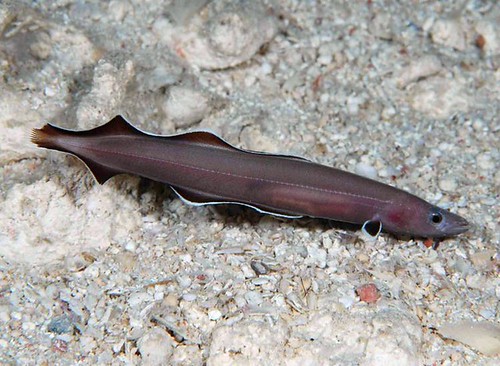
Browsing EOL I stumbled upon the recently described fish Protoanguilla palau, shown below in an image by rairaiken2011:
Palauan Primitive Cave Eel

Two things struck me, the first is that the EOL page for this fish gives absolutely no clue as to where you would to find out more about this fish (apart from an unclickable link to the Wikipedia page http://en.wikipedia.org/wiki/Protoanguilla - seriously, a link that isn't clickable?), despite the fact this fish has been recently described in an Open Access publication ("A 'living fossil eel (Anguilliformes: Protanguillidae, fam. nov.) from an undersea cave in Palau", http://dx.doi.org/10.1098/rspb.2011.1289).

Now that I've got my customary grumble about EOL out of the way, let's look at the article itself. On the first page of the PDF it states:
This article cites 29 articles, 7 of which can be accessed free
http://rspb.royalsocietypublishing.org/content/early/2011/09/16/rspb.2011.1289.full.html#ref-list-1

So 22 of the articles or books cited in this paper are, apparently, not freely available. However, looking at the list of literature cited it becomes obvious that rather more of these citations are available online than we might think. For example, there are articles that are in the Biodiversity Heritage Library (BHL), e.g.


Then there are articles that are available in other digitising projects

  • Hay O. P. 1903 On a collection of Upper Cretaceous fishes from Mount Lebanon, Syria, with descriptions of four new genera and nineteen new species. Bull. Am. Mus. Nat. Hist. N. Y. 19, 395–452. http://hdl.handle.net/2246/1500
  • Nelson G. J. 1966 Gill arches of fishes of the order Anguilliformes. Pac. Sci. 20, 391–408. http://hdl.handle.net/10125/7805

Furthermore, there are articles that aren't necessarily free, but which have been digitised and have DOIs that have been missed by the publisher, such as the Regan paper above, and


So, the Proceedings of the Royal Society has underestimated just how many citations the reader can view online. The problem, of course, is how does a publisher discover these additional citations? Some have been missed because of sloppy bibliographic data. The missing DOIs are probably because the Regan citation lacks a volume number, and the Trewavas paper uses a different volume number to that used by Wiley (who digitised Proc. Zool. Soc. Lond.). But the content in BHL and other digital archives will be missed because finding these is not part of a publisher's normal workflow. Typically citations are matched by using services ultimately provided by CrossRef, and the bulk of BHL content is not in CrossRef.

So it seems there's an opportunity here for someone to provide a service for publishers that adds value to their content in at least three ways:
  1. Add missing DOIs due to problematic citations for older literature
  2. Add links to BHL content
  3. Add links to content in additional digitisation projects, such as journal archives in DSpace respositories

For readers this would enhance their experience (more of the literature becomes accessible to them), and for BHL and the repositories it will drive more readers to those repositories (how many people reading the paper on Protoanguilla palau have even heard of BHL?). I've said most of this before, but I really think there's an opportunity here to provide services to the publishing industry, and we don't seem to be grasping it yet.

Linking taxonomic names to literature: beyond digitised 5×3 index cards

Pubs
Tomorrow is the Anchoring Biodiversity Information: From Sherborn to the 21st century and beyond meeting. It should be an interesting gathering, albeit overshadowed by the sudden death of Frank Bisby.

I'm giving a talk entitled "Open Taxonomy", in which I argue that most taxonomic databases are little more than digitised collections of 5×3 index cards, where literature is treated as dumb citation strings rather than as resources with digital identifiers. To make the discussion concrete I've created a mapping between the Index to Organism Names (ION) database and a range of bibliographic sources, such as CrossRef (for DOIs), BioStor, JSTOR, etc.

This mapping is online at http://iphylo.org/~rpage/itaxon/.

So far I've managed to link some 200,000 animal names to a literature identifier, and a good fraction of these articles are freely available, either as images in BioStor and Gallica (for I've created a simple viewer) or as PDFs (which are displayed using Google Docs.

Some examples are:


The site is obviously a work in progress, and there's a lot to be done to the interface, but I hope it conveys the key point: a significant fraction of the primary taxonomic literature is online, and we should be linking to this. The days of digitised 5×3 index cards are past.


Reflections on the TDWG RDF "Challenge"

This is a follow up to my previous post TDWG Challenge - what is RDF good for? where I'm being, frankly, a pain in the arse, and asking why we bother with RDF? In many ways I'm not particularly anti-RDF, but it bothers me that there's a big disconnect between the reasons we are going down this route and how we are actually using RDF. In other words, if you like RDF and buy the promise of large-scale data integration while still being decentralised ("the web as database"), then we're doing it wrong.

As an aside, my own perspective is one of data integration. I want to link all this stuff together so I can follow a path through multiple datasets and extract the information I want. In other words, "linked data" (little "l", little "d"). I'm interested in fairly light weight integration, typically through shared identifiers. There is also integration via ontologies, which strikes me as a different, if related, problem, that in many ways is closer to the original vision of the Semantic Web as a giant inference engine. I think the concerns (and experience) of these two communities are somewhat different. I don't particularly care about ontologies, I want key-value pairs and reusable identifiers so I can link stuff together. If, for example, you're working on something like Phenoscape, then I think you have a rather more circumscribed set of data, with potentially complicated interrelationships that you want to make inferences on, in which case ontologies are your friend.

So, I posted a "challenge". It wasn't a challenge so much as a set of RDF to play with. What I'm interested in is seeing how easily we can string this data together to learn stuff. For example, using the RDF I posted earlier here is a table listing the name, conservation status, publication DOI and date, and (where available) image from Wikipedia for frogs with sequences in GenBank.

SpeciesStatusDOIYear describedImage
Atelopus nanayCRhttp://dx.doi.org/10.1655/0018-0831(2002)058[0229:TNSOAA]2.0.CO;22002
Eleutherodactylus mariposaCRhttp://dx.doi.org/10.2307/14669621992
Phrynopus kauneorumCRhttp://dx.doi.org/10.2307/15659932002
Eleutherodactylus eunasterCRhttp://dx.doi.org/10.2307/15630101973
Eleutherodactylus amadeusCRhttp://dx.doi.org/10.2307/14455571987
Eleutherodactylus lamprotesCRhttp://dx.doi.org/10.2307/15630101973
Churamiti maridadiCRhttp://dx.doi.org/10.1080/21564574.2002.96354672002
Eleutherodactylus thorectesCRhttp://dx.doi.org/10.2307/14453811988
Eleutherodactylus apostatesCRhttp://dx.doi.org/10.2307/15630101973
Leptodactylus silvanimbusCRhttp://dx.doi.org/10.2307/15636911980
Eleutherodactylus sciagraphusCRhttp://dx.doi.org/10.2307/15630101973
Bufo chavinCRhttp://dx.doi.org/10.1643/0045-8511(2001)001[0216:NSOBAB]2.0.CO;22001
Eleutherodactylus fowleriCRhttp://dx.doi.org/10.2307/15630101973
Ptychohyla hypomykterCRhttp://dx.doi.org/10.2307/36720601993
Hyla suweonensisDDhttp://dx.doi.org/10.2307/14441381980
Proceratophrys concavitympanumDDhttp://dx.doi.org/10.2307/15654122000
Phrynopus bufoidesDDhttp://dx.doi.org/10.1643/CH-04-278R22005
Boophis periegetesDDhttp://dx.doi.org/10.1111/j.1096-3642.1995.tb01427.x1995
Phyllomedusa duellmaniDDhttp://dx.doi.org/10.2307/14446491982
Boophis liamiDDhttp://dx.doi.org/10.1163/1568538033224407722003
Hyalinobatrachium ignioculusDDhttp://dx.doi.org/10.1670/0022-1511(2003)037[0091:ANSOHA]2.0.CO;22003
Proceratophrys cururuDDhttp://dx.doi.org/10.2307/14477121998
Amolops bellulusDDhttp://dx.doi.org/10.1643/0045-8511(2000)000[0536:ABANSO]2.0.CO;22000
Centrolene bacatumDDhttp://dx.doi.org/10.2307/15645281994
Litoria kumaeDDhttp://dx.doi.org/10.1071/ZO030082004
Phrynopus pesantesiDDhttp://dx.doi.org/10.1643/CH-04-278R22005
Gastrotheca galeataDDhttp://dx.doi.org/10.2307/14436171978
Paratelmatobius cardosoiDDhttp://dx.doi.org/10.2307/14479761999
Rhacophorus catamitusDDhttp://dx.doi.org/10.1655/0733-1347(2002)016[0046:NAPKPF]2.0.CO;22002
Huia melasmaDDhttp://dx.doi.org/10.1643/CH-04-137R32005
Telmatobius vilamensisDDhttp://dx.doi.org/10.1655/0018-0831(2003)059[0253:ANSOTA]2.0.CO;22003
Callulina kisiwamsituENhttp://dx.doi.org/10.1670/209-03A2004
Arthroleptis nikeaeENhttp://dx.doi.org/10.1080/21564574.2003.96354862003
Eleutherodactylus amplinymphaENhttp://dx.doi.org/10.1139/z94-2971994
Eleutherodactylus glaphycompusENhttp://dx.doi.org/10.2307/15630101973
Bufo tacanensisENhttp://dx.doi.org/10.2307/14397001952
Phrynopus brackiENhttp://dx.doi.org/10.2307/14458261990
Telmatobius sibiricusENhttp://dx.doi.org/10.1655/0018-0831(2003)059[0127:ANSOTF]2.0.CO;22003
Cochranella macheENhttp://dx.doi.org/10.1655/03-742004
Eleutherodactylus melacaraENhttp://dx.doi.org/10.2307/14669621992
Plectrohyla glandulosaENhttp://dx.doi.org/10.2307/14410461964
Aglyptodactylus laticepsENhttp://dx.doi.org/10.1111/j.1439-0469.1998.tb00775.x1998
Eleutherodactylus glamyrusENhttp://dx.doi.org/10.2307/15656641997
Gastrotheca trachycepsENhttp://dx.doi.org/10.2307/15643751987
Eleutherodactylus grahamiENhttp://dx.doi.org/10.2307/15639291979
Litoria havinaLChttp://dx.doi.org/10.1071/ZO99302251993
Crinia ripariaLChttp://dx.doi.org/10.2307/14407941965
Litoria longirostrisLChttp://dx.doi.org/10.2307/14431591977
Osteocephalus mutaborLChttp://dx.doi.org/10.1163/1568538023208776092002
Leptobrachium nigropsLChttp://dx.doi.org/10.2307/14409661963
Pseudis tocantinsLChttp://dx.doi.org/10.1590/S0101-817519980004000111998
Mantidactylus argenteusLChttp://dx.doi.org/10.1111/j.1096-3642.1919.tb02128.x1919
Aglyptodactylus securiferLChttp://dx.doi.org/10.1111/j.1439-0469.1998.tb00775.x1998
Pseudis cardosoiLChttp://dx.doi.org/10.1163/1568538005072642000
Uperoleia inundataLChttp://dx.doi.org/10.1071/AJZS0791981
Litoria pronimiaLChttp://dx.doi.org/10.1071/ZO99302251993
Litoria paraewingiLChttp://dx.doi.org/10.1071/ZO97602831976
Philautus aurifasciatusLChttp://dx.doi.org/10.1163/156853887X000361987
Proceratophrys avelinoiLChttp://dx.doi.org/10.1163/156853893X001561993
Osteocephalus deridensLChttp://dx.doi.org/10.1163/1568538005075252000
Gephyromantis boulengeriLChttp://dx.doi.org/10.1111/j.1096-3642.1919.tb02128.x1919
Crossodactylus caramaschiiLChttp://dx.doi.org/10.2307/14469071995
Rana yavapaiensisLChttp://dx.doi.org/10.2307/14453381984
Boophis lichenoidesLChttp://dx.doi.org/10.1163/156853898X000251998
Megistolotis lignariusLChttp://dx.doi.org/10.1071/ZO97901351979
Ansonia endauensisNEhttp://dx.doi.org/10.1655/0018-0831(2006)62[466:ANSOAS]2.0.CO;22006
Ansonia kraensisNEhttp://dx.doi.org/10.2108/zsj.22.8092005
Arthroleptella landdrosiaNThttp://dx.doi.org/10.2307/15653592000
Litoria jungguyNThttp://dx.doi.org/10.1071/ZO020692004
Phrynobatrachus phyllophilusNThttp://dx.doi.org/10.2307/15659252002
Philautus ingeriVUhttp://dx.doi.org/10.1163/156853887X000361987
Gastrotheca dendronastesVUhttp://dx.doi.org/10.2307/14450881983
Hyperolius cystocandicansVUhttp://dx.doi.org/10.2307/14439111977
Boophis sambiranoVUhttp://dx.doi.org/10.1080/21564574.2005.96355202005
Ansonia torrentisVUhttp://dx.doi.org/10.1163/156853883X000211983
Telmatobufo australisVUhttp://dx.doi.org/10.2307/15630861972
Stefania coxiVUhttp://dx.doi.org/10.1655/0018-0831(2002)058[0327:EDOSAH]2.0.CO;22002
Oreolalax multipunctatusVUhttp://dx.doi.org/10.2307/15648281993
Eleutherodactylus guantanameraVUhttp://dx.doi.org/10.2307/14669621992
Spicospina flammocaeruleaVUhttp://dx.doi.org/10.2307/14477571997
Cycloramphus acangatanVUhttp://dx.doi.org/10.1655/02-782003
Leiopelma pakekaVUhttp://dx.doi.org/10.1080/03014223.1998.95175541998
Rana okaloosaeVUhttp://dx.doi.org/10.2307/14448471985
Phrynobatrachus uzungwensisVUhttp://dx.doi.org/10.1163/156853883X000301983


This is a small fraction of the frog species actually in GenBank because I've filtered it down to those that have been linked to Wikipedia (from where we get the conservation status) and which were described in papers with DOIs (from which we get the date of description).

I generated this result using this SPARQL query on a triple store that had the primary data sources (Uniprot, Dbpedia, CrossRef, ION) loaded, together with the all-important "glue" datasets that link ION to CrossRef, and Uniprot to Dbpedia (see previous post for details):


PREFIX rdf: <http://www.w3.org/1999/02/22-rdf-syntax-ns#>
PREFIX rdfs: <http://www.w3.org/2000/01/rdf-schema#>
PREFIX dbpedia-owl: <http://dbpedia.org/ontology/>
PREFIX uniprot: <http://purl.uniprot.org/core/>
PREFIX tdwg_tn: <http://rs.tdwg.org/ontology/voc/TaxonName#>
PREFIX tdwg_co: <http://rs.tdwg.org/ontology/voc/Common#>
PREFIX dcterms: <http://purl.org/dc/terms/>

SELECT ?name ?status ?doi ?date ?thumbnail
WHERE {
?ncbi uniprot:scientificName ?name .
?ncbi rdfs:seeAlso ?dbpedia .
?dbpedia dbpedia-owl:conservationStatus ?status .
?ion tdwg_tn:nameComplete ?name .
?ion tdwg_co:publishedInCitation ?doi .
?doi dcterms:date ?date .

OPTIONAL
{
?dbpedia dbpedia-owl:thumbnail ?thumbnail
}
}
ORDER BY ASC(?status)


This table doesn't tell us a great deal, but we could, for example, graph date of description against conservation status (CR=critical, EN=endangered, VU=vulnerable, NT=not threatened, LC=least concern, DD=data deficient):
Chart
In other words, is it the case that more recently described species are more likely to be endangered than taxa we've known about for some time (based on the assumption that we've found all the common species already)? We could imagine extending this query to retrieve sequences for a class of frog (e.g., critically endangered) so we could compute a measure population genetic variation, etc. We shouldn't take the graph above too seriously because it's based on small fraction of the data, but you get the idea. As more frog taxonomy goes online (there's a lot of stuff in BHL and BioStor, for example) we could add more dates and build a dataset worth analysing properly.

It seems to me that these should be fairly simple things to do, yet they are the sort of thing that if we attempt today it's a world of hurt involving scripts, Excel, data cleaning, etc. before we can do the science.

The thing is, without the "glue" files mapping identifiers across different databases even this simple query isn't possible. Obviously we have no say in how many organisations publish RDF, but within the biodiversity informatics community we should make every effort to use external identifiers wherever possible so that we can make these links. This is the core of my complaint. If we are using RDF to foster data integration so we can query across the diverse data sets that speak to biodiversity, then we are doing it wrong.

Update
Here is a nice visualisation of this dataset from @orovellotti (original here), made using ecoRelevé:

AcNbdh2CMAA3ysc png large

TDWG Challenge - what is RDF good for?

Last month, feeling particularly grumpy, I fired off an email to the TDWG-TAG mailing list with the subject Lobbing grenades: a challenge. Here's the email:
It's morning and the coffee hasn't quite kicked in yet, but reading through recent TDWG TAG posts, and mindful of the upcoming meeting in New Orleans (which sadly I won't be attending) I'm seeing a mismatch between the amount of effort being expended on discussions of vocabularies, ontologies, etc. and the concrete results we can point to.

Hence, a challenge:

"What new things have we learnt about biodiversity by converting biodiversity data into RDF?"

I'm not saying we can't learn new things, I'm simply asking what have we learnt so far?

Since around 2006 we have had literally millions of triples in the wild (uBio, ION, Index Fungorum, IPNI, Catalogue of Life, more recently Biodiversity Collections Index, Atlas of Living Australia, World Register of Marine Species, etc.), most of these using the same vocabulary. What new inferences have we made?

Let's make the challenge more concrete. Load all these data sources into a triple store (subchallenge - is this actually possible?). Perhaps add other RDF sources (DBpedia, Bio2RDF, CrossRef). What novel inferences can we make?

I may, of course, simply be in "grumpy old arse" mode, but we have millions of triples in the wild and nothing to show for it. I hope I'm not alone in wondering why...

In the context of the TDWG meeting (happening as we speak and which I'm following via Twitter, hashtag #tdwg) Joel Sachs asked me whether I had any specific data in mind that could form the basis of a discussion. So, here goes. I've assembled some small RDF data sets that it might be fun to play with. Each data set is for frogs, and I've divided them into two sets.

Primary data
These data sets are essentially unmodified RDF fetched from data providers:
  • uniprot.rdf Uniprot RDF for frogs in GenBank
  • ion.rdf Index of Organism Names (ION) RDF for taxonomic names for frogs (filtered to just those names that are also in GenBank, the RDF comes from ION LSIDs)
  • crossref.rdf CrossRef RDF for DOIs for publications that published new frog names (obtaining using CrossRef's support for Linked Data for DOIs)
  • dbpedia.rdf Dbpedia RDF for frogs in GenBank (Update 2011-10-20: the dbpedia.rdf file is a bit big, so here is subset.rdf which has just the conservation status and thumbnail image)


These sources give us information on genomics (at least, they tell us which taxa have been sequenced), where and when the original taxonomic description was published, and by whom, as well as some information on conservation status and what the frog looks like (via Dbpedia). Ideally we just load these files into a triple store and then ask a bunch of questions, such as what is the conservation status of frogs sequenced in Genbank?, is there correlation between the conservation status of a frog and the date it was discovered?, who has described the most frog species?, etc.

My contention is that actually we can't do any of this because the data is siloed due to the lack of shared identifiers and vocabularies (I suspect that there is not a single identifier any of these files share). The only way we can currently link these data sets together is by shared string literals (e.g., taxonomic names), in which case why bother with RDF? So my first challenge is to see whether any of the questions I've just listed can actually be tackled using this data.

Glue
In a slightly more constructive mode, to see if we can make progress I'm providing some additional RDF files, based on projects I'm working on to link data together. These files may help provide some of the missing "glue" to connect these data sets.

  • linkout.rdf The list of links between NCBI and Dbpedia (based on mapping in iPhylo LinkOut)
  • ion_doi.rdf A subset of publications listed in ION have DOIs, this file links the corresponding ION LSIDs to those DOIs (this file is from an ongoing project mapping names to primary literature)


The first file links the ION and CrossRef RDF, so we could start to ask questions about dates of discovery, who described what species, etc.. The second file links NCBI taxon ids (in this case in the form of UniProt URIs) to Wikipedia (in the form of Dbpedia URIs). Dbpedia has information on conservation status, and some frogs will also have pictures, so we can start to join genomics to conservation, as well as make some visualisations.

Update
I've now added another RDF file for 1000 georeferenced GenBank sequences for frogs. The file is genbank.rdf. This file is generated from a local, processed version of EMBL, and uses a mixture of Dublin Core and TDWG vocabularies. Here's an example of a single record:

<?xml version="1.0"?>
<rdf:RDF xmlns:dcterms="http://purl.org/dc/terms/"
xmlns:geo="http://www.w3.org/2003/01/geo/wgs84_pos#"
xmlns:owl="http://www.w3.org/2002/07/owl#"
xmlns:rdf="http://www.w3.org/1999/02/22-rdf-syntax-ns#"
xmlns:rdfs="http://www.w3.org/2000/01/rdf-schema#"
xmlns:tcommon="http://rs.tdwg.org/ontology/voc/Common#"
xmlns:toccurrence="http://rs.tdwg.org/ontology/voc/TaxonOccurrence#"
xmlns:uniprot="http://purl.uniprot.org/core/">
<uniprot:Molecule rdf:about="http://bio2rdf.org/genbank:EU566842">
<dcterms:created>2008-07-06</dcterms:created>
<dcterms:modified>2010-12-23</dcterms:modified>
<dcterms:title>EU566842</dcterms:title>
<dcterms:description>Xenopus borealis voucher MHNG:Herp:2644.64
cytochrome oxidase subunit I (COI) gene, partial cds; mitochondrial.</dcterms:description>
<dcterms:subject rdf:resource="http://purl.uniprot.org/taxonomy/8354"/>
<dcterms:relation rdf:parseType="Resource">
<rdf:type rdf:resource="http://rs.tdwg.org/ontology/voc/TaxonOccurrence#TaxonOccurrence"/>
<toccurrence:identifiedToString>Xenopus borealis</toccurrence:identifiedToString>
<toccurrence:decimalLatitude>0.66</toccurrence:decimalLatitude>
<geo:lat>0.66</geo:lat>
<toccurrence:decimalLongitude>37.5</toccurrence:decimalLongitude>
<geo:long>37.5</geo:long>
<toccurrence:verbatimCoordinates>0.66 N 37.5 E</toccurrence:verbatimCoordinates>
<toccurrence:country>Kenya</toccurrence:country>
<dcterms:identifier>MHNG:Herp:2644.64</dcterms:identifier>
</dcterms:relation>
</uniprot:Molecule>
</rdf:RDF>

I've added this simply so one could do some geographical queries.

Missing links
There are still lots of missing links here (for example, there's no explicit link between NCBI and ION, so we'd need to create this using taxonomic names), and we could add further links to the literature via sequences for taxa. Then there's the lack of geographic data. We could get some of this via georeferenced sequences in GenBank, but there's no RDF for this (Bio2RDF does have RDF for sequences but it ignores the bulk of the organismal metadata such as voucher specimens and latitude and longitude).

In many ways it's this lack of links that was point of my original email. The reality is that "linked data" isn't linked to anything like the extent that makes it useful. Simply pumping out RDF won't get us very far until we tackle this problem (see also my earlier post Linked data that isn't: the failings of RDF).

So, if you think RDF is the way to go, please tell me what you can learn from these data files.


Taylor and Francis Online breaks DOIs - lots of DOIs

TandFOnline twitterDOIs are meant to be the gold standard in bibliographic identifier for article. They are not supposed to break. Yet some publishers seem to struggle to get them to work. In the past I've grumbled about BioOne, Wiley, and others as cuplrits with broken or duplicate or disappearing DOIs.

Today's source of frustration is Taylor and Francis Online. T&F Online is powered by (Atypon), which recently issued this glowing press release:

SANTA CLARA, Calif.—20 September 2011—Atypon®, a leading provider of software to the professional and scholarly publishing industry, today announced that its Literatum™ software is powering the new Taylor & Francis Online platform (www.TandFOnline.com). Taylor & Francis Online hosts 1.7 million articles.
...
"The performance of Taylor & Francis Online has been excellent," said Matthew Jay, Chief Technology Officer for the Taylor & Francis Group. "Atypon has proven that it can deliver on schedule and achieve tremendous scale. We're thrilled to expand the scope of our relationship to include new products and developments."

Great, except that lots of T&F DOIs are broken. I've come across two kinds of fail.

DOI resolves to server that doesn't exist
The first is where a DOI resolves to a phantom web address. For example, the DOI doi:10.1080/00288300809509849 resolves to http://tandfprod.literatumonline.com/doi/abs/10.1080/00288300809509849. But the domain tandfprod.literatumonline.com doesn't exist, so the DOI is a dead end.

DOI doesn't resolve
Taylor and Francis have digitised the complete Annals and Magazine of Natural History, a massive journal comprising nearly 20,000 articles from 1841 to 1966, and which has published some seminal papers, including A. R. Wallace's "On the law which has regulated the introduction of new species" doi"10.1080/037454809495509 which forced Darwin's hand (see the Wikipedia page for the successor journal Journal of Natural History. Taylor and Francis are to be congratulated for putting such a great resource online.

Problem is, I've not found a single DOI for any article in Annals and Magazine of Natural History that actually works. If you try and resolve the DOI for Wallace's paper, doi"10.1080/037454809495509, you get the dreaded "Error - DOI not found" web page. So something like 20,000 DOIs simply don't work. The only way to make the DOI work is append it to "http://www.tandfonline.com/doi/abs/", e.g. http://www.tandfonline.com/doi/abs/10.1080/037454809495509. This gets us to the article, but rather defeats the purpose of DOIs.

Why?
Something is seriously wrong with CrossRef's quality control. It can't be too hard to screen all domains to see if they actually exist (this would catch the first error). It can't be too hard to take a random sample of DOIs and check that they work, or automatically check DOIs that are reported as missing. In the case the Annals and Magazine of Natural History the web page for the Wallace article states that it has been available online since 16 December 2009. That's a long time for a DOI to be dead.

There is a wealth of great content that is being made hard to find by some pretty basic screw ups. So CrossRef, Atypon and Taylor and Francis, can we please sort this out?


Orwellian metadata: making journals disappear

UnknownI've been spending a lot of time recently mapping bibliographic citations for taxonomic names to digital identifiers (such as DOIs). This is tedious work at the best of times (despite lots of automation), but it is not helped but the somewhat Orwellian practices of some publishers. Occasionally when an established journal gets renamed the publisher retrospectively applies that name to the previous journal. For example, in 2000 the journal Entomologica Scandinavica (ISSN 0013-8711) became Insect Systematics & Evolution (ISSN 1399-560X):


(diagram based on WorldCat xISSN history tool, rendered using Google Charts.)

Content for both Entomologica Scandinavica and Insect Systematics & Evolution is available from Ingenta's web site, but every article is listed as being in Insect Systematics & Evolution, and this is reflected in the metadata CrossRef has for each DOI.

For example, the paper
Andersen, N.M. & P.-p. Chen, 1993. A taxonomic revision of pondskater genus Gerris Fabricius in China, with two new species (Hemiptera: Gerridae). – Entomologica Scandinavica 24: 147-166

has the DOI doi:10.1163/187631293X00262 which resolves to a page saying this article was published in Insect Systematics & Evolution. The XML for the DOI says the same thing:


<issn type="print">1399560X</issn>
<issn type="electronic">1876312X</issn>
<journal_title>Insect Systematics & Evolution</journal_title>


In one sense this is no big deal. If you know the DOI then that's all you need to use to refer to the article (and the sooner we abandon fussing with citation styles and just use DOIs the better).

But if you haven't yet found the DOI then this is problem, because if I search CrossRef using the original journal name (Entomologica Scandinavica) I get nothing. As far as CrossRef is concerned the DOI doesn't exist. If, however, I happen to know that Entomologica Scandinavica is now Insect Systematics & Evolution, I rewrite the query and I retrieve the DOI.

It's bad enough dealing with taxonomic names changes without having to deal with journal names changes as well! It would be great if publishers didn't indulge in wholesale renaming old journals, or if CrossRef had a mechanism (perhaps based on WorldCat's xISSN History Visualization Tool) to handle retrospectively renamed journals.

Duplicate DOIs for the same article: alias DOIs, who knew?

As part of a project to map taxonomic citations to bibliographic identifiers I'm tackling strings like this (from the ION record urn:lsid:organismnames.com:name:1405511 for Pseudomyrmex crudelis):

<tdwg_co:PublishedIn>
Systematics, biogeography and host plant associations of the Pseudomyrmex viduus group (Hymenoptera: Formicidae), Triplaris- and Tachigali-inhabiting ants. Zoological Journal of the Linnean Society, 126(4), August 1999: 451-540. 516 [Zoological Record Volume 136]
</tdwg_co:PublishedIn>

I parse the string into its components (e.g., journal, volume, issue, pagination) and use scripts to locate identifiers such as DOIs. I regard DOIs as the gold standard for bibliographic identifiers. The are (usually) unique, and CrossRef provides some really useful services to support them (DOIs now also support linked data if you are in to that sort of thing). Occasionally there are problems, such as duplicate DOIs when material moves from a publisher's site to, say, JSTOR. And some publishers are really, really bad at releasing DOIs that don't resolve. For example, Taylor & Francis Online have at least 18,000 DOIs for the Annals and Magazine of Natural History that don't resolve (e.g., doi:10.1080/00222933809512318 for this paper).

Sometimes my automated scripts for finding DOIs fail and I have to resort to Googling. To my surprise, I found two versions of the paper "Systematics, biogeography and host plant associations of the Pseudomyrmex viduus group (Hymenoptera: Formicidae), Triplaris- and Tachigali-inhabiting ants", each with a different DOI:


Now, this isn't supposed to happen. Interestingly, if you resolve doi:10.1006/zjls.1998.0158, either on the web or using CrossRef's OpenURL resolver, you get the page/metadata for doi:10.1111/j.1096-3642.1999.tb00157.x.

To see what was going on I fired up my local installation of Tony Hammnd's OpenHandle tool (see http://bioguid.info/openhandle/) and entered the Elsevier DOI (10.1006/zjls.1998.0158) and got this:


{
"comment" : "OpenHandle (JSON) - see http://code.google.com/p/openhandle/" ,
"handle" : "hdl:10.1006/zjls.1998.0158" ,
"handleStatus" : {
"code" : "1" ,
"message" : "SUCCESS"
} ,
"handleValues" : [
{
"index" : "100" ,
"type" : "HS_ADMIN" ,
"data" : {
"adminRef" : "hdl:10.1006/zjls.1998.0158?index=100" ,
"adminPermission" : "111111110111"
} ,
"permission" : "1110" ,
"ttl" : "+86400" ,
"timestamp" : "Thu Apr 13 19:09:03 BST 2000" ,
"reference" : []
} ,
{
"index" : "1" ,
"type" : "URL" ,
"data" : "http://linkinghub.elsevier.com/retrieve/pii/S0024408298901583" ,
"permission" : "1110" ,
"ttl" : "+86400" ,
"timestamp" : "Tue Aug 12 16:43:12 BST 2003" ,
"reference" : []
} ,
{
"index" : "700050" ,
"type" : "700050" ,
"data" : "20030811104844000" ,
"permission" : "1110" ,
"ttl" : "+86400" ,
"timestamp" : "Tue Aug 12 16:43:16 BST 2003" ,
"reference" : []
} ,
{
"index" : "1970" ,
"type" : "HS_ALIAS" ,
"data" : "10.1111/j.1096-3642.1999.tb00157.x" ,
"permission" : "1110" ,
"ttl" : "+86400" ,
"timestamp" : "Mon Aug 25 21:06:50 BST 2008" ,
"reference" : []
}
]
}

The interesting bit is the "HS_ALIAS" at the bottom. I'd not come across this before, although it's in the spec (RFC 3651) for all to see (yeah, but who reads those?). The handle system that underlies DOIs has mechanism to support aliases, so that a DOI that originally pointed to a web page (say, for an article) can be redirected to point to another DOI. In this case, the Elsevier DOI redirects to the Wiley DOI ("10.1111/j.1096-3642.1999.tb00157.x" in the HS_ALIAS section), so the user ends up at Wiley's page for this article, not Elsevier's. This provides a way to accommodate changes in article ownership, without requiring an existing publisher to reuse the previous publisher's DOI.

In one sense this seems to defeat the point of DOIs, namely that they are effectively opaque identifiers that any publisher should be able to host. Perhaps in this case the issue is that the DOI prefix ("10.1006" and "10.1111" for Elsevier and Wiley, respectively) corresponds to a publisher, and when something goes wrong with a DOI it's easier to identify who is responsible based on this prefix, rather than the individual DOI.

In any event, next time I come across a duplicate DOI I'll need to check whether it is an alias of another DOI before launching into another rant about the (occasional) failings of DOIs.

The demise of phthiraptera.org and the perils of using Internet domain names as identifiers

When otherwise sensible technorati refer to "owning" a domain name, it makes me want to stick forks in my eyeballs. We do not "own" domain names. At best, we only lease them and there are manifold ways in which we could lose control of a domain name - through litigation, through forgetfulness, through poverty, through voluntary transfer, etc. Once you don't control a domain name anymore, then you can't control your domain-name-based persistent identifiers either. - Geoffrey Bilder interviewed by Martin Fenner
Geoffery Bilder's comments about the unsuitability of URLs as long term identifiers (as opposed, say, to DOIs) came to mind when I discovered that the domain phthiraptera.org is up for sale:

Snapshot 2011-01-14 07-47-39.png

This domain used to be home to a wealth of resources on lice (order Phthiraptera). I discovered that ownership of the domain had expired when a bunch of links to PDFs returned by an iSpecies search for Collodennyus all bounced to the holding page above. Phthiraptera.org was owned by the late Bob Dalgleish. After his death, ownership of the domain lapsed, and it's now up for sale. Although much of the content of Phthiraptera.org has been moved to phthiraptera.info, URLs containing phthiraptera.org still turn up in search results, especially ones that have been cached (for example, in iSpecies). Given that much of the content is still available the loss isn't total, but anyone relying on links containing phthiraptera.org to point to content (such as a PDF), or to identify that content (such as a publication) will find themselves in trouble. Although ideally Cool URIs don't change, in practice they do, and with alarming frequency. Furthermore, in this case, because ownership of phthiraptera.org has lapsed, there's no opportunity to create redirects from URLs with phthiraptera.org to the equivalent content in phthiraptera.info (leaving aside the issue that phthiraptera.info is not a mirror of phthiraptera.org, so exactly what the redirects would point to is unclear).

Identifiers based on domain names, such as URLs and LSIDs are attractive because the DNS helps ensure global uniqueness, and HTTP provides a way to resolve the identifier, but all this is contingent on the domain itself persisting. For more on this topic I recommend reading Martin Fenner's interview of CrossRef's Geoffrey Bilder, from which I took the opening quote.

How to publish a journal RSS feed

This morning I posted
this tweet:
Harvesting Nuytsia RSS http://science.dec.wa.gov.a... Non-trivial as links are not to individual articles #fail
My grumpiness (on this occasion, seems lots of things seem to make me grumpy lately) is that often journal RSS feeds leave a lot to be desired. As RSS feeds are a major source of biodiversity information (for a great example of their use see uBio's RSS, described in doi:10.1093/bioinformatics/btm109) it would be helpful if publishers did a few basic things. Some of these suggestions are in Lisa Roger's RSS and Scholarly Journal Tables of Contents: the ticTOCs Project, and Good Practice Guidelines for Publishers, but some aren't.

In the spirit of being constructive, here are some dos and don'ts.

Do

1. Validate the RSS feed

Fun your feed through Feed Validator to make sure it's valid. Your feed is an XML document, if it won't validate then aggregators may struggle with it. Testing it in your favourite web browser isn't enough, but if a browser fails to display it this may be a clue that something's wrong. For example, Safari won't display the ZooKeys RSS feed, and at the time of writing this feed is not valid.

2. Make sure your feed is autodiscoverable

rssbar.png

When I visit your web page my browser should tell me that there is a feed available (typically with a RSS icon in the location bar). If there's no such icon, then I have to look at your page to find the feed (if it exists). The Nuytsia page is an example of a non-discoverable feed. To make your feed autodiscoverable is easy, just add a link tag inside the head tag on the page. For example, something like this:


<link rel="alternate" type="application/rss+xml"
title="RSS Feed for Nuytsia"
href="http://science.dec.wa.gov.au/nuytsia/nuytsia.rss.xml" />


3. Use standard identifiers as the links

If your journal has DOIs, use those in the links, not the URL of the article web page. The later is likely to change (the DOI won't, unless you are being naughty), and given a DOI I can harvest the metadata via CrossRef.

4. Each item link in the feed links to ONE article

This was the reason for my grumpy tweet. The journal Nuytsia has a RSS feed (great!), but the links are not to individual articles. Instead, they are database queries that may generate one or more results. For example, this link RYE, B.L., (2009). Reinstatement of the Western Australian genus Oxymyrrhine (Myrtaceae : Chamelauci... actually lists two papers, both authored by B. L. Rye. This breaks the underlying model where the feed lists individual articles.

5. Include lots of metadata in your feed

If you don't use DOIs, then include metadata about your article in your feed. That way, I don't need to scrape your web pages, all I need is already in the feed.

6. Make it possible to harvest metadata about your articles

If you don't use DOIs are your article identifier, or use the DOIs are the item links in your RSS feed, then make it easy for me to get the bibliographic details from either the RSS feed, or from the web page. If you use RSS 1.0, then ideally you are using PRISM and I can get the metadata from that. If not, you can embed the metadata in the HTML page describing the article using Dublin Core and meta and link tags. For example, if you resolve this doi:10.1076/snfe.38.2.115.15923 and view the HTML source you will see this:


<meta http-equiv="Content-Type" content="text/html;charset=iso-8859-1" />
<meta http-equiv="Content-Language" content="en-gb" />
<link rel="shortcut icon" href="/mpp/favicon.ico" />
<meta name="verify-v1" content="xKhof/of+uTbjR1pAOMT0/eOFPxG8QxB8VTJ07qNY8w=" />
<meta name="DC.publisher" content="Taylor & Francis" />
<meta name="DC.identifier" content="info:doi/10.1076/snfe.38.2.115.15923" />
<meta name="description" content="In this study we determined the effects of topography on the distribution of ground-dwelling ants in a primary terra-firme forest near Manaus, in cent..." />
<meta name="authors" content="Heraldo L. Vasconcelos ,Antônio C. C. Macedo,José M. S. Vilhena" />
<meta name="DC.creator" content="Heraldo L. Vasconcelos" />
<meta name="DC.creator" content="Antônio C. C. Macedo" />
<meta name="DC.creator" content="José M. S. Vilhena" />


Not pretty, but it enables me to get the details I want.

7. Support conditional HTTP GET

If you don't want feed readers and aggregators to hammer your service, support HTTP conditional GET (see here for details) so that feed readers only grab your feed if it has changed. Not many journal publishers do this, if they get overloaded by people grabbing RSS feeds they've only themselves to blame.

Don'ts

1. Sign up/log in

Don't ever ask me to sign up or log in to get the RSS feed (Cambridge University Press, I'm looking at you). If you think your content is so good/precious that I should sign up for it, you are sadly mistaken. Nature doesn't ask me to login, nor should you.

2. Break DOIs

Another major cause of grumpiness is the frequency with which DOIs break, especially for recently published articles (i.e., precisely those that will be encountered in RSS feeds). There is quite simply no excuse for this. If your workflow results in DOIs being put on web pages before they are registered with CrossRef, then you (or CrossRef) are incompetent.

Dryad, DOIs, and why data matters more than journal articles


For the last two days I've been participating in a NESCent meeting on Dryad, a "repository of data underlying scientific publications, with an initial focus on evolutionary biology and related fields". The aim of Dryad is to provide a durable home for the kinds of data that don't get captured by existing databases such as GenBank and TreeBASE (for example, the Excel spreadsheets, Word files, and tarballs of data that, if they are lucky, make it on to a journal's web site as supplementary material (like this example). These data have an alarming tendency to disappear (see "Unavailability of online supplementary scientific information from articles published in major journals" doi:10.1096/fj.05-4784lsf).

Perhaps it was because I was participating virtually (via Adobe Connect, which worked very well), but at times I felt seriously out of step with many of the participants. I got the sense that they regard the scientific article as primary, data as secondary, and weren't entirely convinced that data needed to be treated in the same way as a publication. I was arguing that Dryad should assign DOIs to data sets, join CrossRef, and ensure data sets were cited in the same way as papers. For me this is a no brainer -- by making data equivalent to a publication, journals don't need to do anything special, publishers know how to handle DOIs, and will have fewer qualms than handling URLs, which have a nasty tendency to break (see "Going, Going, Gone: Lost Internet References" doi:10.1126/science.1088234).

Furthermore, being part of CrossRef would bring other benefits. Their cited-by linking service enables publishers to display lists of articles that cite a given paper -- imagine being able to do this for data sets. Dryad could display not just the paper associated with publication of the data set, but all subsequent citations. As an author, I'd love to see this. It would enable me to see what others had done with my data, and provide an incentive to submit my data to Dryad (providing incentives to authors to archive data is a big issue, see Mark Costello's recent paper doi:10.1525/bio.2009.59.5.9).

Not everyone saw things this way, and it's often a "reality check" to discover that things one takes for granted are not at all obvious to others (leading to mutual incomprehension). Many editors, understandably, think of the the journal article as primary, and data as something else (some even struggle to see why one would want to cite data). There's also (to my mind) a ridiculous level of concern about whether ISI would index the data. In the age of Google, who cares? Partly these concerns may reflect the diversity of the participants. Some subjects, such as phylogenetics, are built on reuse of previous data, and it's this reuse that makes data citation both important and potentially powerful (for more on this see my papers hdl:10101/npre.2009.3173.1 and doi:10.1093/bib/bbn022). In many ways, the data is more important than the publication. If I look at a phylogenetics paper published, say 5 or more years ago, the methods may be outmoded, the software obsolete (I might not be able to run it on a modern machine), and the results likely to be outdated (additional data and/or taxa changing the tree). So, the paper might be virtually useless, but the data continues to be of value. Furthermore, the great thing about data (especially sequence data) is that it can be used in all sorts of unexpected ways. In disciplines such as phylogenetics, data reuse is very common. In other areas in evolution and ecology, this might not be the case.

It will be clear from this that I buy the idea articulated by Philip Bourne (doi:10.1371/journal.pcbi.0​010034) that there's really no difference between a database and a journal article and that the two are converging (I've argued for a long time that the best thing that could happen to phylogeneics would be if Molecular Phylogenetics and Evolution and TreeBASE were to merge and become one entity). Data submission would equal publication. In the age of Google where data is unreasonably effective (doi:10.1109/mis.2009.36, PDF here), privileging articles at the expense of data strikes me as archaic.

So, whither Dryad? I wish it every success, and I'm sure it will be a great start. There are some very clever people behind it, and it takes a lot of work to bring a community on board. However, I think Dryad's use of Handles is a mistake (they are the obvious choice of identifier given Dryad is based on DSpace), as this presents publishers with another identifier to deal with, and has none of the benefits of DOIs. Indeed, I would go further and say that the use of Handles + DSpace marks Dryad as being basically yet another digital library project, which is fine, but it puts it outside the mainstream of science publishing, and I think that is a strategic mistake. An example of how to do things better is Nature Precedings, which assigns DOIs to manuscripts, reports, and presentations. I think the use of DOIs in this context demonstrated that Nature was serious, and valued these sorts of resource. Personally, I'd argue that Dryad should be more ambitious, and see itself as a publisher, not a repository. In fact, it could think of itself as a journal publisher. Ironically, maybe the editors at the NESCent meeting were well advised to be wary, what they could be witnessing is the formation of a new kind of publication, where data is the article, and the article is data.

Nomenclators + digitised literature = fail


Continuing with RSS feeds, I've now added wrappers around IPNI that will return for each plant family a list of names added to the IPNI database in the last 30 days. You can see the list at here.

One thing which is a constant source of frustration for me is the disconnect between nomenclators (lists of published names for species) and scientific publishing. The unit of digitisation for a publisher is the scientific article, but nomenclators often cite not the article in which a name was published, but the page on which the name appears.

For example, consider IPNI record 77096979-1 (or, if you prefer LSIDs urn:lsid:ipni.org:names:77096979-1). It is for the begonia Begonia ozotothrix, and the citation is:

Edinburgh J. Bot. 66(1): 105 (-110; figs. 1, 4-5, map). 2009 [Mar 2009]

Very detailed, and great if I have access to a physical library that has the Edinburgh Journal of Botany -- I just find volume 66 on the shelf and turn to page 105. But, I want this on my computer now ("library" - who they?). How do I find this reference on the web? The answer, is not easily. Tools such as OpenURL, which could be used, assume that I know at least the starting page of the article, but IPNI doesn't tell me that. Nor do I have an article title, which might help, but a Google search on "Begonia ozotothrix" finds the article:

TWO NEW SPECIES OF BEGONIA ( BEGONIACEAE) FROM CENTRAL SULAWESI, INDONESIA
D C Thomas, W H Ardi and M Hughes
Edinburgh Journal of Botany 66, 103 (2009)
doi:10.1017/S0960428609005320

Note the DOI! This article exists on the web, so why can't IPNI give me the DOI? They've gone to a lot of trouble to describe the citation in great detail, but adding the DOI brings the record into the 21st century and the web (the DOI is even printed on the article!).

I think nomenclators need to make a concerted effort to integrate with the digital scientific literature, otherwise they will remain digital backwaters that make the implicit assumption that their users have access to libraries such as that at the Royal Botanic Gardens, Edinburgh (pictured).

For recently published articles there's absolutely no reason not to store the DOI. Finding these retrospectively is a pain, but I need these for my RSS feed (and other projects) so one thing I added a while ago to bioGUID's OpenURL resolver is the ability to search for an article given an arbitrary page. For example,

http://bioguid.info/openurl/?genre=article&title=Edinburgh J. Bot.&volume=66&pages=105

will search various sources (such as CrossRef) to find an article that includes page 105. Now, I just have to have a parser that can make sense of IPNI bibliographic citations...

Connotea tags

For fun I quickly programmed a little tool for bioGUID that makes use of Connotea's web api. When an article is displayed, the page loads a Javascript script that makes a call to a simple web service that looks up a reference in Connotea and displays a tag cloud if the reference is found. For example, the paper announcing Zoobank (doi:10.1038/437477a) looks like this:


The reference has been bookmarked by 6 people, using 15 tags, some more popular than others. The tags and users are linked to Connotea.

This service is can be accessed at http://bioguid.info/services/connotea.php?uri=<doi here>, for example http://bioguid.info/services/connotea.php?uri=doi:10.1038/437477a. By default it returns JSON (you can also set the name of the callback function by add a &callback= parameter), but you can get HTML by adding &format=html. The HTML is also included in the JSON result, if you want to quickly display something, rather than roll your own.

Basically the service takes the DOI you supply, converts it to an MD5 hash, then looks it up in Connotea. There were a few little "gotcha's", such as the fact that the Connotea user may have bookmarked "doi:10.1038/43747" or the proxied version "http://dx.doi.org/10.1038/43747", and these have different MD5 hashes. My service tries both variations and merges the results.