Search this keyword

Showing posts with label GBIF. Show all posts

BioNames update - matching taxon names to classifications

On eof the things BioNames will need to do is match taxon names to classifications. For example, if I want to display a taxonomic hierarchy for the user to browse through the names, then I need a map between the taxon names that I've collected and one or more classifications. The approach I'm taking is to match strings, wherever possible using both the name and taxon authority. In many cases this is straightforward, especially if there is only one taxon with a name. But often we have cases where the same name has been used more than once for different taxa. For example, here is what ION has for the name "Nystactes".
Nystactes Bohlke2735131
Nystactes2787598
Nystactes Gloger 18274888093
Nystactes Kaup 18294888094


If I want to map these names to GBIF then these are corresponding taxa with the name "Nystactes":
Nystactes Böhlke, 19572403398
Nystactes Gloger, 18272475109
Nystactes Kaup, 18293239722


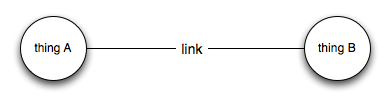
Clearly the names are almost identical, but there are enough little differences (presence or absence of comma, "o" versus "ö") to make things interesting. To make the mapping I construct a bipartite graph where the nodes are taxon names, divided into two sets based on which database they came from. I then connect the nodes of the graph by edges, weighted by how similar the names are. For example, here is the graph for "Nystactes" (displayed using Google images:


I then compute the maximum weighted bipartite matching using a C++ program I wrote. This matching corresponds to the solid lines in the graph above.

In this way we can make a sensible guess as to how names in the two databases relate to one another.

Why are botanists locking away their data in JSTOR Plant Science?

Goet008353Somehow I get the feeling that botanists haven't got the "open data" religion. Not only is the list of plant names list behind a really bad license, but the Global Plants Initiative (GPI) hides its type images behind a JSTOR Plant Sciences paywall. Why is botany determined to keep its data under wraps?

For example, the first specimen on the JSTOR site is the GOET008353, the isotype of Aa achalensis Schltr.. You can see a thumbnail of the specimen (shown on the right), but if you want the full image you need to have a subscription, otherwise you see this message:

The resource you are attempting to access is part of JSTOR Plant Science. JSTOR Plant Science is currently being offered free of charge for all JSTOR participants and not for profit institutions. To learn more about JSTOR Plant Science, please contact plants@jstor.org.


So, without a subscription you don't get to see this in high resolution (the JSTOR site features a higher resolution image and associated viewer):

Resolver

Why would herbariums hand over this imagery? I complained about this on Facebook and Chuck Miller responded that the original herbaria retain control over the images, so they aren't locked away. However, I then when to the herbarium that has this specimen (the Type Database of Herbarium Göttingen (GOET) and search for this specimen I eventually find it listed as 4966. There is no image!

So, the only place I can see this image is on JSTOR, for which I need a subscription. I'm also puzzled by the fact that JSTOR refers to this as "GOET008353", whereas the original herbarium refers to it as "4966". GBIF also has this specimen, which it refers to as GOET GOET-Typen 4966. The GOET008353 is a barcode given to types as part of the GPI digitisation programme. Unfortunately, neither the originating herbarium nor GBIF seems to know about this.

In summary, we have three databases with data on this specimen, each with a different specimen identifier, none of which link to each other, and the available imagery is behind a paywall.

Clearly botany hasn't gotten the memo about open data...

More GBIF specimen identifier strangeness

Continuing the theme of trying to map specimens cited in the literature to the equivalent GBIF records, consider the GBIF record http://data.gbif.org/occurrences/685591320, which according to GBIF is specimen "ZFMK 188762" (a [sic] holotype of Praomys hartwigi).

This is odd, because the original publication of this name (Eisentraut, M. 1968 .Beitrag zur Saugetierfauna von Kamerun. Bonner Zoologische Beitraege, 19:1-14, see PDF below) gives the type (p. 11) as "Museum A. Koenig, Kat. Nr. 68. 7").


The GBIF record includes links to images of ZFMK 188762, such as http://www.biologie.uni-ulm.de/cgi-bin/imgobj.pl?sid=T&lang=e&id=102323.

Bild pl

If we open this link we see that specimen is listed as "ZFMK-68.7", which matches the original description. "ZFMK-68.7" is a link to http://www.biologie.uni-ulm.de/cgi-bin/herbar.pl?herbid=188762&sid=T&lang=e, which is the record for this specimen in the SysTax database.

Note that this URL includes the number 188762, which is treated as the catalogue number by GBIF (i.e., "ZFMK 188762"). So, it seems that in the data provided by SysTax the primary key in that database (188762) has become the catalogue number in GBIF (I tried to verify this by clicking on the original provider message on the GBIF page but it failed to produce anything). This means any naive attempt to locate the specimen "ZFMK-68.7" in GBIF is going to fail because the harvesting and indexing as conflated a local primary key with the catalogue number that appears in publications that refer to this specimen.

Sometimes I think we are doing our level best to make retrieving data as hard as possible...

Towards a biogeographic search engine

We all have a "past" that we might not advertise widely, and my past includes flirting with panbiogeography. Indeed my PhD thesis hdl:2292/1999 is entitled "Panbiogeography: a cladistic approach." Shortly after graduating I moved on to host-parasite cospeciation and the gene tree/species tree problem ("reconciled trees", see Katz et al. http://dx.doi.org/10.1093/sysbio/sys026 for a recent example of this approach), but part of me misses the glory days of vicariance, dispersal, and panbiogeography.

One thing which strikes me is how little use large-scale historical biogeography makes of GBIF data. One of the things that made Croizat's panbiogeography so interesting was the way he exposed similar distribution patterns in unrelated groups of organisms. He did this by hand, producing map after map, some embellished with all manner of annotations ("gates", "nodes", "massings", etc.). In some ways, Croizat as an early data miner. Now we are awash in distributional data, where are the people revisiting global scale historical patterns? In particular, wouldn't it be cool to have a biogeographic search engine that could pull out taxa with particular distribution patterns that we could then analyse.

For example, while working on a project to map taxonomic names to literature and genomics data, I embedded a widget to display GBIF maps. Every so often I come across taxa have the classic "Gondwana" distribution pattern. For example, below is a map for stoneflies of the family the Notonemouridae from GBIF.


Below is a map for the Notonemouridae using an orthographic projection (see earlier post for details):

Notonemouridae
Another family of stone flies, the Gripopterygidae, show a similar pattern:

Gripopterygidae

What I'd like is to be able to query a database like GBIF for patterns such as these Gondwanic distributions, then be able to pull out associated phylogenetic information (e.g., via sequences in GenBank) so that we could determine the antiquity of these patterns, and whether they are consistent with geological models. We could begin to do large-scale testing of biogeographic hypotheses in a (semi-)automated way. At present we generally rely on a few well-studied examples that are either broadly consistent with
Bocxlaer, I. V., Roelants, K., Biju, S. D., Nagaraju, J., & Bossuyt, F. (2006). Late Cretaceous Vicariance in Gondwanan Amphibians. (M. Hofreiter, Ed.)PLoS ONE, 1(1), e74. doi:10.1371/journal.pone.0000074.t002

or contradict
Cook, L. G., & Crisp, M. D. (2005). Not so ancient: the extant crown group of Nothofagus represents a post-Gondwanan radiation. Proceedings of the Royal Society B: Biological Sciences, 272(1580), 2535–2544. doi:10.1098/rspb.2005.3219

the hypothesis that the history of biota of the southern hemisphere has been largely structured by the break-up of Gondwana.

A first step might be to index distributions at, say, family level and above, and provide a series of polygons representing different distribution patterns. We then search for distributions that are largely concordant with those patterns, and query GenBank (or TreeBASE) for sequences (or phylogenies) for those taxa. We then ask the questions "how old are these taxa?" and "what biogeographic histories do they have?"

Dear GBIF, please stop changing occurrenceIDs!

If we are ever going to link biodiversity data together we need to have some way of ensuring persistent links between digital records. This isn't going to happen unless people take persistent identifiers seriously.

I've been trying to link specimen codes in publications to GBIF, with some success, so imagine my horror when it started to fall apart. For example, I recent added this paper to BioStor:

A remarkable new asterophryine microhylid frog from the mountains of New Guinea. Memoirs of The Queensland Museum 37: 281-286 (1994) http://biostor.org/reference/105389

This paper describes a new frog (i>Asterophrys leucopus) from New Guinea, and BioStor has extracted the specimen code QM J58650 (where "QM" is the abbreviation for Queensland Museum), which according to the local copy of GBIF data that I have, corresponds to http://data.gbif.org/occurrences/363089399/. Unfortunately, if you click on that link GBIF denies all knowledge (you get bounced to the search page). After a bit of digging I discover that specimen is now in GBIF as http://data.gbif.org/occurrences/478001337/. At some point GBIF has updated its data and the old occurrenceID for QM J58650 (363089399) has been deleted. Noooo!

Looking at the old record I have there is an additional identifier:
urn:catalog:QM: Herpetology:J58650

This is a URN, and it's (a) unresolvable and (b) invalid as it contains a space. This is why URNs are useless. There's no expectation they will be resolvable hence there's no incentive to make sure they are correct. It's as much use as writing software code but not bothering to run it (because surely it will work, no?).

The GBIF record http://data.gbif.org/occurrences/478001337/ contains a UUID as an alternative identifier:
bc58ce6b-3cc3-459a-9f5b-4a70a026afbe

If you Google this you discover a record in the Atlas of Living Australia http://biocache.ala.org.au/occurrences/bc58ce6b-3cc3-459a-9f5b-4a70a026afbe, which also lists the URN from the now deleted GBIF record http://data.gbif.org/occurrences/363089399/.

I'm guessing that at some point the OZCAM data provided to GBIF was updated and instead of updating data for existing occurrenceIDs the old ones were deleted and new ones created (possibly because OZCAM switched from URNs to UUIDs as alternative identifiers). Whatever the reason, I will now need to get a new copy of GBIF occurrence data and repeat the linking process. Sigh.

If we are ever going to deliver on the promise of linking biodiversity data together we need to take identifiers seriously. Meantime I need to think about mechanisms to handle links that disappear on a whim.

Microbiome as climate, macrobiome as weather, and a global model of biodiversity

Lp attenboroughHalf-baked idea time. Thinking about projects such as the Earth Microbiome Project and Genomic Observatories, the recent GBIC2012 meeting (I'm still digesting that meeting), and mulling over the book A Vast Machine I keep thinking about the possible parallels between climate science and biodiversity science.

One metaphor from "A Vast Machine" is the difference between "global data" and "making data global". Getting data from around the world ("global data") is one challenge, but then comes making that data global:
building complete, coherent, and consistent global data sets from incomplete, inconsistent, and heterogeneous datasources

The focus of GBIF's data portal is global data, bringing together specimen records and observations from all around the world. This is global data, but one could argue that it's not yet ready to be used for most applications. For example, GBIF doesn't give you the geographic distribution of a given species, merely where it's been recorded from (based on that subset of records that have been digitised). That's a very important start, but if we had for each species an estimated distribution based on museum records, observations, published maps, together with habitat modelling, then we'd be closer to a dataset that we could use to tackle key questions about the distribution of biodiversity.

EMP green smallBut if we continue with the theme that microbiology is the dark matter of biology, and if we look at projects like the Earth Microbiome Project, then we could argue that focussing on eukaryote, particularly macro-eukaryote such as plants, fungi, and animals, may be a mistake. To use a crude analogy, perhaps we have been focussing on the big phenomena (equivalent to thunder storms, flash floods, tornados, etc.) rather than the underlying drivers (equivalent to climatic processes such as those captured in global climate models). Certainly, any attempt to model the biosphere is going to have to include the microbiome, and indeed perhaps the microbiome would be enough to have a working model of the biosphere?

I'm simply waving my arms around here (no, really?), but it's worth thinking about whether the macroecology that conservation and biodiversity focusses on is actually the important thing to consider if you want to model fundamental biological processes. Might macro-organisms be like the weather, and the microbiome is like the climate. As humans we notice the weather, because it is at a scale that affects us directly. But if the weather is a (not entirely predictable) consequence of the climate, what is the equivalent of global climate model for biodiversity?

Post GBIC2012 thoughts

I'm back from Copenhagen and GBIC2012. The meeting spanned three fairly intense days (with the days immediately before and after also working days for some of us), and was run by a group of facilitators lead by Natasha Walker, who were described us as "an interesting (and delightfully brainy, if sometimes scatty) group of academics, researchers, museum managers and people close to policy...". I've attempted to capture tweets about the meeting using Storify.

There will be a document (perhaps several) based on the meeting, but until then here are a few quick thoughts. Note that the comments below are my own and you shouldn't read into this anything about what directions the GBIC document(s) will actually take.

Microbiology rocks


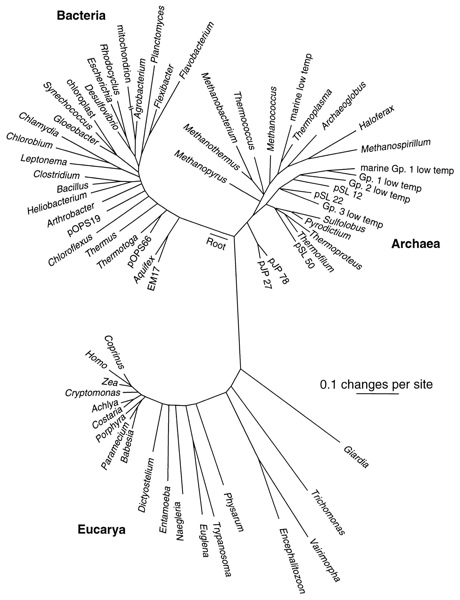
Highlight of the first day was Robert J. Robbin's talk which urged the audience to consider that life was mostly microbial, that the the things most people in the room cared about were actually merely a few twigs on the tree of life, that the tree of life didn't actually exist anyway, and many of the concepts that made sense for multicellular organisms simply didn't apply in the microbial world. Basically it was a homage to Carl Woese (see also Pace et al. 2012 doi:10.1073/pnas.1109716109) and a wake up call to biodiversity informaticians to stop viewing the world through multicellular eyes. (You can find all the keynotes from the first day here).
F1 large
From Pace, N. R. (1997). A Molecular View of Microbial Diversity and the Biosphere. Science, 276(5313), 734–740. doi:10.1126/science.276.5313.734

Sequences rule


The future of a lot of biodiversity science belongs to sequences, from simple DNA barcoding as a tool for species discovery and identification, metabarcoding as a tool for community analysis, to comparisons of metabolic pathways and beyond. The challenge for classical biodiversity informatics is how to engage with this, and to what extent we should try and map between, say sequences and classical taxa, or whether it might make more sense (gasp) to abandon the taxonomic legacy and move on. Perhaps are more nuanced response is that the point of connection between sequences and classical biodiversity data is unlikely to be at the level of taxonomic names (which are mostly tags for collections of things that look similar) but at the level of specimens and observations.

Ontologies considered harmful


This is my own particular hobby horse. Often the call would come "we need an ontology", to which I respond read Ontology is Overrated: Categories, Links, and Tags. I have several problems with ontologies. The first is that they are too easy to make and distract from the real problem. From my perspective a big challenge is linking data together, that is going from

a

to

b

Let's leave aside what "A" and "B" are (I suspect it matters less than people think), once we have the link then we can can start to do stuff. From my perspective, what ontologies give us is basically this:
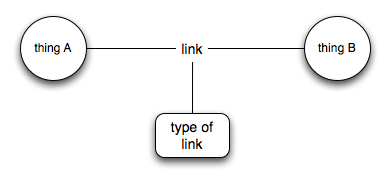
c

So now we know the "type" of the link (e.g., "is a part of", "cites approvingly", etc.). I'm not arguing that this isn't useful to have, but if you don't have the network of links then typing the links becomes an idle exercise.

To give an example, the web itself can be modelled as simply nodes connected by links, ignoring the nature of the links between the web pages. The importance of those links can be inferred later from properties of the network. To a first approximation this is how Google works, it doesn't ask what the links "mean" it simply investigates the connections to determine how important each web page is. In the same way, we build citation networks without bothering to ask the nature of the citation (yes I know there are ontologies for citations, but anyone willing to bet how widely they'll be adopted?).

My second complaint is that building ontologies is easy, "easy" in the sense that get a bunch of people together, they squabble for a long time about terminology, and out comes an ontology. Maybe, if you're lucky, someone will adopt it. The cost of making ontologies, and indeed of adopting them is relatively low (although it might not seem like it at the time). The cost of linking data is, I'd argue, higher, because it requires that you trust someone else's identifiers to the extent that you use them for things you care about deeply. Consider the citation network that is emerging from the widespread adoption of DOIs by the publishing industry. Once people trust that the endpoints of the links will survive, then the network starts to grow. But without that trust, that leap of faith, there's no network (unless you have enough resources to build the whole thing internally yourself, which is what happened with the closed citation network owned by Thomson Reuters). It's much easier to silo the data using unique identifiers than it is to link to other data (it's a variant of the "not invented here" syndrome).

Lastly, ontologies can have short lives. They reflect a certain world view that can become out of date, or supplanted if the relationships between things that the ontology cares about can be computed using other data. For example, biological taxonomy is a huge ontology that is rapidly being supplanted by phylogenetic trees computed from sequence (and other) data (compare the classification used by flagship biodiversity projects like GBIF and EOL with the Pace tree of life shown above). Who needs an ontology when you can infer the actual relationships? Likewise, once you have GPS the value of a geographic ontology (say of place names) starts to decline. I can compute if I'm on a mountain simply by knowing where I am.

I'm not saying ontologies are always bad (they're not), nor that they can't be cool (they can be), I'm just suggesting that they aren't the first thing you need. And they certainly aren't a prerequisite for linking stuff together.

Google flu trends


Perhaps the most interesting idea that emerged was the notion of intelligently detecting changes in biodiversity (which is the kind of thing a lot of people want to know) in the way analogous to Google.org's Flu Trends uses flu-related search terms to predict flu outbreaks:

Ginsberg, J., Mohebbi, M. H., Patel, R. S., Brammer, L., Smolinski, M. S., & Brilliant, L. (2008). Detecting influenza epidemics using search engine query data. Nature, 457(7232), 1012–1014. doi:10.1038/nature07634

Could we do something like this for biodiversity data? For various reasons this suggestion become known at GBIC2012 as the "Heidorn paradigm".

Thinking globally


One challenge for a meeting like GBIC 2012 is scope. There's so much cool stuff to think about. From my perspective, a useful filter is to ask "what will happen anyway?" In other words, there is a lot of stuff (for example the growth of metabarcoding) that will happen regardless of anything the biodiversity informatics community does. People will make taxon-specific ontologies for organismal traits, digitise collections, assess biodiversity, etc. without necessarily requiring an entity like GBIF. The key question is "what won't happen at a global scale unless GBIF (or some other entity) gets involved?"

A Vast Machine

51OttqQDcVL SL500 AA300Lastly, in one session Tom Moritz mentioned a book that he felt we could learn from (A Vast Machine: Computer Models, Climate Data, and the Politics of Global Warming). The book recounts the history of climatology and its slow transition to a truly global science. I've started to read it, and it's fascinating to see the interplay between early visions of the future, and the technology (typically driven by military or large-scale commercial interests) that made possible the realisation of those visions. This is one reason why predicting the future is such a futile activity, the things that have the biggest effect come from unexpected sources, and effect things in ways it's hard to anticipate. On a final note, it took about a minute from the time from the time Tom mentioned the book to the time I had a copy from Amazon in the Kindle app on my iPad. Oh that accessing biodiversity data were that simple.

Planet management, GBIF, and the future of biodiversity informatics

Earth russia large verge medium landscape

Next week I'm in Copenhagen for GBIC, the Global Biodiversity Informatics Conference. The goal of the conference is to:
...convene expertise in the fields of biodiversity informatics, genomics, earth observation, natural history collections, biodiversity research and policy needed to set such collaboration in motion.

The collaboration referred to is the agreement to mobilise data and informatics capability to met the Aichi Biodiversity Targets.

I confess I have mixed feelings about the upcoming meeting. There will be something like 100 people attending the conference, with backgrounds ranging from pure science to intergovernmental policy. It promises to be interesting, but whether a clear vision of the future of biodiversity informatics will emerge is another matter.

GBIC is part of the process of "planet management", a phrase that's been around for a while, but I only came across in the Bowker's essay "Biodiversity Datadiversity"1:

Bowker, G. C. (2000). Biodiversity Datadiversity. Social Studies of Science, 30(5), 643–683. doi:10.1177/030631200030005001

Bowker's essay is well worth a read, not least for the choice quotes such as:

Each particular discipline associated with biodiversity has its own incompletely articulated series of objects. These objects each enfold an organizational history and subtend a particular temporality or spatiality. They frequently are incompletely articulated with other objects, temporalities and spatialities — often legacy versions, when drawing on non-proximate disciplines. If one wants to produce a consistent, long-term database of biodiversity-relevant information the world over, all this sounds like an unholy mess. At the very least it suggests that global panopticons are not the way to go in biodiversity data. (p. 675, emphasis added)

and
I have not, in general, questioned the mania to name which is rife in the circles whose work I have described. There is no absolutely compelling connection between the observation that many of the world’s species are dying and the attempt to catalogue the world before they do. If your house is on fire, you do not necessarily stop to inventory the contents before diving out the window. However, as Jack Goody (1977) and others have observed, list-keeping is at the heart of our body politic. It is also, by extension, at the heart of our scientific strategies. Right or wrong, it is what we do. (p. 676, emphasis added)

Given that I'm a fan of the notion of a "global panopticon", and spend a lot of time fussing with lists of names, I find Bowker's views refreshing. Meantime, roll on GBIC2012.


1. Bowker cites Elichirigoity as a source of the term "planet management":

Fernando Elichirigoity (1999), Planet Management: Limits to Growth,
Computer Simulations, and the Emergence of Global Spaces (Evanston, IL: Northwestern
University Press). ISBN 0810115875 (Google Books oP3wVnKpGDkC).

From the limited Google preview, and the review by Edwards, this looks like an interesting book:

Edwards, P. (2000). Book Review:Planet Management: Limits to Growth, Computer Simulation, and the Emergence of Global Spaces Fernando Elichirigoity. Isis, 91(4), 828. doi:10.1086/385020 (PDF here)

Fictional taxa

Anyone who works with taxonomic databases is aware of the fact that they have errors. Some taxonomic databases are restricted in scope to a particular taxon in which one or more people have expertise, these then get aggregated into larger databases, which may in turn be aggregated by databases whose scope is global. One consequence of this is that errors in one database can be propagated through many other databases.

As an example (for reasons I can't remember), I came across the name "Panisopus" (in the water mote family Thyasidae) but was struggling to find any mention of the taxonomic literature associated with this name. If you Google Panisopus the first two pages are full of search results from ITIS, EOL, GBIF, ZipCodeZoo, all listing several species in the genus, and sometimes taxonomic authorities, but no links to the primary literature. If you search BHL for Panisopus you get nothing, nothing at all. It's as if the name didn't exist.

Turns out, that's exactly the point. The name doesn't exist, other than in the various databases that have consumed other databases and recycled this fictional taxon. After some Googling of author's names it became clear that "Panisopus" is probably a misspelling of "Panisopsis", which according to ION was published in:

Viets, K. (1926) Eine nomenklatorische Aenderung im Hydracarinen-Genus Thyas C. L. Koch. Zool Anz Leipzig, 66: 145--148

I can't verify this because this article is not available online. But to give one example, ITIS lists the name "Panisopus pedunculata Keonike, 1895" (TSN 83185). This name should be, as far as I can tell, Panisopsis pedunculata (Koenike, 1895), based on Mitchell, 1954 (http://biostor.org/reference/104266, http://dx.doi.org/10.5962/bhl.title.3110) who on page 36 states:

Mitchell

Note that Panisopsis pedunculata was originally described in a different genus (Koenike 1895 preceeds the publication of the genus name by Viets in 1926). We can locate Koenike's original publication "Nordamerikanische Hydrachniden" in BHL, which I've added to BioStor http://biostor.org/reference/104265, and the original description appears on p. 192 as Thyas pedunculata (note that ITIS misspells the author's name Koenike [o and e transposed], as well as omitting the parentheses around the name).

What I find a little alarming (if not surprising) is that the entirely fictional genus "Panisopus" its accompanying species have ended up in numerous taxonomic databases, and these databases consistently appear in the top Google searches for this name. The good news is that it's becoming increasingly easy to discover these errors, in part because more and more taxonomic literature is coming online, making it possible for users to investigate matters for themselves, rather than rely on unsupported statements in taxonomic databases. I'm continually amazed by how little evidence most taxonomic databases provide for any of the assertions that they make. If a database includes a name, I want some evidence that the name is "real". Show me the publication, or at least give me a citation that I can follow up. I can't take these databases on blind faith, because demonstrably they are replete with errors. Ironically, one measure of success in the Internet age is being in the top 10 hits for a Google search. Now, if the top ten hits are all taxonomic databases I get very, very nervous. It's a good sign the name only exists in those databases.

Linking NCBI taxonomy to GBIF


In response to Rutger Vos's question I've started to add GBIF taxon ids to the iPhylo Linkout website. If you've not come across iPhylo Linkout, it's a Semantic Mediawiki-based site were I maintain links between the NCBI taxonomy and other resources, such as Wikipedia and the BBC Nature Wildlife finder. For more background see

Page, R. D. M. (2011). Linking NCBI to Wikipedia: a wiki-based approach. PLoS Currents, 3, RRN1228. doi:10.1371/currents.RRN1228

I'm now starting to add GBIF ids to this site. This is potentially fraught with difficulties. There's no guarantee that the GBIF taxonomy ids are stable, unlike NCBI tax_ids which are fairly persistent (NCBI publish deletion/merge lists when they make changes). Then there are the obvious problems with the GBIF taxonomy itself. But, if you want a way to generate a distribution map for a taxon in the NCBI taxonomy, the quickest way is going to be via GBIF.

The mapping is being made automatically, with some crude checks to try and avoid too many erroneous links (e.g., due to homonyms). It will probably take a few days to complete (the mapping is quick, uploading to the wiki is a bit slower). Using a wiki to manage the mapping makes it easy to correct any spurious matches.

As an example, the page http://iphylo.org/linkout/Ncbi:109175 is for the frog Hyla japonica (NCBI tax_id 109175) and shows links to Wikipedia (http://en.wikipedia.org/wiki/Japanese_Tree_Frog, and to GBIF (http://data.gbif.org/species/2427601/). There's even a link to TreeBASE. I display a GBIF map so you can see what data GBIF currently has for that taxon.

Hyla

So, we have a wiki page, how do we answer Rutger's original question: how to get GBIF occurrence records via web service?

To do this we can use the RDF output by the Semantic Mediawiki software that underpins the Wiki. You can gte this by clicking on the RDF icon near the bottom of the page, or go to http://iphylo.org/linkout/Special:ExportRDF/Ncbi:109175. The RDF this produces is really, really ugly (and people wonder why the Semantic Web has been slow to take off...). In this RDF you will see the statement:

<rdfs:seeAlso rdf:resource="http://data.gbif.org/species/2427601/"/>

So, arm yourself with XPath, a regular expression, or if you are a serious RDF geek break out the SPARQL, and you can extract the GBIF taxon id for a NCBI taxon. Given that id you can query the GBIF web services. One service that I like is the occurrence density service, which you can use to recreate the 1°×1° density maps shown by GBIF. For example, http://data.gbif.org/ws/rest/density/list?taxonconceptkey=2427601 will get you the squares shown in the screen shot above.

Of course, I have glossed over several issues, such as the errors and redundancy in the GBIF classification, the mismatch between NCBI and GBIF classifications (NCBI has many more ranks than GBIF), and whether the taxon concepts used by the two databases are equivalent (this is likely to be more of an issue for higher taxa). But it's a start.

The GBIF classification is broken — how do we fix it?

This post arose from an ongoing email conversation with Tony Rees about extracting and annotating taxonomic names. In BioStor I use the GBIF classification to display the taxonomic names found in the OCR text in the form of a tree. The idea is to give the reader a sense of "what the paper is about". I also use the classification to help link to GBIF occurrence records.

The GBIF backbone classification ("nub") is probably the single largest classification of life that has been assembled, and provides GBIF users with a way to navigate through GBIF's collection of specimen and observation records. Given the scale of the undertaking it is inevitable that there will be issues with the classification, and this post provides one example.

On the page for the article "Further additions to the known marine Molluscan fauna of St. Helena" (http://biostor.org/reference/88554, see also http://dx.doi.org/10.1080/00222939208677383) part of the classification looks like this:

└Animalia
└Annelida
└Polychaeta
└Sabellida
└Serpulidae
└Hipponyx
Tony points out that "Hipponyx" is a mollusc, yet in the GBIF classification appears in the annelid worms.

Like a fool I started to investigate further. First off, what is "Hipponyx"? Browsing the GBIF classification there are species of Hipponyx and Hipponix under the genus Hipponix, so it looks like we have two alternative spellings of this genus name. Nomenclator Zoologicus has both spellings, Hipponix credited to DeFrance 1819 Journ. de Physique, 88, 217, and Hipponyx credited to Defrance 1819 Bull. Sci. Soc. philom. Paris, 8. Gotta love those cryptic citations. After some digging around in BHL I found Journ. de Physique, 88, 217 (Mémoire sur un nouveau genre de mollusque) and Bull. Sci. Soc. philom. Paris, 8. (Sur un nouveau genre de coquilles (Hipponix)). Both papers are by Jacques Louis Marin DeFrance, and both use the spelling Hipponix (no 'y'). I'm guessing the second paper is actually the original description of the genus, but my French is abysmal (Google Translate to the rescue).

OK, so we have two spellings of what is probably the same thing (and I've no idea why we have two spellings). Both spellings seem in use (see Google NGrams chart below).


So, bit of a mess, but this still doesn't deal with Hipponyx being a worm in GBIF. After a bit of Googling on "Serpulidae" and "Hipponyx" I came across a specimen record from Te Papa labelled "Worm, Temporaria inexpectata (Mestayer, 1929); holotype; holotype of Hipponyx inexpectata Mestayer, 1929". I then came across this paper:

Fleming, C. A. (1971). A preliminary list of New Zealand fossil polychaetes. New Zealand Journal of Geology and Geophysics, 14(4), 742–756. doi:10.1080/00288306.1971.10426332

with the following abstract:
An annotated list of fossil “worm tubes” from New Zealand includes both published and new records from Mesozoic and Cenozoic deposits.

The binomen Zoophycos plicatus (Hutton) is proposed for the trace fossil long known as the Amuri fucoid, of unknown zoological affinity.

The following living species are recorded as New Zealand fossils for the first time: Protula bispiralis (Savigny), Salmacina dysteri (Huxley), Hydroides norvegicus Gunnerus, Pomatoceras cariniferus (Gray), P. aff. terranovae (Benham), Galeolaria hystrix (Moerch), Boccardia ? polybranchia (Haswell); new records of fossil species are Ditrupa cf. plana (Sowerby), Dorsoserpula lumbricalis (Schlotheim), and Neomicrorbis crenatostriatus (Münster). The name Hipponyx inexpectata Mestayer 1929, applied to a serpulid operculum, is used in the combination Temporaria inexpectata for a tubeworm common in deep water off New Zealand that has also been identified, with associated operculum, from the bathyal Waitotaran (Pliocene) sediments of Palliser Bay. Serpula wharjensis Wilkens and S. ougenensis Chapman are placed in Sclerostyla Moerch. Two species of Vermiliopsis and two of Spirorbis are figured but not named specifically.

The author of the paper (Charles Fleming) argues that Hipponyx inexpectata, regarded as a mollusc by its describer (Marjorie K. Mestayer, see Notes on New Zealand Mollusca. No. 4.) is actually a worm, and he moves it to the genus Temporaria.

So it seems that the reason Hipponyx has ended up being a worm in the GBIF classification is due to this synonymy.

Now, this little investigation was "fun", but took a couple of hours. Much of that was spent tracking down the literature and adding it to BioStor, which is a one-time cost. Not every issue with the GBIF classification will take this long to resolve, some cases may take longer. So there's a problem of scalability. Then there's the issue of how this information gets into the GBIF classification so we fix it (and so that people don't think Hipponyx is a worm). As has been said several times before, most eloquently by David Shorthouse, isn't it time we started using software development tools such as version control to help build, annotate, and correct classifications such as the one that underpins GBIF? That way when somebody spots an error it can be flagged, and someone with the time (and curiosity) can fix it.

BHL and GBIF as biomedical databases

When I think of the Biodiversity Heritage Library (BHL) or GBIF I tend to think of taxonomy and biodiversity. Folk wisdom has it that BHL is full of old books, mostly pre-1923. Great for finding old taxonomic names, or nice artwork, but not exactly "modern" biology. GBIF is mainly about displaying organism distributions based on museum specimens, the primary data of taxonomic research. Again, great stuff, but aren't museums simply full of dead stuff that people have collected and forgotten about?

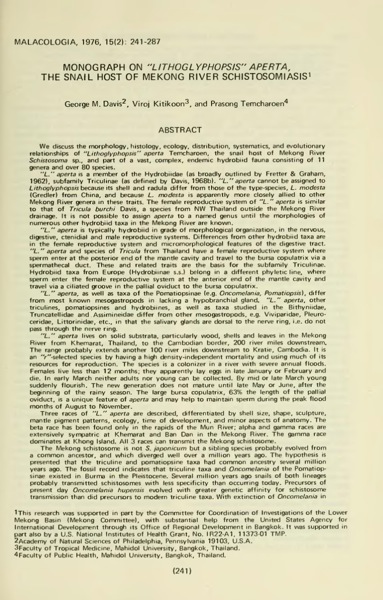
But BHL has a lot more post-1923 content than I suspect most people realise (several museum or society journals have 21st century issues in BHL's archives, for example). Continuing the theme of linking BHL and GBIF content, as part of a forthcoming project on taxonomic names (to be made available "real soon now") I stumbled across this 1976 paper in BHL (now in BioStor):

Monograph on "Lithoglyphopsis" aperta, the snail host of Mekong River Schistosomiasis by Davis et al..

Malacologia157576inst 0263

This paper has been indexed in PubMed (PMID:948206, but as far as I'm aware, BHL (and BioStor) has the only digital copy of this paper. (As a side note, wouldn't it be great if PubMed could link to BHL content?).

The article page in BioStor shows a map derived from the OCR text, showing a two localities:

Mekong

Below the map are the specimen codes I've automatically extracted from the OCR text, linked to the corresponding records in GBIF, which are georeferenced (e.g., ANSP Malacology 330925).

If we joined these things up just a little more, we could do some useful things. For example, what if a researcher searching in PubMed for schistosomiasis in South East Asia could find the Davis et al. paper, and then go to BHL or BioStor to read it? What if a researcher looking at gastropod distributions in the Mekong River in the GBIF portal could see that BHL had publications on diseases associated with these organisms (as well as their taxonomy and biology). We could also traverse the link from GBIF to BHL to PubMed and provide a direct route from distribution maps to biomedical literature.

It seems there's scope for trying to connect BHL, GBIF, and PubMed, and that BHL and GBIF may have important roles to play in providing access to basic information about organisms that have a serious impact on human populations.

Yet more reasons to have specimen identifiers: annotating GenBank sequences

One reason I'm pursuing the theme of specimen identifiers (and identifiers in general) is the central role they play in annotating databases. To give a concrete example, I (among others) have argued for a wiki-style annotation layer on top of GenBank to capture things such as sequencing errors, updated species names, etc. Annotation is a lot easier if we have consistent identifiers for the things being annotated. For example, every GenBank sequence has a unique accession number, so if you and I are discussing sequence DQ055738, you and I can be sure we are talking about the same thing.

Sequence DQ055738 is interesting because Hua et al. A Revised Phylogeny of Holarctic Treefrogs (Genus Hyla) Based on Nuclear and Mitochondrial DNA Sequences (http://dx.doi.org/10.1655/08-058R1.1 - note the nice identifier we have for this article) have suggested this sequence (published in http://dx.doi.org/10.1554/05-284.1, another nice identifier) is misidentified. Given these identifiers we could construct various statements, such as:


DQ055738 -> published in -> doi:10.1554/05-284.1
DQ055738 -> annotated by -> doi:10.1655/08-058R1.1

(I've omitted the http:// stuff to keep things legible). Hua et al: state the following:

However, the tissue number of this specimen (LSUMZ H-19067) is similar to that of a specimen of H. versicolor (LSUMZ H-19077), which appears to have been processed at the same time (C. Austin, personal communication). Therefore, we hypothesize that the sequence data for H. gratiosa used by Smith et al. (2005) were actually from H. versicolor.

It would be nice if we had unique, resolvable identifiers for LSUMZ H-19067 and LSUMZ H-19077 so that we could construct statements linking the sequence, the publications, and the specimens. But we don't. Nor is it obvious how to find out anything more about LSUMZ H-19067 and LSUMZ H-19077. By contrast, for the DOI or the sequence accession I know how to get more information, in either human- or machine-readable form.

The acronym LSUMZ in this case is the Lousiana State University Museum of Natural Science Herpetology collection (http://biocol.org/urn:lsid:biocol.org:col:34806). Just to confuse matters, LSUMZ specimens in GBIF use LSU as the acronym for Lousiana State University Museum of Natural Science. Given that GBIF's data comes from LSU itself, it's odd (but not surprising) that there's a muddle about which acronym to use (it would be nice to clear this up, but then anybody building identifiers based on those acronyms is in for some heartbreak).

If I look at GBIF LSUMZ records there aren't specimens with the catalogue numbers H-19067 or H-19077. However, after a bit of poking around, and a helpful file from GBIF's Tim Robertson, I discovered that the LSUMZ herpetology tissue numbers (which is what the H-* codes actually are) are stored in GBIF, so I've found the corresponding specimens are http://data.gbif.org/occurrences/45716232 (LSU Herp 84850, LSUMZ HerpNet Tissue 19067) and http://data.gbif.org/occurrences/45710033 (LSU Herp 84862, LSUMZ HerpNet Tissue 19077). (Note that Hua et al. tell the reader that LSU 84850 = LSUMZ H-19067, but don't give the specimen code for LSUMZ H-19077).

Now I have some resolvable identifiers, so I could construct statements like:


DQ055738 -> voucher -> occurrences/45716232
DQ055738 -> voucher -> occurrences/45710033
|
+-> according to -> doi:10.1655/08-058R1.1

Let's skip over whether this is actually the best way to record the annotation, the point is we can now start to construct statements that can be linked to the wider world. If someone else has made statements about these specimens, and they used the GBIF URL, then we could aggregate those and learn more about these specimen and their associated sequences. Without globally unique, stable, resolvable identifiers we are left to flounder around in the bowels of various databases searching for something that may or may not be the object being discussed. Isn't it time we did something about this?

GBIF specimens in BioStor: who are the top ten museums with citable specimens?

GbifBrief update on yesterday's post about finding specimens in BioStor. BioStor has some 66,000 articles from BHL, from which I've extracted 143,000 cases of a specimen code being cited in the text. Of these 143,000 occurrences, 81,000 have been matched to an occurrence in GBIF.

The top ten collections with specimens in BioStor are:

DatasetNumber of specimens
NMNH Vertebrate Zoology Herpetology Collections (National Museum of Natural History)11194
Herpetology Collection (University of Kansas Biodiversity Research Center)9619
Herpetology Collection (University of Kansas Biodiversity Research Center)9328
NMNH Invertebrate Zoology Collections (National Museum of Natural History)9061
CAS Herpetology Collection Catalog (California Academy of Sciences)6720
MCZ Herpetology Collection (Museum of Comparative Zoology, Harvard University)5818
NMNH Vertebrate Zoology Fishes Collections (National Museum of Natural History)4642
MCZ Herpetology Collection - Reptile Database (Museum of Comparative Zoology, Harvard University)4380
FMNH Herpetology Collections (Field Museum)2110
FMNH Fishes Collections (Field Museum)2061


This is pretty much what I expected. Virtually complete runs of publications from The Field Museum at Chicago, the University of Kansas, and the Biological Society of Washington are available in BHL, and many of these have been added to BioStor. These journals have extensive taxonomic treatments of vertebrate taxa, particularly frogs, hence herpetology collections dominate the rankings.

There will inevitably be errors in the mapping between specimen codes and GBIF occurrences. I've tried to minimise these by mapping codes within taxonomic groups, but it's clear that there are duplicate codes even within some collections. There is also all manner of variation in the way people cite museum specimens, and these are often different from the codes that appear in GBIF. There will also be issues with extracting specimen codes, and I'm also discovering a few *cough* duplicates of articles in BioStor, so the numbers I present above are liable to change as I clean things up.

But one could imagine a "league table" of museum collections, where we can measure both the extent to which those collections have been digitised, and the extent to which material from those collections have been cited. We could use this to compute measures of the impact of a collection.

But for now I'm browsing the results trying to get a sense of how successful the mapping has been. There are some interesting examples. The specimen codes extracted from the article Review Of The Chewing Louse Genus Abrocomophaga (Phthiraptera : Amblycera), With Description Of Two New Species are those for the mammalian hosts of the lice. Hence someone viewing the records for these specimens and following the link to this paper would discover that these mammals had parasitic lice. If we add other sorts of links to the mix, such as between specimens and DNA sequences, then we can start to build a rich network of connections between the basic data of biodiversity.


Linking GBIF and the Biodiversity Heritage Library

Following on from exploring links between GBIF and GenBank here I'm going to look at links between GBIF and the primary literature, in this case articles scanned by the Biodiversity Heritage Library (BHL). The OCR text in BHL can be mined for a variety of entities. BHL itself has used uBio's tools to identity taxonomic names in the OCR text, and in my BioStor project I've extracted article-level metadata and geographic co-ordinates. Given that many articles in BioStor list museum specimens I wrote some code to extract these (see Extracting museum specimen codes from text) and applied this to the OCR text for those articles.

Having a list of specimens is nice, but in this digital age I want to be able to find out more about these specimens. An obvious solution is try and match these specimen codes to the specimen records held by GBIF. Linking to GBIF is complicated by the fact that museum codes are not unique. For example, "FMNH 147942" could refer to a bird, an amphibian, or a mammal. To tackle the non uniqueness I use the taxonomic names extracted from each page by BHL to work out what taxon an article is mainly "about". To do this I use the Catalogue of Life classification to get "paths" for each name (i.e., the lineage of each taxon down to the root of the classification) and then find the majority-rule path. You can see these paths in the "Taxonomic classification" displayed on a page for a BioStor article. If there are multiple GBIF specimens for the same code I test whether the taxon or rank "class" in the GBIF record is in the majority-rule path for the article. If so, I accept that specimen as the match to the code.

There are also issues where the specimen codes in GBIF have been modified during input (e.g., USNM 730715 has become USNM 730715.457409). There are also the inevitable OCR errors that may cause museum codes to be missed or otherwise corrupted. Bearing all this in mind, BioStor now has specimen pages (these are still being generated as I write this). For example, the page for FMNH 147942 lists the three articles in BioStor that cite this specimen code:

Fmnh147942

All three specimens have been mapped on to GBIF occurrence http://data.gbif.org/occurrences/61846037/. When BioStor displays the articles it now lists the specimen codes that have been extracted from the article, together with the GBIF logo if the specimen has been matched to a GBIF record. For example, here is a screenshot from Deep-water octopods (Mollusca: Cephalopoda) of the northeastern Pacific:
Deepwater

The map has been extracted from the OCR text (an obvious next step would be to add localities associated with the specimen records). Below the map are the specimen codes. The lack of some USNM specimens is probably due to misinterpreted specimen codes, whereas the CAS specimens don't seem to be online (the California Academy of Sciences has some of its collections in GBIF, but not its molluscs).

Where next?
Once these links between BioStor (and hence, BHL) and GBIF are created then we can do some interesting things. If you visit BioStor and want to learn more about a specimen you can click on the link an view the record in GBIF. We could also envisage doing the reverse. GBIF could augment the information it displays about a specimen by displaying a link to the content in BioStor (e.g., "this specimen is cited by these articles"). Those articles may contain further information about that specimen (for example, the habitat it was collected from, how secure is its identification, and so on).

We could also start to compute the "impact" of different museum collections based on the number of citations of specimens from their collections (this idea is explored further in this paper: http://dx.doi.org/10.1093/bib/bbn022, free preprint available here: hdl:10101/npre.2008.1760.1).

All of this works because we are linking objects (in this case articles and specimens) via their identifiers. Consequently, the links are as stable as their identifiers, which is why I've been pursuing the issue of specimen identifiers recently (see here, here, and here). If GBIF maintains the URLs for the specimens I've linked to, then links I've created could persist. If these URLs are likely to change (e.g., because the metadata from the host institution has changed) then the links (and any associated value we get from them) disappear. This is why I want globally unique, resolvable, persistent identifiers for specimens.


How many specimens does GBIF really have?

GbifDuplicate records are the bane of any project that aggregates data from multiple sources. Mendeley, for example, has numerous copies of the same article, as documented by Duncan Hull (How many unique papers are there in Mendeley?). In their defence, Mendeley is aggregating data from lots of personal reference libraries and hence they will often encounter the same article with slightly differing metadata (we all have our own quirks when we store bibliographic details of papers). It's a challenging problem to identify and merge records which are not identical, but which are clearly the same thing.

What I'm finding rather more alarming is that GBIF has duplicate records for the same specimen from the same data provider. For example, the specimen USNM 547844 is present twice:

As far as I can tell this is the same specimen, but the catalogue numbers differ (547844 versus 547844.6544573). Apart from this the only difference is when the two records were indexed. The source for 547844 was last indexed August 9, 2009, the source for 547844.6544573 was first indexed August 22, 2010. So it would appear that some time between these two dates the US National Museum of Natural History (NMNH) changed the catalogue codes (by appending another number), so GBIF has treated them as two distinct specimens. Browsing other GBIF records from the NMNH shows the same pattern. I've not quantified the extent of this problem, but it's probably a safe bet that every NMNH herp specimen occurs twice in GBIF.

Then there are the records from Harvard's Museum of Comparative Zoology that are duplicates, such as http://data.gbif.org/occurrences/33400333/ and http://data.gbif.org/occurrences/328478233/ (both for specimen MCZ A-4092, in this case the collectionCode is either "Herp" or "HERPAMPH"). These are records that have been loaded at different times, and because the metadata has changed GBIF hasn't recognised that these are the same thing.

At the root of this problem is the lack of globally unique identifiers for specimens, or even identifiers that are unique and stable within a dataset. The Darwin Core wiki lists a field for occurrenceID for which it states:

The occurrenceID is supposed to (globally) uniquely identify an occurrence record, whether it is a specimen-based occurrence, a one-time observation of a species at a location, or one of many occurrences of an individual who is being tracked, monitored, or recaptured. Making it globally unique is quite a trick, one for which we don't really have good solutions in place yet, but one which ontologists insist is essential.

Well, now we see the side effect of not tackling this problem - our flagship aggregator of biodiversity data has duplicate records. Note that this has nothing to do with "ontologists" (whatever they are), it's simple data management. Assign a unique id (a primary key in a database will do fine) that can be used to track the identity of an object even as its metadata changes. Otherwise you are reduced to matching based on metadata, and if that is changeable then you have a problem.

Now, just imagine the potential chaos if we start changing institution and collection codes to conform to the Darwin Core triplet. In the absence of unique identifiers (again, these can be local to the data set) GBIF is going to be faced with a massive data reconciliation task to try and match old and new specimen records.

The other problem, of course, is that my plan to use GBIF occurrence URLs as globally unique identifiers for specimens is looking pretty shaky because they are unique (the same specimen can have more than one) and if GBIF cleans up the duplicates a number of these URLs will disappear. Bugger.


Linking GBIF and Genbank

As part of my mantra that it's not about the data, it's all about the links between the data, I've started exploring matching GenBank sequences to GBIF occurrences using the specimen_voucher codes recorded in GenBank sequences. It's quickly becoming apparent that this is not going to be easy. Specimen codes are not unique, are written in all sorts of ways, there are multiple codes for the same specimen (GenBank sequences may be associated with museum catalogue entries, or which field or collector numbers).

So why undertake what is fast looking like a hopeless task? There are several reasons:
  1. GBIF occurrences have a unique URL which we could potentially use as a unique, resolvable identifier for the corresponding specimen.
  2. Linking GenBank to GBIF would make it possible for GBIF to list sequences associated with a specimen, as well as the associated publication, which means we could demonstrate the "impact" of a specimen. In the simplest terms this could be the number of sequences and publications that use data from the specimen, more sophisticated approaches could use PageRank-like measures, see hdl:10101/npre.2008.1760.1.
  3. Having a unique identifier that is shared across different databases makes it easier to combine data from different sources. For example, if a sequence in GenBank lacks geographic coordinates but the voucher specimen in GBIF is georeferenced, we can use that information to locate the sequence in geographic space (and hence build geophylogenies or add spatial indexes to databases such as TreeBASE). Conversely, if the GenBank sequence is georeferenced but the GBIF record isn't we can update the GBIF record and possibly expand the range of the corresponding taxon (this was part of the motivation behind hdl:10101/npre.2009.3173.1.

As an example, below is the GBIF 1° density map for the frog Pristimantis ridens from GBIF, with the phylogeny from Wang et al.Phylogeography of the Pygmy Rain Frog (Pristimantis ridens) across the lowland wet forests of isthmian Central Americahttp://dx.doi.org/10.1016/j.ympev.2008.02.021 layered over it. I created the KML tree from the corresponding tree in TreeBASE using the tool I described earlier. You can grab the KML for the tree here.

Density

As we'd expect, there is a lot of overlap in the two sources of data. If we investigate further, there are records that are in fact based on the same specimen. For example, if we download the GBIF KML file with individual placemarks we see that in the northern part of the range their are 15 GBIF occurrences that map onto the same point as one of the terminal taxa in the tree.

Gbif

One of these 15 GBIF records (http://data.gbif.org/occurrences/244335848) is for specimen USNM 514547, which is the voucher specimen for EU443175. This gives us a link between the record in GBIF and the record in GenBank. It also gives us a URI we can use for the specimen http://data.gbif.org/occurrences/244335848 instead of the unresolvable and potentially ambiguous USNM 514547.

If we view the geophylogeny from a different vantage point we see numerous localities that don't have occurrences in GBIF.

Nogbif

Close inspection reveals that some of the specimens listed in the Wang et al. paper are actually in GBIF, but lack geographic coordinates. For example the OTU "Pristimantis ridens Nusagandi AJC 0211" has the voucher specimen FMNH 257697. This specimen is in GBIF as http://data.gbif.org/occurrences/57919777/, but without coordinates, so it doesn't appear on the GBIF map. However, both the Wang et al. paper and the GenBank record for the sequence from this specimen EU443164 give the latitude and longitude. In this example, GBIF gives us a unique identifier for the specimen, and GenBank provides data on location that GBIF lacks.

Part of GBIFs success is due to the relative ease of integrating data by taxonomic names (despite the problems caused by synonyms, homonyms, misspellings, etc.) or using spatial coordinates (which immediately enables integration with environmental data. But if we want to integrate at deeper levels then specimen records are the glue that connects GBIF (and its contributing data sources) to sequence databases, phylogenies, and the taxonomic literature (via lists of material exampled). This will not be easy, certainly for legacy data that cites ambiguous specimen codes, but I would argue that the potential rewards are great.

DNA Barcoding, the Darwin Core Triplet, and failing to learn from past mistakes

Banner05
Given various discussions about identifiers, dark taxa, and DNA barcoding that have been swirling around the last few weeks, there's one notion that is starting to bug me more and more. It's the "Darwin Core triplet", which creates identifiers for voucher specimens in the form <institution-code>:<OPTIONAL collection-code>:<specimen-id>. For example,

MVZ:Herp:246033

is the identifier for specimen 246033 in the Herpetology collection of the Museum of Vertebrate Zoology (see http://arctos.database.museum/guid/MVZ:Herp:246033).

On the face of it this seems a perfectly reasonable idea, and goes some way towards addressing the problem of linking GenBank sequences to vouchers (see, for example, http://dx.doi.org/10.1016/j.ympev.2009.04.016, preprint at PubMed Central). But I'd argue that this is a hack, and one which potentially will create the same sort of mess that citation linking was in before the widespread use of DOIs. In other words, it's a fudge to postpone adopting what we really need, namely persistent resolvable identifiers for specimens.

In many ways the Darwin Core triplet is analogous to an article citation of the form <journal>, <volume>:<starting page>. In order to go from this "triplet" to the digital version of the article we've ended up with OpenURL resolvers, which are basically web services that take this triple and (hopefully) return a link. In practice building OpenURL resolvers gets tricky, not least because you have to deal with ambiguities in the <journal> field. Journal names are often abbreviated, and there are various ways those abbreviations can be constructed. This leads to lists of standard abbreviations of journals and/or tools to map these to standard identifiers for journals, such as ISSNs.

This should sound familiar to anybody dealing with specimens. Databases such as the Registry of Biological Repositories and the Biodiversity Collectuons Index have been created to provide standardised lists of collection abbreviations (such as MVZ = Museum of Vertebrate Zoology). Indeed, one could easily argue that the what we need is an OpenURL for specimens (and I've done exactly that).

As much as there are advantages to OpenURL (nicely articulated in Eric Hellman's post When shall we link?), ultimately this will end in tears. Linking mechanisms that depend on metadata (such as museum acronyms and specimen codes, or journal names) are prone to break as the metadata changes. In the case of journals, publishers can rename entire back catalogues and change the corresponding metadata (see Orwellian metadata: making journals disappear), journals can be renamed, merged, or moved to new publishers. In the same way, museums can be rebranded, specimens moved to new institutions, etc. By using a metadata-based identifier we are storing up a world of hurt for someone in the future. Why don't we look at the publishing industry and learn from them? By having unique, resolvable, widely adopted identifiers (in this case DOIs) scientific publishers have created an infrastructure we now take for granted. I can read a paper online, and follow the citations by clicking on the DOIs. It's seamless and by and large it works.

On could argue that a big advantage of the Darwin Core triplet is that it can identify a specimen even if it doesn't have a web presence (which is another way of saying that maybe it doesn't have a web presence now, but it might in the future). But for me this is the crux of the matter. Why don't these specimens have a web presence? Why is it the case that biodiversity informatics has failed to tackle this? It seems crazy that in the context of digital data (DNA sequences) and digital databases (GenBank) we are constructing unresolvable text strings as identifiers.

But, of course, much of the specimen data we care about is online, in the form of aggregated records hosted by GBIF. It would be technically trivial for GBIF to assign a decent identifier to these (for example, a DOI) and we could complete the link between sequence and specimen. There are ways this could be done such that these identifiers could be passed on to the home institutions if and when they have the infrastructure to do it (see GBIF and Handles: admitting that "distributed" begets "centralized").

But for now, we seem determined to postpone having resolvable identifiers for specimens. The Darwin Core triplet may seem a pragmatic solution to the lack of specimen identifiers, but it seems to me it's simply postponing the day we actually get serious about this problem.


Referring to a one-degree square in RDF using c-squares

I'm in the midst of rebuilding iSpecies (my mash-up of Wikipedia, NCBI, GBIF, Yahoo, and Google search results) with the aim of outputting the results in RDF. The goal is to convert iSpecies from a pretty crude "on-the-fly" mash-up to a triple store where results are cached and can be queried in interesting ways. Why? Partly because I think such a triple store is an obvious way to underpin a "biodiversity hub" of the kind envisaged by PLoS (see my earlier post).

As ever, once one embarks down the RDF route (and I've been here before), one hits all the classic stumbling blocks, such as "what URI do I use for a thing?", and "what vocabulary do I use to express relationships between things?". For example, I'd like to represent the geographic distribution of a taxon as depicted on a GBIF map. How do I describe this in a RDF document?

To make this concrete, take one of my favourite animals, the New Zealand mud crab Helice crassa. Here's the GBIF map for this taxon:

wms.png
This map has the URL (I kid you not):

http://ogc.gbif.org/wms?request=GetMap
&bgcolor=0x666698
&styles=,,,
&layers=gbif:country_fill,gbif:tabDensityLayer,gbif:country_borders,gbif:country_names
&srs=EPSG:4326
&filter=()(
%3CFilter%3E
%3CPropertyIsEqualTo%3E
%3CPropertyName%3Eurl
%3C/PropertyName%3E
%3CLiteral%3E
%3C![CDATA[http%3A%2F%2Fdata.gbif.org%2Fmaplayer%2Ftaxon%2F17462693%2FtenDeg%2F-45%2F160%2F]]%3E
%3C/Literal%3E
%3C/PropertyIsEqualTo%3E
%3C/Filter%3E)()()
&width=721
&height=362
&Format=image/png
&bbox=160,-45,180,-35

(or http://bit.ly/cuTFW9, if you prefer). Now, there's no way I'm using this URL! Plus, the URL identifies an image, not the distribution.

But, if we look at the map we see that it is made of 1° × 1° squares. If each of those had a URI then I could simply list those squares as the distribution of the crab. This seems straightforward as GBIF has a service that provides these squares. For example, the URL http://data.gbif.org/species/17462693 (where 17462693 corresponds to Helice crassa) returns:

MINX MINY MAXX MAXY DENSITY
167.0 -45.0 168.0 -44.0 5
174.0 -42.0 175.0 -41.0 20
174.0 -38.0 175.0 -37.0 17
174.0 -37.0 175.0 -36.0 4

These are the 1° × 1° squares for which there are records of Helice crassa. Now, what I'd like to do is have a URI for each square, and I'd like to do this without reinventing the wheel. I've come across a URI space for points of the globe (the WGS 84 Geographic Point URI Space"), but not one for polygons. Then it dawned on me that perhaps c-squares, developed by Tony Rees at the CSIRO in Australia, would do the trick1. To quote Tony:
C-squares is a system for storage, querying, display, and exchange of "spatial data" locations and extents in a simple, text-based, human- and machine- readable format. It uses numbered (coded) squares on the earth's surface measured in degrees (or fractions of degrees) of latitude and longitude as fundamental units of spatial information, which can then be quoted as single squares (similar to a "global postcode") in which one or more data points are located, or be built up into strings of codes to represent a wide variety of shapes and sizes of spatial data "footprints".

C-squares appeal partly (and this says nothing good about me) because they have a slightly Byzantine syntax. However, they are short, and quite easy to calculate. I'll let the reader find out the gory details. To give an example, my home town, Auckland, has latitude -36.84, longitude 174.74, which corresponds to the 1° × 1° c-square with the code 3317:364.

Now, all I need to do is convert c-squares into URIs. If you append the c-square to http://bioguid.info/csquare:, like this, http://bioguid.info/csquare:3317:364, you get a linked data-friendly URI for the c-square. In a web browser you get a simple web page like this:

csquare.png
A linked data client will get RDF, like this:

<?xml version="1.0" encoding="utf-8"?>
<rdf:RDF
xmlns:rdf="http://www.w3.org/1999/02/22-rdf-syntax-ns#"
xmlns:rdfs="http://www.w3.org/2000/01/rdf-schema#"
xmlns:dcterms="http://purl.org/dc/terms/"
xmlns:dwc="http://rs.tdwg.org/dwc/terms/"
xmlns:geom="http://fabl.net/vocabularies/geometry/1.1/">
<dcterms:Location rdf:about="http://bioguid.info/csquare:3307:364">
<rdfs:label>3307:364</rdfs:label>
<geom:xmin>74</geom:xmin>
<geom:ymin>-37</geom:ymin>
<geom:xmax>75</geom:xmax>
<geom:ymax>-36</geom:ymax>
<dwc:footprintWKT>POLYGON((-37 75,-37 74,-36 74,-36 75,-37 75))</dwc:footprintWKT>
</dcterms:Location>
</rdf:RDF>

Now, I can refer to each square by it's own URI. This will also enable me to query a triple store by c-square (e.g., what other taxa occur within this 1° × 1° square?).
  1. Tony Rees had emailed me about this in response to a tweet about URIs for co-ordinates, but it took me a while to realise how useful c-square notation could be.

GBIF and Linked Data

At the end of day two of the GBIF LSID-GUID Task Group I put together this crude diagram to summarise some of the possible links between biodiversity data and the larger linked data cloud, which I, among others, have argued is where biodiversity informatics should be heading. Here's my hastily put together diagram (created using the wonderful OmniGraffle):
Links.jpg


I've put GBIF at the centre since we're at GBIF, and it's them we are trying to convince. Yellow circles are biodiversity data sources (which aren't linked data providers (but some can me made so using, for example, my LSID proxy resolver), white circles are linked data sources.

The "sales pitch"is that if we join the linked data cloud we open up the possibility of some very powerful queries, especially once that are outside the relatively narrow scope of what GBIF and TDWG concern themselves with. Imagine being able to query biodiversity data with respect to population and economic data across countries. These are the sort of things we could realistically aim for.

On a practical level, it also means biodiversity database could devolve a lot of their tasks to other databases (via reusing identifiers). Some taxonomists have DBPedia URIs, and more could be added to Wikipedia (and so will find there way into DBPedia). Geonames provides geographic URIs which we could reuse, and so on. Within our own community we could do a better job of reusing our own identifiers, and reusing external ones (such as taxa in Wikipedia).

It's late, this is a rushed diagram, and I don't know if it's going to end up in whatever report we manage to assemble tomorrow (our final day). But I hope it captures some of the scope of what we're looking at. I know there are some problems (as have been pointed out to me on Twitter), I'll try and deal with these tomorrow.