Search this keyword

Showing posts with label phylogeny. Show all posts

Elsevier articles have interactive phylogenies

Elsevier treeSay what you will about Elsevier, they are certainly exploring ways to re-imagine the scientific article. In a comment on an earlier post Fabian Schreiber pointed out that Elsevier have released an app to display phylogenies in articles they publish. The app is based on jsPhyloSVGand is described here. You can see live examples in these articles:

Matos-Maraví, P. F., Peña, C., Willmott, K. R., Freitas, A. V. L., & Wahlberg, N. (2013). Systematics and evolutionary history of butterflies in the “Taygetis clade” (Nymphalidae: Satyrinae: Euptychiina): Towards a better understanding of Neotropical biogeography. Molecular Phylogenetics and Evolution, 66(1), 54–68. doi:10.1016/j.ympev.2012.09.005
Poćwierz-Kotus, A., Burzyński, A., & Wenne, R. (2010). Identification of a Tc1-like transposon integration site in the genome of the flounder (Platichthys flesus): A novel use of an inverse PCR method. Marine Genomics, 3(1), 45–50. doi:10.1016/j.margen.2010.03.001
Sampleimg2Sampleimg3

The failure of phylogeny databases


It is well known that phylogeny databases such as TreeBASE capture a small fraction of the published phylogenies. This raises the question of how to increase the number of trees that get archived. One approach is compulsion:


In other words:
  1. Databasing trees is the Right Thing™ to do
  2. Few people are doing the Right Thing™
  3. This is because those people are bad/misguided and must be made to see the light

I want to suggest an alternative explanation:
  1. It is not at all obvious that databasing trees is useful
  2. The databases we have suck
  3. There's no obvious incentive for the people producing trees to database them
Why do we need a database of trees?

That we don't have a decent, widely used database of trees suggests that the argument still has to be made. Way back in the mid 1990's when TreeBASE was first starting I was at Oxford University and Paul Harvey (coauthor of The Comparative Method in Evolutionary Biology) was sceptical of its merits. Given that the comparative method depends on phylogenies, and people like Andy Purvis were in the Harvey lab building supertrees (http://dx.doi.org/10.1098/rstb.1995.0078) this may seem odd (it certainly did to me) but Paul shared the view of many systematists. Phylogenies are labile, they change with increased data and taxon sampling, hence individual trees have a short life span.

Data, in contrast, is long-lived. You'd happily reuse GenBank sequences published a decade ago, you probably wouldn't use a decade-old phylogeny. I made this point in an earlier post about the data archive Dryad (Data matters but do data sets?). A problem facing packages of data (such as papers, data sets, and phylogenies) is that the package itself may be of limited interest, beyond reproducing earlier results and benchmarking. In the case of phylogenies, if someone has a tree ((a,b),c) and someone else has a tree ((d,e),f), it's not obvious that we can combine these. But if we have sequences for the same gene from the same six taxa we can build a larger tree, say (((a,d),(b,e)),(c,f)).

I think this is part of the reason why GenBank works. Yes, there is compulsion (it's very hard to publish on sequences if you haven't deposited the data in GenBank), but there are clear benefits of depositing data. As the database grows we can do bigger analyses. If you are trying to identify a species based on its DNA, the chances are that the nearest sequence will have been deposited by somebody else. By depositing data your work it also lasts longer than if people just had the paper (your tree is likely to be outdated, that sequence from a rare, hard to obtain species might be used for decades to come).

Note that I'm not saying a database of trees isn't a good idea, but there seems to be an assumption that it is so obvious that it doesn't need justification. Demonstrably this isn't the case. Maybe we should figure out what we'd want to do with such a database, then tackle how we'd make that possible. For example, I'd want to query a phylogeny database geographically (show me trees from this part of the globe), by ecological association (find the trees for any parasites on this clade), by temporal period (what clades originated in the Miocene?), by data (what trees used this sequence which we now know is chimeric?), by topology (have we settled on the sister group to snakes yet?), and so on. I would also argue that much of this is doable, but might not actually require archiving published phylogenies. Personally I think anybody tackling these questions would do well to use PhyLoTA as their starting point.

TreeBASE sucks

Yes, I'm as sick of saying this as you are of reading it. But it doesn't change the fact that just about everything about TreeBASE from the complexity of the underlying data model, the choice of programming language, the use of a Java applet to display trees, the Byzantine search interface, and the voluminous XML output make TreeBASE a bag of hurt. None of this would matter much if it was an indispensable part of people's research toolkit, but this isn't the case. If you are trying to convince people of the benefits of sharing trees you really want a tool that makes a it seem a no brainer. We aren't there yet.

The "fuck this" point

In a great post on the piracy threshold, Matt Gemmell argues that piracy is largely the fault of content providers because they make being honest too difficult. How many times have you wanted to buy something such as a book or a movie only to discover that the content provider doesn't sell it in your part of the world (e.g., in the iBooks store in the US but not the UK) or doesn't provide it in the media you want (e.g., DVD but not online)? To top it off every time you go to the movies you are subjected to emotional blackmail or threats of unlimited fines if you were to copy the movie you already paid to watch?

6892585935 32d4e21e77 o

I think databases have the same "fuck this" threshold. If you are asking people to submit data you want to make it as easy as possible. And you want at least some of the benefits to be immediate and obvious. Otherwise you are left with coercing people, and that's being, at best, lazy.

If you want an example of how to do it right, look at Mendeley's model. They want to build a public cloud of academic papers, a laudable goal, the Right Thing™ to do. But they sell the idea not as a public good, not as the Right Thing™, nor by trying to compel people (they can't, they're a private company). Instead they address a major point of pain - where the hell did I put that PDF? - and make it trivial to organise your collection of articles. Then they make it possible to back them up to the cloud, to view them on multiple devices, to share them, and viola, we get a huge database of publications. The sociology works. So, my question is, what would the equivalent be for phylogenetics?

BLAST a sequence and get a tree

For this weeks sessions of my phyloinformatics course I'm developing some phylogeny tools. The first is a simple AJAX-based BLAST tool. I've always wanted a quick way to see a GenBank sequence in its phylogenetic context, so I've built a simple tool to that takes a GenBank accession number or GI number, submits a BLAST job, retrieves the sequences, aligns them using CLUSTALW, builds a quick and dirty neighbour-joining tree using PAUP*, then displays the tree using SVG (if your browser doesn't support this you won't see the tree). One use for this is to quikcly get a sense of whether an unnamed ("dark") taxon is related to sequences that have been identified.

Nothing fancy, but it was a chance to display the whole process in the browser without opening new windows or refreshing the page. Here's an example for the GenBank sequence FJ559186:


For the technically-minded, the calls to BLAST and the alignment and tree construction tools all use AJAX, and there's a simple Javascript timer to countdown the seconds that the NCBI BLAST web service estimates the BLAST job will take, before we poll NCBI to see if the job has in fact finished. The code is in GitHub.

Talk @vizbi on phylogeny visualisation

The talks from the 2001 workshop on Visualizing Biological Data (VizBi 2011) are now available on Vimeo. There were some great talks at VizBi, especially the keynotes (the "featured videos" on the Vimeo page for VizBi).

My own (slightly breathless) talk was on phylogeny visualisation, which you can watch below.

Visualization of phylogenetics & phylogeography from Roderic Page on Vimeo.


In the talk I mention that the slides are also on SlideShare, and that is where you'll find URLs for the projects I mention. The URls aren't all that easy to get that way, so here they are:

Why 3D phylogeny viewers don't work

Matt Yoder (@mjyoder had a Twitter conversation yesterday about phylogeny viewers, prompted by my tweeting about my latest displacement activity, a 2D tree browser using the tiling approach made popular by Google Maps.

As part of that conversation, Matt tweeted:
RT @rdmpage: @mjyoder - I think 3D is the worse thing we could do, there's no natural mapping to 3D. <- meh, where's the imagination?

Well, Matt's imagination has gone into overdrive, and he's blogged about his ideas.

3d_tree_browsing.jpg


This issue deserves more exploration, but here are some quick thoughts. 3D has been used in a number of phylogeny browsers, such as Mike Sanderson's Paloverde, Walrus, and the Wellcome Trust's Tree of Life. I don't find any terribly successful, pretty as they may be. I think there are several problems with trees in general, and 3D versions in particular.

Trees aren't real
Trees aren't real in the same way that the physical world is (or even imagined physical worlds). Trees are conceptual structures. The history of web interfaces is littered with attempts to visualise conceptual space, for example to summarise search results. These have been failures, a simple top ten list as used by Google wins. I don't think this is because Google's designers lack imagination, it's because it works. Furthermore, this is actually a very successful visualisation:


I think elaborate attempts to depict conceptual spaces on screens are mostly going to fail.

Trees are empty
Compared to, say, a geographic map, trees are largely empty space. In a map every pixel counts, in that it potentially represents something. Think of the satellite view in Google Maps. Each pixel on the screen has information. Trees are largely empty, hence much of the display space is wasted. Moving trees to 3D just gives us more space to waste.

Trees don't have a natural ordering
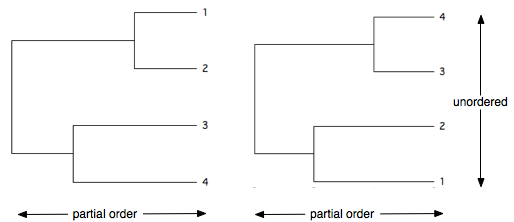
Even if we accept that trees are useful visualisations, they have problems. Given the tree ((1,2),(3,4)); we have a lot of (perhaps too much) freedom in how we can depict that tree. For example, both diagrams below depict this tree. In the x-axis there is a partial order of internal nodes (the ancestor of {1,2} must be to the right of the ancestor {1,2,3,4}), but the tree ((1,2),(3,4)); says nothing about the relative ordering of {1,2} versus {3,4}. We are free to choose. A natural linear ordering would be divergence time, but estimates of those times can be contested, or unavailable.

order.png


Phylogenies are unordered trees in the sense that I can rotate any node about it's ancestor and still have the same tree (compare the two trees above). Phylogenies are like mobiles:


The practical consequence of this is that different tree viewers can render the same tree in very different ways, making navigation across viewers unpredictable. Compare this to maps. Even if I use different projections, the maps remain recognisably similar, and most maps retain similar relationships between areas. If I look at a map of Glasgow and move left I will end up in the Atlantic Ocean, no matter if I use Google Maps or Microsoft Maps. Furthermore, trees grow in a way that maps don't (at least, not much). If I add nodes to a tree it may radically change shape, destroying navigation cues that I may have relied on before. Typically maps change by the addition of layers, not by moving bits around (paleogeographic maps excepted).

Trees aren't 3D
There's nothing intrinsically 3D about trees, which means any mapping to 3D space is going to be arbitrary. Indeed, most 3D viewers simply avoid any mapping and show a 2D tree in 3D space, which seems rather pointless.

Perhaps it's because I don't play computer games much (went through an Angry Birds phase, and occasionally pick up an X-Box controller, only to be mercilessly slaughtered by my son), but I'm not inspired by the analogy with computer games. I'm not denying that there are useful things to learn from games (I'm sure the controls in Google Earth owe something to games). But games also rely on a visceral connection with the play, and an understanding of the visual vocabulary (how to unlock treasure, etc.). Matt's 3D model requires users to learn a whole visual vocabulary, much of which (e.g., "Fruit on your tree? Someone has left comment(s) or feedback. ") seems forced.

My sense is that the most successful interfaces make the minimal demands on users, don't fight their intuition, and don't force them to accept a particular visualisation of their own cognitive space.

I'll write more about this once I get my 2D tree viewer into shape where it can be shown. It will be a lot less imaginative than Matt's vision, all I'm shooting for is that it is usable.


TreeBASE, again

My views on TreeBASE are pretty well known. Lately I've been thinking a lot about how to "fix" TreeBASE, or indeed, move beyond it. I've made a couple of baby steps in this direction.

The first step is that I've created a group for TreeBASE papers on Mendeley. I've uploaded all the studies in TreeBASE as of December 13 (2010). Having these in Mendeley makes it easier to tidy up the bibliographic metadata, add missing identifiers (such as DOIs and PubMed ids), and correct citations to non-existent papers (which can occur if at the time the authors uploaded their data the planned to submit their paper to one journal, but it ending up being accepted in another). If you've a Mendeley account, feel free to join the group. If you've contributed to TreeBASE, you should find your papers already there.

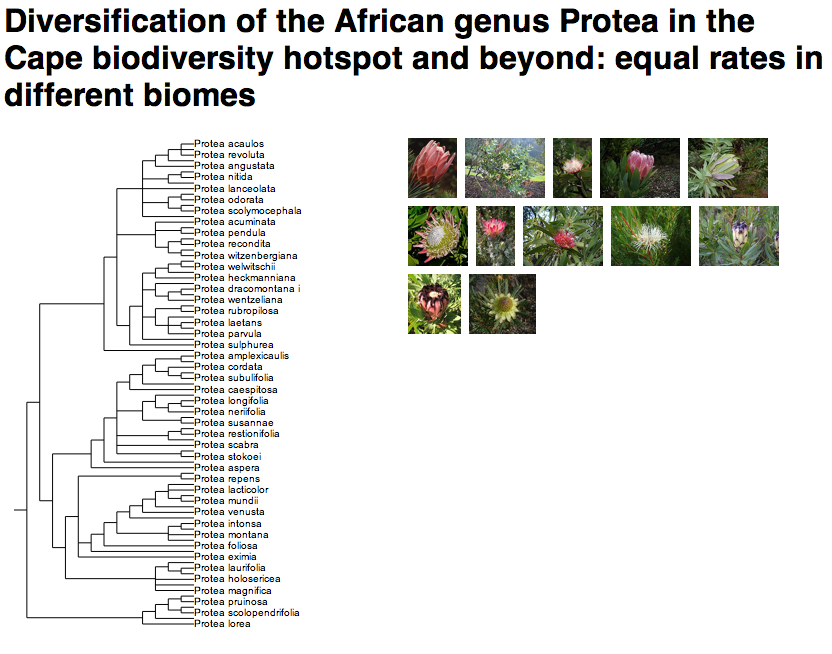
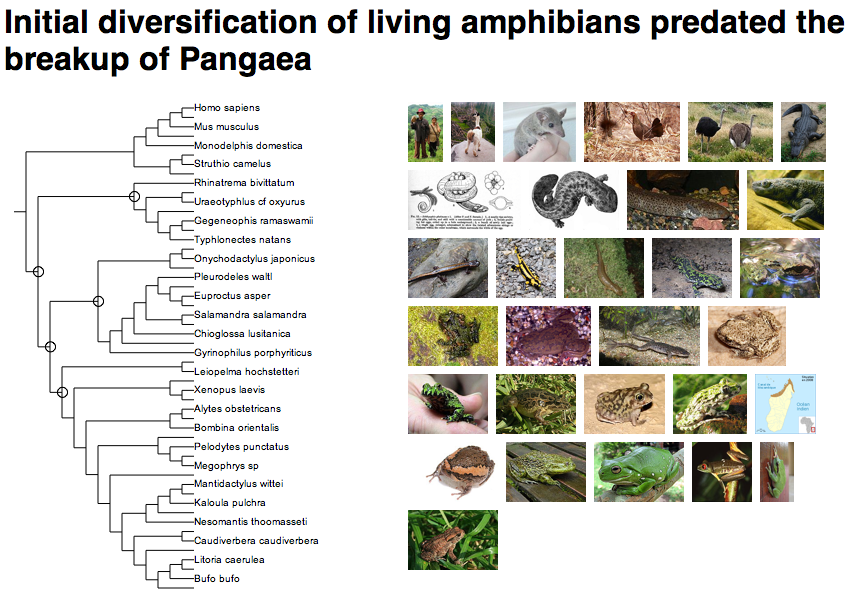
The second step is playing with CouchDB (this years new hotness), exploring ways to build a database of phylogenies that has nothing much to do with either a relational database or a triple store. CouchDB is a document store, and I'm playing with taking NeXML files from TreeBASE, converting them to something vaguely usable (i.e., JSON), and adding them to CouchDB. For fun, I'm using my NCBI to Wikipedia mapping to get images for taxa, so if TreeBASE has mapped a taxon to the NCBI taxonomy, and that taxon has a page in Wikipedia with an image, we get an image for that taxon. The reason for this is I'd really like a phylogeny database that was visually interesting. To give you some examples, here are trees from TreeBASE (displayed using SVG), together with thumbnails of images from Wikipedia:

myzo.png


troidini.png


protea.png


Snapshot 2010-12-15 10-38-02.png


Everything (tree and images) is stored within a single document in CouchDB, making the display pretty trivial to construct. Obviously this isn't a proper interface, and there's things I'd need to do, such as order the images in such a way that they matched the placement of the taxa on the tree, but at a glance you can see what the tree is about. We could then envisage making the images clickable so you could find out more about that taxon (e.g., text from Wikipedia, lists of other trees in the database, etc.).

We could expand this further by extracting geographical information (say, from the sequences included in the study) and make a map, or eventually a phylogeny on Google Earth) (see David Kidd's recent "Geophylogenies and the Map of Life" for a manifesto doi:10.1093/sysbio/syq043).

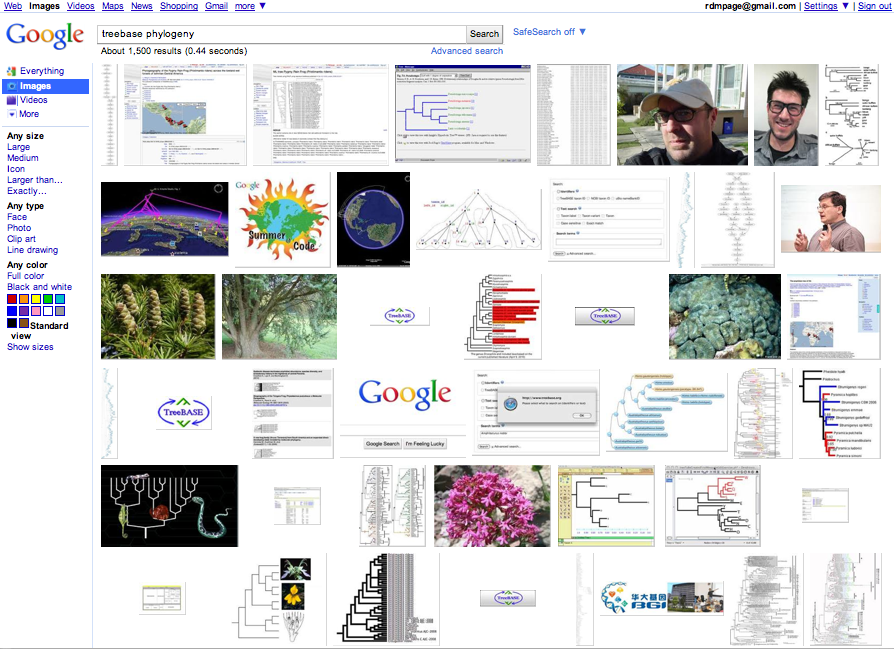
One of the big things missing from databases like TreeBASE is a sense of "fun", or serendipity. It's hard to find stuff, hard to discover new things, make new connections, or put things in context. And that's tragic. Try a Google image search for treebase+phylogeny:

treebasephylogeny.png

Call me crazy, but I looked at that and thought "Wow! This phylogeny stuff is cool!" Wouldn't it be great if that's the reaction people had when they looked at a database of evolutionary trees?

Drawing a phylogeny in a web browser using the canvas element

Some serious displacement activity. I'm toying with adding phylogenies to iSpecies, probably sourced from the PhyLoTA browser. This raises the issue of how to display trees on a web page. PhyLoTA itself uses bitmap images, such as this one:
ti26779_cl0-201004120822386532.png
but I'd like to avoid bitmaps. I toyed with using SVG, but that has it's own series of issues (it basically has to be served as a separate file). So, I've spent a couple of hours playing with the <canvas> element. This enables some quite nice drawing to be down in a browser window, without plugins, SVG, or Flash. I wrote a quick PHP script to parse a Newick tree and draw it using <canvas>. It's really pretty simple, and the results are quite nice:
canvas.png
One minor gotcha is interacting with the diagram (this is one advantage of SVG). Turns out we need a hack, so I've used the trick of a blank, transparent GIF and a usemap (see Greg Houston's Canvas Pie Chart with Tooltips). The picture above is a screen shot, you can see a live example here.

What I want from a web phylogeny viewer - XML, SVG and Newick round tripping

Random half-formed idea time. Thinking about marking up an article (e.g., from PLoS) with a phylogeny (such as the image below, see doi:10.1371/journal.pone.0001109.g001), I keep hitting the fact that existing web-based tree viewers are, in general, crap.
53BC7C85-7D00-475D-AE8A-7D91FBE75068.jpg

Given that a PLoS article is an XML document, it would be great if the tree diagram was itself XML, in particular SVG. But, in one sense, we don't want just a diagram, we want access to the underlying tree (for example, so we can play with it in other software). The tree may or may not be available in TreeBASE, but what if the diagram itself was the tree? In other words, imagine a tree viewing program could output SVG, structured in such a way that with a XSLT stylesheet the underlying tree could be extracted (say in Newick or, gack, NexXML) from the SVG, but users could take the SVG and embellish it (in Adobe Illustrator or Inkscape). The nice illustration and the tree data structure would be one and the same thing! No getting tree and illustration out of sync, and no hoping authors have put tree in a database somewhere -- the article contains the tree.

In order for this to happen, we need a tree viewer that exports SVG, and ideally would allow annotation so that the author could do most of the work within that program (ensuring that the underlying tree object isn't broken by graphic editing). Then export the SVG, add extract bits in Illustrator/Inkscape if needed, and have it incorporated into the article XML (which is what the publisher uses to render the article on the web). Simples.

Co-located Collaborative Tree Comparison

Stumbled across this cool visualisation project by Petra Isenberg at Calgary University. Collaborative tree comparison uses a tabletop system to enable two (or more) people to interact when comparing (in this case) phylogenies. I want one!

The system is described in "Interactive Tree Comparison for Co-located Collaborative Information Visualization" (doi:10.1109/TVCG.2007.70568), a PDF of which is available from her web site (which also has a great video entitled "how co-located collaborative data analysis should not take place").


Visualizing the Evolutionary Tree of Life

Over on the EOL blog is a summary of a meeting Visualizing the Evolutionary Tree of Life. This sounds like it was a fun meeting, but part of me is suffering from déjà vu. Our community has tossed this subject around for a while now. I recall Tamara Munzner wowing us with the H3 hyperbolic browser at a meeting at UC Davis in 2000 (part of the original NSF TOL workshops, archived herel) -- the image of Joel Cracraft excitedly running up to the display screen to find various birds is forever etched into my brain. TreeJuxtaposer has been around for a while, to not much effect.

We seem to continue to fail to make much progress on this topic, despite meetings such as the EOL one, great reviews of the topic, fancy 3D visualisation, and Mike Sanderson's way kewl wall of monitors.

Maybe progress was made at the EOL meeting, but I don't get the sense that we're any further forward. It would be interesting to work out why we've struggled to satisfactorily solve this problem.