More zoom viewer experiments (see previous post), this time with a linked map that updates as you browse the tree (SVG-capable browser required). As you browse the frog classification the map updates to show the location of georeferenced sequences in GenBank from the taxa in the part of the tree you are looking at. The map is limited to not more than 200 localities, and many frog sequences aren't georeferenced, but it's a fun way to combine classification and geography. You can try it at:
http://iphylo.org/~rpage/deeptree/7.html
or watch the video:
The Mendeley API Binary Battle - win $US 10,001
Now we'll bring the awesome. Mendeley have announced The Mendeley API Binary Battle, with a first prize of $US 10,0001, and some very high-profile judges (Juan Enriquez, Tim O'Reilly, James Powell, Werner Vogels, and John Wilbanks). Deadline for submission is August 31st 2011, with the results announced in October.
The criterion for judging are:
Start your engines...
The criterion for judging are:
- How active is your application? We’ll look at your API key usage.
- How viral is the app? We’ll look at the number of sign ups on Mendeley and/or your application, and we’ll also have an eye on Twitter.
- Does the application increase collaboration and/or transparency? We’ll look at how much your application contributes to making science more open.
- How cool is your app? Does it make our jaws drop? Is it the most fun that you can have with your pants on? Is it making use of Facebook, Twitter, etc.?
- The Binary Battle is open to apps built previous to this announcement.
Start your engines...
Nomenclator Zoologicus meets Biodiversity Heritage Library: linking names directly to literature
Following on from my previous post on microcitations I've blasted all the citations in Nomenclator Zoologicus through my microcitation service and created a simple web site where these results can be browsed.
The web site is here: http://iphylo.org/~rpage/nz/.
To create it I've taken a file dump of Nomenclator Zoologicus provided by Dave Remsen and run all the citations through the microcitation service, storing the results in a simple database. You can search by genus name, author and year, or publication. The search is pretty crude, and in the case of publications can be a bit hit and miss. Citations in Nomenclator Zoologicus are stored as strings, so I've used some crude rules to try and extract the publication name from the rest of the details (such as page numbering).
To get started, you can look at names published by published by Distant in 1910, which you can see below:
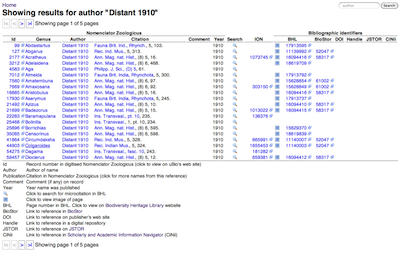
If the citation has been found you can click on the icon to view the page in a popup, like this:

You can also click on the page number to be taken to that page in BHL.
I've also added some other links, such as to the name in the Index to Organism Names, as well as bibliographic identifiers such as DOIs, Handles, and links to JSTOR and CiNii.
So far only 10% of Nomenclator Zoologicus records have a match in BHL, which is slightly depressing. Browsing through there are some obvious gaps where my parser clearly failed, typically where multiple pages are included in the citation, or the citation has some additional comments. These could be fixed. There are also cases where the OCR text is so mangled that a match has been rejected because the genus name and text were too different.
This has been hastily assembled, but it's one vision of a simple service where we can go from genus name to being able to see the original publication of that name. There are other things we could do with this mapping, such as enabling BHL to tell users that the reference they are looking at is the original source of a particular name, and enabling services that use BHL content (such as EOL and Atlas of Living Australia to flag which reference in BHL is the one that matters in terms of nomenclature.
The web site is here: http://iphylo.org/~rpage/nz/.
To create it I've taken a file dump of Nomenclator Zoologicus provided by Dave Remsen and run all the citations through the microcitation service, storing the results in a simple database. You can search by genus name, author and year, or publication. The search is pretty crude, and in the case of publications can be a bit hit and miss. Citations in Nomenclator Zoologicus are stored as strings, so I've used some crude rules to try and extract the publication name from the rest of the details (such as page numbering).
To get started, you can look at names published by published by Distant in 1910, which you can see below:
If the citation has been found you can click on the
icon to view the page in a popup, like this:You can also click on the page number to be taken to that page in BHL.
I've also added some other links, such as to the name in the Index to Organism Names, as well as bibliographic identifiers such as DOIs, Handles, and links to JSTOR and CiNii.
So far only 10% of Nomenclator Zoologicus records have a match in BHL, which is slightly depressing. Browsing through there are some obvious gaps where my parser clearly failed, typically where multiple pages are included in the citation, or the citation has some additional comments. These could be fixed. There are also cases where the OCR text is so mangled that a match has been rejected because the genus name and text were too different.
This has been hastily assembled, but it's one vision of a simple service where we can go from genus name to being able to see the original publication of that name. There are other things we could do with this mapping, such as enabling BHL to tell users that the reference they are looking at is the original source of a particular name, and enabling services that use BHL content (such as EOL and Atlas of Living Australia to flag which reference in BHL is the one that matters in terms of nomenclature.
Subscribe to:
Comments
(
Atom
)