Deep tree zooming from Roderic Page on Vimeo.
Deep zooming a large 2D tree
Here's a quick demo of a 2D large tree viewer that I'm working on. The aim is to provide a simple way to view and navigate very large trees (such as the NCBI classification) in a web browser using just HTML and Javascript. At the moment this is simply a viewer, but the goal is to add the ability to show "tracks" like a genome browser. For example, you could imagine columns appearing to the right of the tree showing you whether there are phylogenies available for these taxa in TreeBASE, images from Wikipedia, sparklines for sequencing activity over time, etc. I'll blog some more on the implementation details when I get the chance, but it's pretty straightforward. Image tiles are generated from SVG images of tree using ImageMagick, labelling is applied on the fly using GIS-style queries to a MySQL database that holds the "world coordinates" of the nodes in the tree (see discussion of world coordinates on Google's Map API pages), and the zooming and tile fetching is based on Michal Migurski's Giant-Ass Image Viewer. Once I've tidied up a few things I'll put up a live demo so people can play with it.
Why 3D phylogeny viewers don't work
Matt Yoder (@mjyoder had a Twitter conversation yesterday about phylogeny viewers, prompted by my tweeting about my latest displacement activity, a 2D tree browser using the tiling approach made popular by Google Maps.
As part of that conversation, Matt tweeted:
Well, Matt's imagination has gone into overdrive, and he's blogged about his ideas.

This issue deserves more exploration, but here are some quick thoughts. 3D has been used in a number of phylogeny browsers, such as Mike Sanderson's Paloverde, Walrus, and the Wellcome Trust's Tree of Life. I don't find any terribly successful, pretty as they may be. I think there are several problems with trees in general, and 3D versions in particular.
Trees aren't real
Trees aren't real in the same way that the physical world is (or even imagined physical worlds). Trees are conceptual structures. The history of web interfaces is littered with attempts to visualise conceptual space, for example to summarise search results. These have been failures, a simple top ten list as used by Google wins. I don't think this is because Google's designers lack imagination, it's because it works. Furthermore, this is actually a very successful visualisation:
I think elaborate attempts to depict conceptual spaces on screens are mostly going to fail.
Trees are empty
Compared to, say, a geographic map, trees are largely empty space. In a map every pixel counts, in that it potentially represents something. Think of the satellite view in Google Maps. Each pixel on the screen has information. Trees are largely empty, hence much of the display space is wasted. Moving trees to 3D just gives us more space to waste.
Trees don't have a natural ordering
Even if we accept that trees are useful visualisations, they have problems. Given the tree
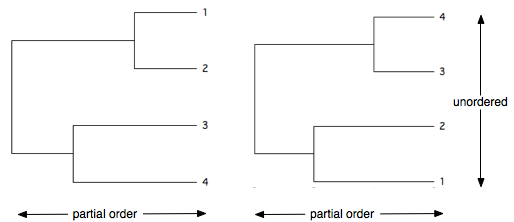
Phylogenies are unordered trees in the sense that I can rotate any node about it's ancestor and still have the same tree (compare the two trees above). Phylogenies are like mobiles:
The practical consequence of this is that different tree viewers can render the same tree in very different ways, making navigation across viewers unpredictable. Compare this to maps. Even if I use different projections, the maps remain recognisably similar, and most maps retain similar relationships between areas. If I look at a map of Glasgow and move left I will end up in the Atlantic Ocean, no matter if I use Google Maps or Microsoft Maps. Furthermore, trees grow in a way that maps don't (at least, not much). If I add nodes to a tree it may radically change shape, destroying navigation cues that I may have relied on before. Typically maps change by the addition of layers, not by moving bits around (paleogeographic maps excepted).
Trees aren't 3D
There's nothing intrinsically 3D about trees, which means any mapping to 3D space is going to be arbitrary. Indeed, most 3D viewers simply avoid any mapping and show a 2D tree in 3D space, which seems rather pointless.
Perhaps it's because I don't play computer games much (went through an Angry Birds phase, and occasionally pick up an X-Box controller, only to be mercilessly slaughtered by my son), but I'm not inspired by the analogy with computer games. I'm not denying that there are useful things to learn from games (I'm sure the controls in Google Earth owe something to games). But games also rely on a visceral connection with the play, and an understanding of the visual vocabulary (how to unlock treasure, etc.). Matt's 3D model requires users to learn a whole visual vocabulary, much of which (e.g., "Fruit on your tree? Someone has left comment(s) or feedback. ") seems forced.
My sense is that the most successful interfaces make the minimal demands on users, don't fight their intuition, and don't force them to accept a particular visualisation of their own cognitive space.
I'll write more about this once I get my 2D tree viewer into shape where it can be shown. It will be a lot less imaginative than Matt's vision, all I'm shooting for is that it is usable.
As part of that conversation, Matt tweeted:
RT @rdmpage: @mjyoder - I think 3D is the worse thing we could do, there's no natural mapping to 3D. <- meh, where's the imagination?
Well, Matt's imagination has gone into overdrive, and he's blogged about his ideas.
This issue deserves more exploration, but here are some quick thoughts. 3D has been used in a number of phylogeny browsers, such as Mike Sanderson's Paloverde, Walrus, and the Wellcome Trust's Tree of Life. I don't find any terribly successful, pretty as they may be. I think there are several problems with trees in general, and 3D versions in particular.
Trees aren't real
Trees aren't real in the same way that the physical world is (or even imagined physical worlds). Trees are conceptual structures. The history of web interfaces is littered with attempts to visualise conceptual space, for example to summarise search results. These have been failures, a simple top ten list as used by Google wins. I don't think this is because Google's designers lack imagination, it's because it works. Furthermore, this is actually a very successful visualisation:
I think elaborate attempts to depict conceptual spaces on screens are mostly going to fail.
Trees are empty
Compared to, say, a geographic map, trees are largely empty space. In a map every pixel counts, in that it potentially represents something. Think of the satellite view in Google Maps. Each pixel on the screen has information. Trees are largely empty, hence much of the display space is wasted. Moving trees to 3D just gives us more space to waste.
Trees don't have a natural ordering
Even if we accept that trees are useful visualisations, they have problems. Given the tree
((1,2),(3,4)); we have a lot of (perhaps too much) freedom in how we can depict that tree. For example, both diagrams below depict this tree. In the x-axis there is a partial order of internal nodes (the ancestor of {1,2} must be to the right of the ancestor {1,2,3,4}), but the tree ((1,2),(3,4)); says nothing about the relative ordering of {1,2} versus {3,4}. We are free to choose. A natural linear ordering would be divergence time, but estimates of those times can be contested, or unavailable.Phylogenies are unordered trees in the sense that I can rotate any node about it's ancestor and still have the same tree (compare the two trees above). Phylogenies are like mobiles:
The practical consequence of this is that different tree viewers can render the same tree in very different ways, making navigation across viewers unpredictable. Compare this to maps. Even if I use different projections, the maps remain recognisably similar, and most maps retain similar relationships between areas. If I look at a map of Glasgow and move left I will end up in the Atlantic Ocean, no matter if I use Google Maps or Microsoft Maps. Furthermore, trees grow in a way that maps don't (at least, not much). If I add nodes to a tree it may radically change shape, destroying navigation cues that I may have relied on before. Typically maps change by the addition of layers, not by moving bits around (paleogeographic maps excepted).
Trees aren't 3D
There's nothing intrinsically 3D about trees, which means any mapping to 3D space is going to be arbitrary. Indeed, most 3D viewers simply avoid any mapping and show a 2D tree in 3D space, which seems rather pointless.
Perhaps it's because I don't play computer games much (went through an Angry Birds phase, and occasionally pick up an X-Box controller, only to be mercilessly slaughtered by my son), but I'm not inspired by the analogy with computer games. I'm not denying that there are useful things to learn from games (I'm sure the controls in Google Earth owe something to games). But games also rely on a visceral connection with the play, and an understanding of the visual vocabulary (how to unlock treasure, etc.). Matt's 3D model requires users to learn a whole visual vocabulary, much of which (e.g., "Fruit on your tree? Someone has left comment(s) or feedback. ") seems forced.
My sense is that the most successful interfaces make the minimal demands on users, don't fight their intuition, and don't force them to accept a particular visualisation of their own cognitive space.
I'll write more about this once I get my 2D tree viewer into shape where it can be shown. It will be a lot less imaginative than Matt's vision, all I'm shooting for is that it is usable.
Subscribe to:
Comments
(
Atom
)